






About
Begusarai sits within Bihar, a region in eastern India where fields meet factories. Alongside rich farmland, industrial activity shapes daily life across the area. Close to the Ganges, its soil benefits from river-fed fertility. Because of this, growing food remains central to survival for many residents. Rice, along with wheat, spreads across fields during planting seasons. Farming supports households, linking tradition to modern needs.
It stands as the central urban hub of the region, functioning primarily in governance and commerce. Connected efficiently to adjacent metropolitan zones such as Patna, movement of goods and people flows without delay. Industrial growth here evolved gradually, gaining strength through locations including Barauni - home to large-scale production units and processing plants.
Among its fields and quiet lanes, Begusarai holds a steady rhythm between old rhythms and new structures. Where farming communities continue age-old practices, factories and roads also take shape slowly. Not every corner looks the same - some reflect calm countryside patterns, others show signs of gradual change. Its character forms not through contrast alone but how daily life adapts without losing footing. Growth appears without rushing; tradition remains without resisting. In Bihar’s wider story, this place adds depth simply by being what it is.
History and Culture
Begun long before modern borders, Begusarai traces roots into eras of early Indian civilization. Once seated within Anga, its terrain shifted hands as dynasties rose - Mauryan authority followed by Gupta reach shaping its path. Positioned near the Ganges, movement of goods and people found steady rhythm here. Rule changed often through medieval years, local thrones giving way to broader control when Mughal administration took hold.
Begusarai took shape under British colonial oversight, functioning mainly in governance and farming. With rail lines arriving in the 1800s, links to distant regions grew stronger. Political energy rose here following national freedom, driven by community-level activism and clashing viewpoints. Left-leaning currents ran deep, leading some to call it Bihar's "Leningrad." .
The district carries forward Bihar's wider heritage, yet holds distinct customs of its own. During festival seasons, energy fills the air - Chhath Puja stands central here. Along rivers and water bodies, worshippers assemble at dawn, facing the rising sun in quiet devotion. Though rooted in tradition, shared celebrations mark the rhythm of life. Diwali arrives with lamps aglow; Holi unfolds in bursts of color. Eid brings gatherings under open skies. Durga Puja echoes through neighborhoods with measured chants. Each observance adds texture to a landscape shaped by coexistence.
A quiet thread within Begusarai's way of living shows how custom meets new ways without force. From village homes, song rises at dawn - devotion shaping starts. As daylight fades, groups form naturally under open skies, talk flowing without agenda. Markets held on certain days do more than sell goods - they hold space for meeting, laughter, sometimes music. Garments such as sarees, dhotis, or simple kurtas appear regularly, particularly when families gather for celebration, holding meaning across years.
Oral tales and handmade crafts carry weight here. Though time passes, stories travel forward, while melodies rise at weddings and when crops come in, stitching past to present. When people marry, events unfold slowly, layered with song, gesture, laughter - spanning more than one day. What is eaten speaks clearly: meals built from nearby soil show how land shapes living. Even as cities press near, something steady remains in Begusarai - a way of treating older kin, staying tied within family, gathering often - not loud, but constant.
Economy
Begusarai's economic structure combines farming, manufacturing, and service sectors. Its regional importance within Bihar stems from this diversity. A balance between these areas supports steady activity across the district. Not every region in the state shares such varied foundations. Employment and infrastructure grow through activity within the public sector. Offices, educational institutions, health centers - each supports livelihoods while strengthening local governance.
Programs focused on farming, village progress, job creation see consistent rollout across the area. Among industrial towns, Begusarai stands out due to its concentration of public enterprises. Located within it, the Barauni Refinery holds particular importance. While operating at scale, this facility fuels regional economic activity. Instead of merely processing crude, it generates jobs and stimulates ancillary sectors.
Besides manufacturing, a key facility stands in Barauni - its fertilizer production site serving farming across Bihar along with nearby regions. Owing to such operations, Begusarai has gradually evolved industrially, setting it apart within the state's broader landscape. Steady growth marks the services sector across the district. Expansion unfolds in banking, alongside education, healthcare, yet retail sees momentum mainly within urban hubs such as Begusarai town and Barauni. Schools appear, followed by colleges, even coaching centers - each shaping education into an economic pillar locally. Growth here ties closely to institutional presence rather than population alone.
Farming continues to shape economic life across the region. Main harvests include rice, followed by wheat, alongside maize and pulses. Thanks to rich earth and steady access to river sources - especially the Ganges and related streams - yields stay strong. Alongside crop fields, raising animals and producing milk play roles in village livelihoods.
Tourism
Begusarai does not hold the fame of more prominent travel spots; still, quiet charm lives within its landscapes and traditions. Though overlooked by many, layers of history shape the rhythm of daily life here. Nature appears in subtle forms - fields stretching beyond sight, rivers moving without hurry. Culture reveals itself through small gestures, old routines kept alive across generations. Recognition may elude this place, yet presence remains strong where stone meets soil and memory lingers in alleys.
Among key highlights stands the Kanwar Lake Bird Sanctuary, locally named Kabartal Wetland. Spanning vast stretches, this freshwater oxbow lake ranks among Asia’s biggest. Bird enthusiasts find rich rewards here due to seasonal arrivals from distant regions. Its global significance emerges through diverse species that arrive each year. Ecological value grows stronger as these visitors settle into wetland habitats. A quiet stretch emerges at Simaria Ghat, set beside the flowing waters of the Ganges. Along its shoreline, people arrive in numbers when festival time comes, drawn by age-old observances like Chhath Puja. Stillness lingers here, woven into moments of prayer and reflection. Visitors often find themselves returning, pulled back not by words but by presence.
Among its functions, the Barauni industrial area serves a role beyond commerce - drawing those curious about how industry has evolved in Bihar. Progress appears through structures like the refinery and the systems built alongside it. Though rooted in production, this place reflects
shifts in regional ambition over time. A few steps beyond the main roads, small shrines appear quietly among homes and fields. Devotion lives here, shaped by years of quiet practice rather than loud proclamations. Each stone pathway leads toward something held close through generations. Belief moves slowly, carried in routine gestures more than words spoken aloud.
Demographics
Begusarai district hosts a mix of communities, lively in character. With figures recently recorded, its residents surpass 2.9 million. High concentration of people marks the area, common among regions nestled in Bihar's productive lowlands. Among recent developments, the literacy level in the district shows gradual progress, now estimated between 63% and 65%. While urban zones see moderate gains, rural regions benefit noticeably due to initiatives launched by both state bodies and independent organizations.
Of Hindi, the district's official tongue, Maithili stands alongside as a common voice. Regional speech flows through Angika just as deeply rooted. Where culture shapes expression, distinct sounds emerge naturally across communities. Linguistic variety grows quietly within daily life here. Besides farmland homes, some people live in towns, most remain in small settlements. Still, city-style growth creeps forward, especially near Begusarai and Barauni. While open spaces dominate now, built-up zones spread slowly over time.
Administration
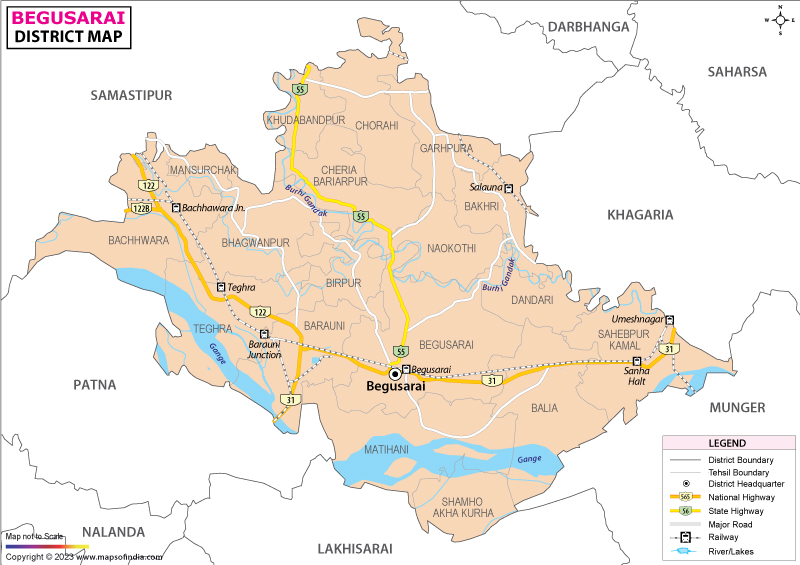
Begusarai district organizes its administration through multiple tehsils and blocks, aiding smoother oversight. Among these divisions are Begusarai, Teghra, and Balia, each functioning as a core segment. Governance at lower levels unfolds via blocks paired with panchayats, handling community-level tasks. Where one tier ends, another begins - local needs guiding the structure.
Among the many villages lies a network of gram panchayats, each overseeing its own area. From these local bodies come decisions shaping daily life. Though distant from city centers, governance still takes root through structured delegation. Progress moves forward not in sweeping waves but through steady, localized effort.
Maintaining law and order falls under the responsibility of local police units, whereas separate government divisions manage areas including education, health care, farming, and road networks. Oversight at the district level comes mainly through figures like the District Magistrate along with the head of regional policing, both involved deeply in daily administrative functions and community well-being. Progress in governance often follows consistent review processes, feedback channels open to residents, and shared efforts across agencies. Digital platforms receive ongoing updates, aiming to make public services simpler to reach, reducing delays for users needing support.
Public safety within the region falls under municipal law enforcement, whereas different administrative bodies manage areas such as schooling, medical services, farming practices, and public works. Though oversight is divided, each unit operates within its designated scope. Where one agency focuses on classroom standards, another tracks crop yields or road conditions. Meanwhile, coordination happens through established interdepartmental channels. Despite separate functions, alignment occurs via routine reporting mechanisms.
| Facts of Begusarai District | |
|---|---|
| Official Name | Begusarai |
| Location | North Bihar |
| Area (km2) | 1918 |
| Population | 2970541 |
| Language | Hindi, Urdu, Maithili |
FAQs
Q1: How many villages are there in the district?
Begusarai district holds close to three hundred to three fifty rural settlements. These are grouped into different panchayat units for governance tasks.
Q2: What is the population of the district?
The district holds a count beyond 2.9 million souls, standing among Bihar's most tightly settled regions. Density here shapes its character quite distinctly.
Q3: What is this district famous for?
Begusarai hosts the Barauri Refinery, known for heavy industry. Fertile soil supports extensive farming here. Migratory birds arrive each season due to habitat offered by Kanwar Lake Bird Sanctuary. This wetland draws species from distant regions every year.
Last Updated on : June 24, 2026
