|
||||||||||
| ||||||||||
|





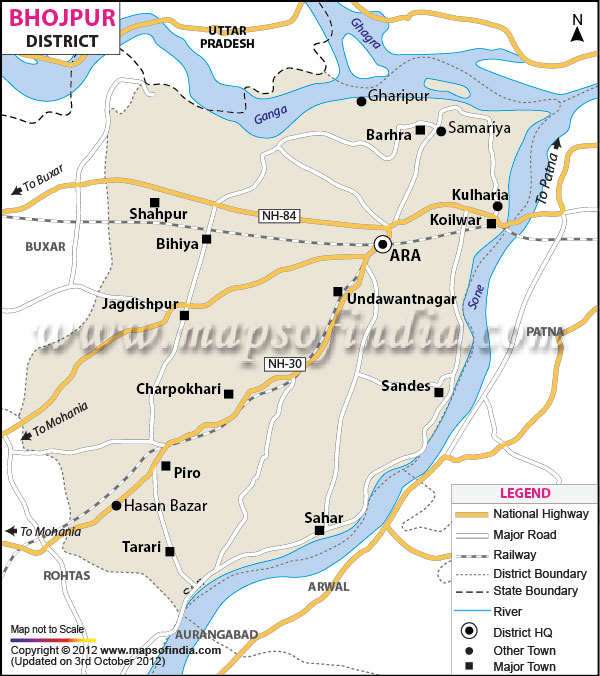
| *Bhojpur District Map highlights the National Highways, Major Roads, District Headquarter, etc. |
About
Bhojpur district is one of the historically important and culturally rich districts in locality of the western region of the Indian state of Bihar. The district is named after the old region of Bhojpur that is suspected to have belonged to the mythical King Bhoj reputed to have patronized art, culture and education. A large administrative centre of the district is Ara (also spelt Arrah), the seat of government, trade and learning in the district.
Bhojpur district is located geographically to the west of river Ganga, which is a major factor in forming its fertile land and agricultural success. River systems have contributed to the agro-richness and high population of the district due to availability of the alluvial soils characterizing the area. The map of the bhojpur district also indicates that it was strategically located in the state of Bihar, which had led to trading and transportation routes.
Ara is located in one of the largest intersections within the district, as it nearly has a rail and road network. The Bhojpur district map too is a reflection of its administrative subdivisions and rural settlements and bears witness to its agrarian primacy. As a region with an extensive history, a rich sense of culture and politics, Bhojpur has nevertheless continued to play an important role in the socio-economic life of Bihar.
The Bhojpur District map also indicates topography of rivers and transportation pattern and settlements which provides a clear understanding of the topography of the Bhojpur District.
History and Culture
The Bhojpur district has a historic ground that could be dated back to the ancient and medieval periods. It used to be a part of Magadha Empire which was one of the most powerful kingdoms of ancient India. It found its way to other ruling dynasties over the centuries with a transference to Mauryas, Guptas and later the Mughals. It was related to the Bhojpur rulers during the medieval period when it became eminent.
One major event in the history of the district was the Revolt of 1857 where a local zamindar and freedom fighter (Veer Kunwar Singh) planned a massive rebellion against the British rule. His leadership and boldness made Bhojpur to become a centre of resistance during 1st war of independence in India. The center of the district, Ara, was the place of tough combats and the monuments and local myths bear the evidence of this period of history. These historic sites are also common on the Bhojpur district map that can then be used to ascertain their position.
The folk music tradition, dance tradition and oral storytelling coupled with the fact that culturally Bhojpur falls within the Bhojpuri speaking belt give the impression that Bhojpur district is endowed with a rich folk music tradition. The most popular and significant in cultural expression is Bhojpuri language. The folk songs also feature the origin of folk songs such as Kajri, Chaita and Birha and they are interlaced with the life of people and sung at festivals and social get together.
Bhojpur is a great festival state. Hinduism in particular places a special significance on major Hindu festivals such as Diwali, Holi, Durga Puja and Chhath Puja. The river and pond shores especially are observed during Chhath Puja which are observed with glorious rituals respecting the Sun God. These are common water bodies commonly observed on the Bhojpur district map, and are the focus of such celebrations.
Such aspects of culture as clothes, food and traditions also define cultural specificity. Litti-chokha, sattu, as well as traditional sweets are also consumed. The social life comprises community involvement, religion and farming cycles. As it can be seen in the map of the bhojpur district, there is a high degree of connectedness between villages and settlements and the agricultural lands, which influences the culture and day-to-day life.
The district is also endowed with the history of literary and intellectual works and various scholars and writers have contributed toward the Bhojpuri and Hindu literature. Traditions, the development of which occurs furthermore due to gradual modernisation, make Bhojpur a unique cultural character.
Economy
Bhojpur district has a largely agricultural economy with agriculture as the main source of livelihood of most people in the district. The plains are fertile due to river and canal based irrigation and crops like rice, wheat, maize, pulses, and sugarcane can be grown. The Bhojpur district map indicates clearly the distribution of crop land and irrigation networks, which are crucial to the privileging of the rural economy.
The Government Sector boasts of an organized administrative unit, which aids governance, law enforcement, education, healthcare services in Bhojpur district. The presence of government offices in Ara and other subdivisions employs a good number of individuals. The role of these schemes like the public welfare schemes, rural development programmes and infrastructure projects contributes significantly to the local economy. Administrative boundaries are frequently provided on the Bhojpur district map, which is useful in implementing and monitoring this type of programme.
Public Sector comprises the schools, colleges, hospitals, and cooperative societies of government. Such establishments do not only offer the mandatory services, but they also create jobs. Credit, seeds and equipment Agricultural cooperatives and rural banks can help the farmers with credit, seeds as well as equipment to improve productivity. It is possible to find these institutions on the map of the bhojpur district and realize how they can be accessible in the whole district.
Bhojpur service sector has been growing gradually especially in the urban problems in Ara. This sector is comprised of education, healthcare, retail, transport and small-scale trade. Small businesses are involved in coaching centres, clinics and in private schools which add to the diversification of the economy. The map of the bhojpur district indicates urban clusters that comprise concentration of such services.
The small-scale industries and cottage industries contribute to the economy of the district too. These are agro based industries, handicraft and food processing units. Although industrialisation is not widespread on a large scale, it can be expanded, as there is enhanced connectivity and governmental programs. The Bhojpur district map assists in locating any areas where industries can be developed and infrastructure needs to be expanded.
Tourism
The Bhojpur district is blessed with a number of tourist sites that are able to embrace historical, cultural and religious values. The Jagdishpur fort is among the most appealing places of sightseeing and attributed to Veer Kunwar Singh. It is a historical fort and a reminder of the Revolt of 1857, visitors come to learn more about the struggle that Indians had gone through to gain their independence. This type of heritage sites can be easily traced down with the help of the Bhojpur district map that is given to the visitors.
Another significant tourist site is the Aranya Devi Temple in Ara because of its sanctity as a worshiping place of the Goddess Durga. People visit the temple throughout the year especially in the period of Navratri. The temple is not merely appreciated in terms of its religious importance and the temple has a cultural value in the district.
The district also has other temples, ponds and ghats, which are also the activity centres during festivals. Chhath Puja rituals are particularly interesting and held both in the river banks and attended by both locals and tourists. The Bhojpur district map identifies these water bodies and therefore tourists can easy plan their visits.
Local fairs and cultural events also attract visitors to the district by offering them a access to a rich heritage in the district. Handicraft and folk performances and traditional foods also go hand in hand with these meetings.
Tourism in Bhojpur as a whole heavily centers on the historic background, pilgrimages and culture of the region. In the future, the district can acquire even greater number of visitors with improved infrastructure and advertising.
Demographics
The Bhojpur district has a large population which bears settlement density and its agricultural reliance. The population of the district as per the recently available census data is around 2.7 million. Distribution of the population is in both rural and urban areas, where majority live in the villages. This distribution can be seen in the Bhojpur district map, where there are concentrations of settlements around the district.
Literacy rate in Bhojpur district is approximately at 70 percent demonstrating a stable growth in education over the years. Both government and privately run educational institutions have helped in enhancing literacy levels. The gap between metropolitan and rural literacy is however, still there.
The main dialect in the district is Bhojpuri used everywhere in its everyday communication and cultural expression. Hindi is also widely spoken, and acts as the administrative language. The diverse nature of language is a sign of the cultural diversification of the area.
The district is highly heterogeneous socially, and lots of different communities and traditions co-exist. The Bhojpur district map assists in comprehending demographic characteristics and settlement designs in various blocks and villages.
Administration
The administratively Bhojpur district is divided into a number of subdivisions and blocks so that effective governance and delivery of services is facilitated. The district is further subdivided into Ara and Jagdishpur which are the subdivisions having administrative officers in charge of local governments. These divisions are outlined in the Bhojpur district map which helps in planning the administration.
The district consists of various tehsils or blocks that are the basic units of administration. These blocks are Ara, Jagdishpur, Piro, Sahar, Sandesh, Barhara, Koilwar, Udwantnagar, Charpokhari, Agiaon, Tarari and Shahpur. The block takes charge of implementing government schemes, law and order, and assisting rural development programs.
The rural economy and social life of the district are based on over 1,200 villages that make up the Bhojpur. Panchayati Raj institutions that govern such villages are very important in local self-governance. The Bhojpur district map gives an elaborate display of the dispersal and connectivity of villages.
There are administrative efficiency which is covered by different departments in the government such as education, health, agriculture and public works. There is slow digital governance and infrastructure improvement in the district, which is augmenting service delivery.
FAQs
Q1: How many villages are there in the district?
The total number of villages in Bhojpur district is more than 1,200, reflecting its predominantly rural character.
Q2: What is the population of the district?
The population of Bhojpur district is approximately 2.7 million, based on recent census estimates.
Q3: What is this district famous for?
Bhojpur district is famous for its historical significance, particularly its association with Veer Kunwar Singh and the Revolt of 1857, as well as its rich Bhojpuri culture and traditions.
Last Updated on : June 24, 2026
