|
||||||||||
| ||||||||||
|





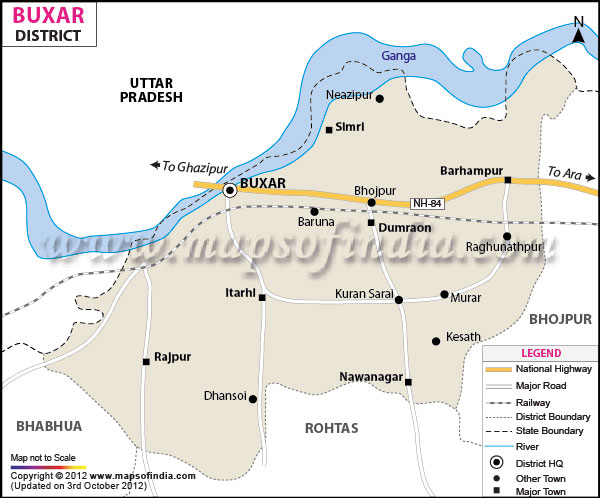
| *Buxar District Map highlights the National Highways, Major Roads, District Headquarter, etc. |
About
Buxar district lies in western Bihar, shaped by time and land beside the Ganga's flowing waters. Near the boundary shared with Uttar Pradesh, movement through this area has long connected Bihar to regions farther north. Not only defined by geography but also layered with moments from the past, its presence appears in broader narratives of Indian history. While memory turns often toward 1764 - the year forces clashed here - its story extends well before that turning point. Myth takes form among fields where farming continues without pause under open skies. Rooted in old traditions, spiritual threads emerge through tales tied to figures such as Maharishi Vishwamitra and Lord Rama. This stretch of earth holds quiet reverence passed down across lifetimes.
In place of outside influence, Bhojpuri ways stand firm - seen in speech, seasonal events, melodies played locally, meals shared daily. By the banks of the Ganga, rituals unfold during Chhath Puja, marking moments when community spirit becomes visible. Buxar carries weight not through factories, yet through echoes of the past that persist in quiet ways. Ancient stories here do more than linger - they shape how days unfold. Memory is kept not in books alone, but within routines passed across generations. Life moves at a pace set by soil, seasons, even silence between prayers. The ground feeds crops, just as myths feed identity, each sustaining the other. Even without modern industry, presence remains strong - rooted deeply, felt subtly.
History and Culture
Buxar carries stories older than written records - its past shaped by gods, sages, and shifting empires. Not many places in Bihar sit at such a crossroads of faith and power. Deep within Hindu belief rests the idea that Maharishi Vishwamitra lived here, his hermitage rooted in this soil. From the Ramayana comes word that Rama and Lakshman walked these lands when they guarded the sage’s rites from harm. Because of moments like those, devotion has long found its way to Buxar.
Beginning far before dawn, pilgrims trace the Panchkoshi Parikrama - a loop tied deeply to the district’s spiritual past. Though ancient, its path stays alive through those walking it today. Sites like Ahirauli, Nadav, and Charitravan mark stages along the route, each holding layered meanings. More than temples alone, these spots anchor memory into land. Myth isn’t just told here - it shows up in choices, rhythms, everyday life.
Back then, it stepped into the spotlight because of a key clash on October 22, 1764. That day saw forces under Hector Munro, serving the British East India Company, face off against an alliance - Mir Qasim, Shuja-ud-Daula, and the Mughal ruler Shah Alam II standing together. Victory went to the British, unexpectedly firming their hold on tax control across Bengal, Bihar, and Odisha. Power shifted quietly but deeply after that point. From mere geography, the town grew into a symbol - one marking where colonial rule took root. So it stayed: not just another region, yet a turning spot in how India’s governance changed.
Deep within Buxar, life unfolds without grand displays. Stories from long ago still shape how people live today. Not through fanfare but steady practice, customs endure here. Memory of the past stays strong, passed down in small acts. What keeps identity intact is not performance, yet routine woven into daily existence. Tradition breathes softly in ordinary moments.
Economy
Farming drives Buxar’s economy, forming the core of daily survival and influencing community patterns across the region. Thanks to rich soil left behind by the Ganga River network, crop production thrives under favorable natural circumstances. Wheat, rice, maize, pulses, and sugarcane dominate fields, whereas growing fruits and vegetables adds extra earnings for village households. In countless homes, working the land goes beyond job status - passed down through decades, it defines identity itself.
Among job opportunities in the district, those offered by state-run bodies stand out clearly. Offices handling civic matters, along with educational facilities and law enforcement units, employ many who hold degrees. Health centers and local administrative setups contribute too, offering stable positions. Instead of private ventures, these institutions often serve as primary employers for graduates. Funding tied to farming water supply, shelter construction, and transport networks reshapes how money moves locally. Where roads are built or work is guaranteed in villages, household incomes tend to respond. Economic patterns shift noticeably when such initiatives take root.
Public institutions support growth by managing banks, running food supply networks, delivering water for farming, along with backing farm-related agencies. Essential services like cooperative lending groups, spots that deliver crop nutrients, and government health clinics shape progress across districts. Though large-scale factories are absent in Buxar, state-backed bodies still hold a central role in how the local economy operates.
Nowhere more visible than in daily street activity, the rise of service-based work marks recent shifts across Buxar. At its core stands the town itself - handling much of the region’s commerce through small-scale outlets such as tutors’ classrooms, clinics, phone fixers, storefronts, freight movers, and bulk rice dealers. Because it sits where Bihar meets Uttar Pradesh, movement of goods and people powers large parts of the economy here.
Though modest in size, rice mills, flour mills, brick kilns, and similar local enterprises create work opportunities within communities. Livestock care, raising poultry, alongside dairy operations boost earnings for many rural families. Where crops meet commerce, weekly markets thrive as hubs for trading farm harvests and everyday items.
The economy holds steady despite minimal industrial activity, driven by crop output rather than factory work. Resilience shows up in government jobs, farming success, money sent home by migrants, along with small-scale commerce across neighborhoods. Progress ahead could rest less on factories and more on stronger roads, water access for fields, food processing ventures, together with broader learning paths for youth. What happens next might hinge not only on policy but also soil conditions, school quality, market links, alongside how well farms connect to wider networks.
Tourism
Built on legacy more than modern tourism, Buxar draws those drawn to stories older than textbooks. Pilgrims arrive first, followed by scholars tracing colonial imprints across dusty roads and old stone walls. Along the riverbank lies Ramrekha Ghat - steeped not in spectacle but in memory tied to Lord Rama’s path long ago.
A quiet stretch of land near the Ganges tells more than grander sites ever could. There, in 1764, the fate of an entire region quietly shifted. Not through ceremony or spectacle - but through conflict that reshaped authority across Bengal and beyond. The ground remains unadorned, yet layered with consequence. Anyone tracing how imperial control took root will find this spot essential. What looks like an open field once decided who held real influence in northern India.
Mythology wraps around Ahirauli through its ties to Gautam Rishi and Ahalya. Linked by old stories, Charitravan and Kamaldah Kund echo regional beliefs in quieter ways. Though facilities for visitors stay limited, meaning still lives within these sites. What remains is not a grand display, yet history lingers where tradition shaped daily life.
Buxar draws travelers through genuine encounters rather than staged attractions. Its appeal grows from daily rituals still practiced across neighborhoods. Sacred sites shape the rhythm of life here. History feels close when walking paths used for centuries. Meaning sticks not because it is explained but because it is lived.
Demographics
Buxar district recorded about 1.7 million people during the 2011 Census; most live outside urban centers. Rural communities shape its core makeup, while farming still guides where people settle. Because the soil supports crops and settlements have long existed here, space is limited across much of the area.
Starting at roughly 70%, literacy shows slow but steady gains in education across time. Despite progress, men still outpace women in reading and writing skills. Yet opportunities for girls have grown, thanks to wider school availability and support programs aimed at inclusion.
Across the district, Bhojpuri shapes daily talk, music, and traditions in fundamental ways. Official work and schools rely heavily on Hindi for instruction and documentation. Among certain communities, Urdu appears regularly in conversation and written form. Among villages, caste lines blend with faith-based clusters and age-old local councils shaping daily life. Though homes stay rooted in kinship ties, movement elsewhere quietly shifts what people hope for. What holds steady often bends under quiet pressures from those who leave.
Administration
One way the district handles local management is through a tiered structure of subdivisions, blocks, and village councils. While several areas fall under its authority, the core divisions are Buxar and Dumraon. Within these lie key operational units such as Buxar block, along with Chausa and Rajpur. Itarhi serves as another node, just like Dumraon which also functions both as subdivision and block. Nawanagar and Kesath help bridge urban oversight with countryside needs. Brahmpur adds to this network, followed by Simri where governance adapts to smaller settlements. Scattered across the map, Chakki operates alongside Chaugain. Each unit plays a role in extending administration into remote zones. Though separate, they link together under one district framework.
Running through rural areas, these administrative units handle schooling, medical services, farming support, policing, also social aid programs. At the heart of village decision-making, Panchayati Raj bodies tackle community-specific issues alongside growth priorities.
With over a thousand villages, the district shapes its farming roots and local traditions through scattered settlements. Because most people live in rural areas, governance at the village level holds steady importance across the region.
| Facts of Buxar District | |
|---|---|
| Official Name | Buxar |
| Location | Southern Bihar |
| Area (km2) | 1624 |
| Population | 1706352 |
| Language | Hindi, Urdu |
FAQs
Q1: How many villages are there in the district?
Buxar district has more than 1,000 villages spread across its various administrative blocks.
Q2: What is the population of the district?
The district’s population is 1.7 million according to Census 2011.
Q3: What is this district famous for?
It is famous for the historic Battle of Buxar, its connection to Lord Rama and Vishwamitra, Ramrekha Ghat, and its Bhojpuri cultural heritage.
Last Updated on : June 24, 2026
