






About
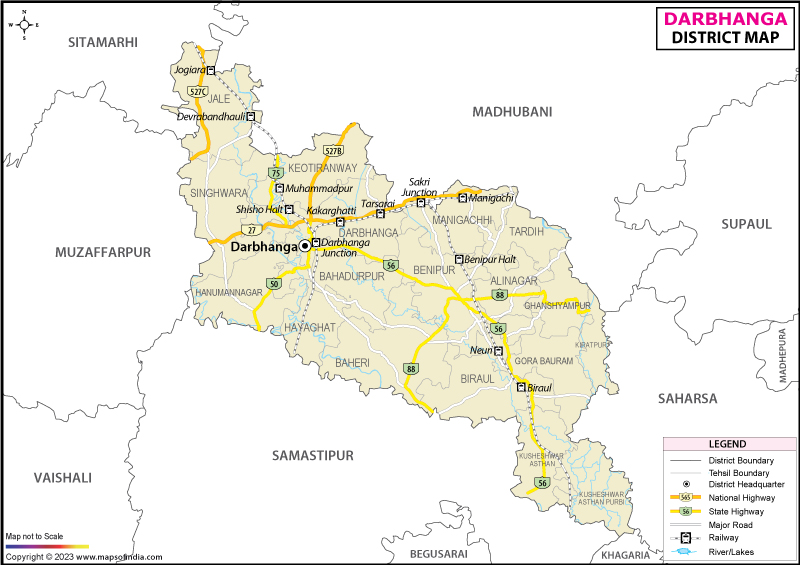
The district of Darbhanga is an important culture and administration center in the Mithila area in the Northern part of Bihar. The district is a key component of the Gangetic plains that is characterized by its rich historical heritage and cultural traditions. Its agrarian economy and the high concentration of its rural settlement pattern have been brought by the availability of fertile alluvial soil that has been aided by the rivers like the Bagmati River, the Kamla River.
Traditionally, the region has interacted with one of the ancient cultural terrain of Mithila which has helped in building the great intellectual and artistic heritage. The rule of the Darbhanga Raj brought the district into the limelight by contributing towards the propagation of education, music and literature. Darbhanga city is an administrative centre and a great seat of culture and trade.
History and Culture
Darbanga district has a rich history and cultural identity, which has existed within the ecosystem of a larger (cultural) centre of Mithila and its intellectual culture, religious prominence, and artistic legacy in contemporary Bihar. Since ancient times It has been a significant seat of learning and culture and has been closely connected with the history of Maithili language and philosophy. It is significantly impacted by the cultures of the Mithila region, which was a crucial part of the development of Indian early thought especially in the areas of philosophy, literature and education.
The region was part of a strong political organization in the ancient era like the Magadha kingdom that assisted in the expansion of administrative structure and other cultural institutions. Subsequently, during the Maurya Empire and the Gupta Empire there was the growth of trade, administration as well as intellectual activity in the area. Though it was not always in the political centre, it was closely related to these imperial developments and was influenced by their cultures.
Through the medieval time the region was influenced by the dynasties related with the Delhi Sultanate and subsequently Mughal Empire. The phases ushered in fresh administrative habits and styles of architecture, as well as promoting cultural exchanges between various religious communities. Hindu and Islamic cultures were able to co-exist and this led to a stratum of cultural layering that still finds reflection in local culture and practices.
The significance of the region’s history comes from the Darbhanga Raj, which was one of the most powerful zamindari properties in the eastern region of India. People who controlled this estate were great benefactors of education, music and literature. They contributed more to the promotion of Maithili culture, the maintenance of learning institutions that helped to maintain the ancient traditions and also inspired the development of art.
Festivals like Chhath Puja are very important as they focus on relations between people, nature and spirituality. The community ties and upholds traditional values through other cultural customs such as marriage rituals, local fairs and religious gatherings that strengthen their cultural bonds.
Economy
Darbanga district is majorly agrarian in nature, which is indicative of the economical system of larger rural Bihar, in Bihar. The area is blessed with fertile alluvium soils, which are deposited by rivers like the Bagmati River and the Kamla River; these rivers also facilitate a high agricultural production in the region. Agriculture is the main method of livelihood of much of the population with the major crops being rice, wheat, maize and pulses. The high agricultural production is affected heavily by seasonal flooding and ground-level rainfall derived by the monsoon winds, although there is some stability because of irrigation via canals, tube wells, and local water bodies.
Agricultural practices are mainly traditional though adoption of modern technology has been seen gradually such as the use of better seeds, fertilisers, as well as the use of farming machines. Large-scale production and investment is curtailed by the fact that small and marginal landholdings dominate, and agriculture is therefore not that lucrative to most households. Alongside the farming of crops, livestock raising, especially cattle and goats is also an adjunct income and sustenance of rural livelihoods.
Urban centers are a center of trade and commerce, and Darbhanga serves as an important market of agricultural products, dairy goods, and day to day goods. Another noteworthy role played by the informal economy is the weekly markets and local fairs that enable rural consumers and producers to sell and buy.
The industrial sector has not yet been properly developed and there is very little employment in small-scale industries, cottage industries like food processing, handicrafts and agro based industries that are small in scale. Poor infrastructure, inaccessibility to capital and poor technological development are some of the constraints that do not facilitate industrial growth.
Migration is also to be considered as an influential aspect of the economy of the district as most of its members are migrating to urban centres and other states in search of improved jobs. Migrant workers also send remittances that increase the household incomes, as well as economic activity of the area.
Tourism
Tourism of Darbhanga district signifies its abundant cultural heritage, association of history and religious aspect of the Mithila area of Bihar. The district has not gotten much marketing like other major pilgrimage centres but receives visitors who are interested in history, architecture and the traditional culture. Its stature as a former aristocratic patron centre and Maithiliadoras complement its cultural tourism attractiveness.
The most notable sight is the Darbhanga Raj Campus which harbors a number of historical buildings relating to the previous Darbhanga Raj. In this district, there is the grand Nargona Palace, the Anand Bagh Palace that all bear the impact of a blend of Indian and colonial architecture. The structures are used to remind people of the princely history of the area, the role it played in art, education and culture.
the Shyama Mai Temple, drawing worshippers throughout the year. Festivals such as Durga Puja and Kali Puja bring huge crowds; rituals fill courtyards of temples. Kusheshwar Asthan, a revered shrine dedicated to Lord Shiva, pulls devotees from far corners nearby. Its presence echoes beyond just local practice.
Other cultural traditions that are linked closely to the district are the cultural festivals of Mithila especially in regards to festivals, music and art where the riverbanks and the ponds are converted into colorful places where people gather to do their worship.
Demographics
The Darbhanga district demographics is representative of the general population characteristics of the Mithila region of Bihar that includes in its parameters high density, a rural predominant population and a socio-cultural diversity. The 2011 Census of India lists the population of the district at more than 3.9 million, which is also one of the more densely populated per capita districts in the state. The most rural areas contain a major majority of the population and urban centres like Darbhanga serve as major administrative, trading, education and service centres.
The district has a relatively high population density, which means a lot of strain on land and the natural environment, especially in agrarian environments where landholdings are usually small and fragmented. The sex ratio is lower than parity, with less females per thousand males. Gradually the literacy rates have been improving but still it is lower compared to the national average. There has been a notable gender gap with males having considerably higher rates of literacy, compared to females demonstrating unequal access to education.
It has a diverse social structure, which includes different caste groups and communities. Scheduled Castes represent a significant percentage of the population, whereas Scheduled Tribes are more of a small number. Patterns of settlement, occupation and access to resources are affected by these social categories. The religious texture is mainly Hindu with a large minority of Muslims and minorities who practice other religions and thus adding to a pluralistic social structure.
Linguistically, the district belongs to the Maithili-speaking area where Maithili is commonly spoken and culturally used. The official language, Hindi, is both an educational language, which forms a bilingual condition, necessary to serve the administrative and local identity. These linguistic traditions are closely intertwined with cultural activities like folk songs, oral traditions, and festivals.
There is a high percentage of the populace that is in the working age bracket and this can be economically productive. Nevertheless, there are few employment opportunities in the district as it relies on agriculture and low level of industrialization. This has led to the general migration to urban centres and other states especially in younger people pursuing enhanced chances of jobs. Migration of workers has a significant impact because remittances are used to sustain local economic activity and support household income of the region.
Administration
In Darbhanga district, governance follows the usual setup seen across Bihar, where authority blends state oversight with limited local control. The District Magistrate - sometimes called Deputy Commissioner handles peace, enforces rules, and pushes forward public initiatives. When it comes to security, the police step in through their top officer, the Superintendent of Police, responsible for crime response and legal matters locally.
To facilitate administration the district is subdivided into subdivisions, each under a Sub-Divisional Officer (SDO). These subdivisions can again be further subdivided into blocks that serve as major units of rural administration and development. Block Development Officers (BDOs) undertake the role of executing different government programs in terms of agriculture, rural development, welfare initiatives, and development of infrastructure at grassroots.
The administrative control is done at the village level and is known as the Panchayati Raj where decentralization in decision makers is encouraged and the people are involved. Gram Panchayats are elected authorities and they are important in management of local resources, solving minor disputes, and implementation of development projects.
Municipal governing bodies like municipal corporations and municipal councils are in charge of urban areas in the district. All these institutions have the role of offering fundamental civic services, such as water supply, sanitation, garbage removal, and urban planning. Administrative officers coordinate with elected officials to provide good administration of urban areas.
| Facts of Darbhanga District | |
|---|---|
| Official Name | Darbhanga |
| Location | Bihar |
| Area (km2) | 2,279 |
| Population | 3,937,385 |
FAQs
Q1: How many villages are there in the district?
1,252 villages.
Q2: What is the population of the district?
3,937,385 (2011 census).
Q3: What is this district famous for?
Darbhanga Raj legacy, Mithila painting, Makhana production, and its status as the Cultural Capital of Bihar.
Last Updated on : June 24, 2026
