|
||||||||||
| ||||||||||
|





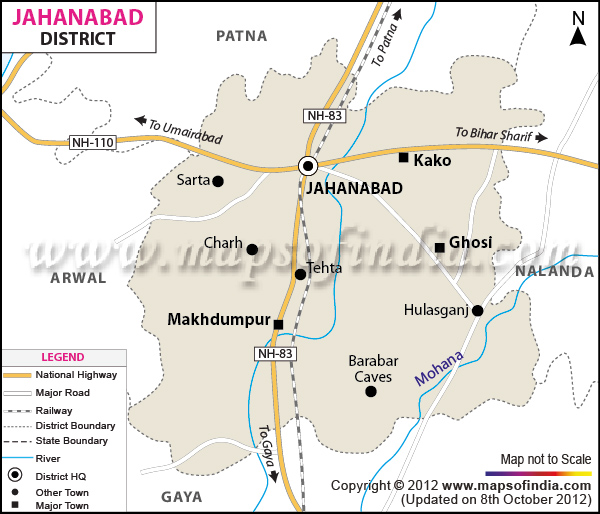
| *Jahanabad District Map highlights the National Highways, Major Roads, District Headquarter, etc. |
About
The Jahanabad district is a significant administrative unit which is situated in the south central part of the Indian state of Bihar. The name of Jahanabad is thought to have an historical background which is associated with the influence of Persians, with abad meaning a settlement or habitation, that it has had a long history of importance as a populated centre.
Geographically, the region lies in the fertile plains of Ganges basin which contains alluvial soil which harbors high magnitude of agricultural activity. Its neighbors are the Patna district on the north, Gaya on the south, Arwal on the west and Nalanda on the east. The existence of river systems like Punpun River promotes the process of irrigation and determine the agrarian environment of the district. The Jahanabad district map is a clear visual folk of the boundaries of the district, links of transportation and settlement patterns, with most sites having very close access links, to major urban centres, such as Patna.
A combination of the traditional rural life and a slow urbanisation characterises the district. The farming terrain is prominently in agriculture but, there is an increased trend in studying, infrastructural provisions as well as domestic governance. The distribution of villages and administrative units indicated by the Jahanabad district map, is vital in the governance and development planning. Generally, the Jahanabad is a region that is rich in historicities, farming skills, and an evolving socio-economic environment.
History and Culture
The historical development of Jahanabad district has a rich historical background that can be traced to the bigger historical heritage of the Magadh region, which is one of the oldest and most influential historical zones in India. The region was historically a part of the great Magadhan kingdom and was central to the very conception of the history of the early civilisation of India. Throughout centuries, rule of different dynasties such as the Mauryas, Guptas and later the Delhi Sultanate and Mughal Empire exercised their rule over the area. Cultural and political impacts of these regimes have created long lasting changes in the district.
The medieval period saw the rise of Jahanabad as one of the regional centres and was lucky to be located in between major centres in the region such as Patna and Gaya. This Mughal influence can be seen in some of the architectural styles as well as in the patterns of the settlements. The Jahanabad district map could usually assist the historians and researchers to evaluate the history and progress of settlements and trade routes at various times.
The district has been linked with agrarian movements and socio-political struggles, in more recent history. It has also seen the great mobilisation of the masses, principally on land-reform, and country rights. The movements have not only defined the contemporary identity of the district but also helped in the creation of the socio-political awareness of the district. In such cases, the Jahanabad district map is common to academic studies to examine land distribution and rural demographics in these contexts.
Culturally Jahanabad is connected culturally with the rural parts of Bihar in which there is an impressive emphasis on community life, festivals and local customs. The district celebrates a wide variety of major festivals such as chhath puja, diwali, holi and eid with great zeal in the district which represents the cultural diversity and harmony of the region. The Chhath Puja especially so is especially noteworthy with the rituals performed on either side of the river and the water bodies.The major language spoken in the area is Magahi, and Hindi, which is the official language in administration and education.
The, religious places and local temples enhance the spiritual life of the district. Not only do these places play the role of centres of worship but also communities which interact. The culture of the district is based on the agrarian way of life where the cycles of seasons shape the festivals, traditions and everyday life. The map of the district of Jahanabad gives us an idea of the distribution of cultural and religious sites over the district.
Economy
Jahanabad district mainly is an agrarian economy that is further supported by favourable climatic conditions along with fertile land. The economic set up of the district has been underpinned by the agricultural sector and has been a source of employment to a large number of people. The Jahanabad district map reveals vast farmland, irrigation systems and rural settlements, which rely on agriculture.
Employment opportunities in the government sector include administrative services, education and law enforcement. Government offices, schools, and healthcare centres are great partners in service delivery as well as, job creating. The district administration efforts are directed towards the development of rural areas, improvement of infrastructure and application of welfare schemes. Jahanabad district map is a valuable resource in planning such programs and to guarantee equal development.
The government sector in Jahanabad is rather small as compared to urban districts but it encompasses such government institutions like government schools, hospitals, cooperative societies. These organizations are able to give back to the economy of the city as they offer the services and contribute towards agriculture activities. The cooperative banks and agricultural societies assist farmers in obtaining credit and resources. Jahanabad district map will help in identifying some of the areas which such institutions are found and where additional development is required.
Services industry is slowly growing, specifically in education, retail, transport and small scale business. Local markets are centres of trade whereby agricultural produce is sold and purchased. The small businesses, transport services and institutes of private learning are the sources of employment and income generation. The layout of the Jahanabad district manages the proportion of these service centres in regard to the towns and villages.
The biggest economic practice and agricultural products such as rice, wheat, pulses and oilseeds are drastically farmed. Farming is sustained all year round with support of irrigation facilities, such as canals and tube wells. Livestock rearing and dairy farming is another activity that is used to earn livelihood in rural areas. The Jahanabad district map is highly beneficial in regards to irrigation tendencies and cultivated lands.
Tourism
The tourism in the Jahanabad district is relatively small but has a potential owing to historical and cultural background of the area. The district provides an insight into the way of living, traditions and heritage of Bihar in the rural sector. Jahanabad district map is a useful tool that may help visitors of the area in terms of finding out the main attractions and planning their trips.
Among the sightseeing spots in the district is the Barabar Hills which is located close to the border between the district and the neighbouring districts. The hills also have some ancient rock-cut caves which date back as far as the Mauryan period. The caves are reported to be one of the archaic surviving rock-cut constructions of India, which are of interest to historians and lovers of archaeology.
The other notable feature of the tourism in Jahanabad is that there are religious places as well. The presence of temples and shrines in the region has attracted people and more so the festival times. These sites are an eye opener on spiritual life of the site as well as cultural practices. The visitors can easily see the location of these religious centres on the Jahanabad district map and therefore, exploration of these religious centres becomes easy.
The district has been formed of natural phenomena such as rivers and country scenes which have since become a part of the beauty of the district. The rural setting and serene environment give a nice holiday to the tourists who have taken a break to city life. The Jahanabad district map will help travellers to tell which scenic routes, and rural locations would be worth exploring.
Other features of cultural attractions might also be local fairs and festivals which show traditional practices and crafts as well as celebration activities in the neighborhood. The events may provide the visitors with an opportunity to familiarize with the lively culture of this district close up.
Though the tourism infrastructure is currently still in its 3 stage development, with improved connections and awareness, the district will become more attractive as a destination. The Jahanabad district map is vital in advancing tourism in the area since it offers the necessary geographical and logistical information.
Demographics
The population of Jahanabad district is a major urban rural population as majority of the population resides in villages. As per the last existing census data, the district has about 1.1 million populations. The map of Jahanabad district assists in showing the distribution of population and patterns of settlements in the region.
The literacy level in the district is approximately 66% and this is an indication of the continuing process of bettering education and awareness. Both the government and the privately owned educational institutions are slowly playing their role towards achieving higher literacy levels. Millennium map of the Jahanabad district is helpful in ascertaining the dispersion of educational establishments.
The population structure could be described as a mixture of various communities that add and contribute to the diverse social fabric. The rural way of life prevails and the major occupation among most families is farming. Jahanabad district map is a graphic depiction of the way the cluster of population is with respect to each other.
Administration
To facilitate good governance and development in the Jahanabad district; the district is determined to be administratively divided into subdivisions and blocks. These are administrative units that help in the execution of government schemes as well as the provision of government services. An important source to find information on these divisions is the Jahanabad district map.
The district has a number of tehsils (subdivisions), further subdivided into blocks and villages. Every unit possesses its administrative unit and within this unit there are local governing units such as panchayats. These institutions are central to rural governance and development of communities.
It is the land of hundreds of villages, which make the essential bulk of its administrative and social complex. These villages are differently large and varied in population and all of them are components of total identity of the district. The map of the Jahanabad district will enable finding of these villages and comprehend their spatial distribution.
Police stations, administrative offices as well as development agencies are at a strategic location that ensures they are accessible and efficient. The district administration attempts to make sure that there is law and order, that there is development and that there are others who are interested.
FAQs
Q1: What is the total number of villages in Jahanabad district?
Jahanabad district has approximately 600 villages, forming the core of its rural administrative structure.
Q2: What is the population of Jahanabad district?
The district has a population of around 1.1 million people, according to recent census data.
Q3: What is Jahanabad district famous for?
Jahanabad district is famous for its agricultural productivity, historical significance in the Magadh region, and nearby ancient sites such as the Barabar caves.
Last Updated on : June 24, 2026
