






About
In the south of Bihar lies Jamui district - a place shaped by old ruins, wooded slopes, and villages holding firm through time. Situated under Munger division, it touches Jharkhand, forming a quiet bridge between flat farmlands and highland stretches eastward. Rather than flowing rivers feeding fields, here terrain shifts - rocky ridges rise beside green canopies, mines hum below soil, crops grow in pockets among stone. History layers upon itself: traces remain from eras long past, when footprints crossed these paths for worship or war. While cities draw louder attention across Bihar, this area whispers deeper tales - from Jain monks walking trails centuries ago, to echoes of rebellion rooted in local courage.
Known by a name tracing back to "Jambhiya Gram," this region points to an old village tied deeply to faith and past narratives. Located near landmarks significant to Lord Mahavira, the twenty-fourth Tirthankara, its bond with Jainism stands firm. Lachhuar forms part of that legacy - thought to reflect moments from Mahavira's youth. While Jain roots run strong, Hindu customs also thrive here - notably in shrines, gods honored locally, and yearly events guiding daily rhythm. From one era into another, spiritual layers remain visible across the land.
Away from the usual flatness seen across Bihar’s Gangetic belt, Jamui stands out through uneven ground. Rising slopes, patches of woodland, and stony areas shape much of its land - especially near Chakai and Sono. Life here adapts to these natural features, where plants and animals coexist alongside human activity. Waterways including the Kiul and Ulai feed farmland, yet income comes not only from fields but also trees, herds, and modest market exchanges. Even though farming holds strong importance, growing rice, wheat, corn, and legumes mainly in richer soils defines daily work for many residents.
History and Culture
Deep within ancient India lies the origin of Jamui, marking it as a notable district in Bihar through time. Tied closely to Magadh’s wider civilizational footprint, its past unfolds alongside one of early India's dominant powers. Under rulers like the Mauryas and later the Guptas, the area absorbed shifts that defined political thought across centuries. Positioned where flatlands meet wooded highlands, movement shaped life here beyond mere habitation. Pathways used for commerce and pilgrimage passed through, guided by geography more than design.
What stands out most about Jamui links back to Jainism. Though many traditions exist here, one belief holds deeper roots. Connected to Lord Mahavira - the twenty-fourth Tirthankara - this land carries weight for followers. In fact, Lachhuar within the district draws attention due to its ties with his mother's lineage. Not just any village, it bears status among holy locations. Pilgrimage routes often include these parts, shaped by long-held reverence. Because of such visits, the area remains marked on India’s map of faith. Spiritual significance lingers where footsteps repeat across generations.
Among its features stands a link to ancestral warrior practices. Sheltered by woods, Jamui once hosted native groups whose ways still shape community identity today. Owing to uneven landforms, opposition against colonial rule found footing here quite naturally. Control proved difficult for imperial officials due to terrain that resisted easy passage.
In Jamui, culture shows both common Bihari ways and tribal roots. While Hindi spreads across towns, voices carry Magahi, Angika, even native tongues deep in villages. Life moves with old rhythms where farming shapes songs. Season by season, music rises at weddings, harvests, celebrations. These sounds stay alive far from city reach. Among trees and fields, tradition speaks through melody. Not all speech fits official labels - some words pass only by ear.
Economy
Though farming shapes most lives in Jamui, especially across flat and gently rolling lands, the local economy includes more than crops alone. Forest reserves contribute materials that add to household income beyond fields. Areas rich in minerals introduce another layer of economic activity uncommon in strictly farm-based regions. Across villages, people grow paddy, followed by wheat, maize, pulses, and oil-bearing seeds, their success tied closely to rain patterns each year. Because water supply through irrigation varies from place to place, timing and amount of rainfall still play decisive roles. While land use centers on cultivation, natural diversity allows slight divergence from typical rural setups.
Deep within the hills, trees shape daily life far more than often acknowledged. From those woodlands come materials people rely on - firewood gathered at dawn, herbs pulled from shaded clearings, wild fruit taken in season - all easing household burdens. Instead of cash wages, many depend on what grows between roots and canopy. Animals move across small farms too: cows grazing narrow fields, goats stepping through thin brush, chickens scattering underfoot. Where crops struggle, hooves and feathers help sustain families. Not money alone keeps meals on tables. Among those working in Jamui, many find positions within public services such as district governance, law enforcement, teaching roles, rail operations, conservation units, medical centers, along with social support agencies. Institutions like educational campuses and municipal hubs offer stable job pathways for residents. Programs focused on village infrastructure, livelihood creation, and shelter provision shape economic patterns across the region. Among state-run organizations, financial agencies help maintain market balance. Movement of goods gains advantage when rail networks operate through key hubs like Jamui. Support structures funded by taxation assist families with limited earnings. Accessibility improves where infrastructure links regions effectively.
Elsewhere, migration shapes local economies just as much. Some villagers find jobs in distant urban centers across India, even crossing state lines. From those places, money flows back regularly - this income covers daily needs, pays school fees, sometimes helps build a room or repair a roof. Not every household relies on it, yet the pattern repeats often enough to matter.
Still, farming holds steady alongside forest use, movement of people, and new service work in Jamui. Though hurdles exist, progress in roads and buildings, along with local assets, quietly steer what comes next.
Tourism
Rooted in faith, natural landscapes, and local heritage, Jamui draws quiet interest from those drawn to pilgrimage or open spaces. Not part of heavily promoted routes, it remains a place where visitors seeking depth arrive without fanfare. Its value lies not in spectacle but in presence - temples stand beside forest edges, stories linger in village pathways. While larger circuits pulse elsewhere, this region holds steady with unmarked trails and modest shrines. Travelers who pause here often do so by choice, not chance. What emerges is not curated excitement, rather an unfolding sense of continuity between land and belief.
Lachhuar holds deep religious meaning for followers linked to Lord Mahavira. Because of this tie, Jamui finds itself marked on key spiritual paths. Devotees view the location with reverence, so its presence shapes regional faith patterns. Through quiet importance rather than grand display, the site draws those who walk ancient traditions.
Among quiet woods stands Giddheshwar Temple, a place of spiritual weight for many Hindu worshippers. Though sometimes grouped with nearby areas, Simantala holds identity through cultural threads woven into the wider region - its air calm, views stretching wide.
Among Jamui’s rolling hills, patches of forest open space for nature-based travel - yet facilities stay sparse. Scenes unfold quietly near Chakai, where terrain shifts with seasonal rhythm. From Sono outward, plant and animal life appear in layered variety. Observation here reveals depth within the region's environmental fabric. What lies beneath these green covers often escapes notice at first glance. Festivals at temples draw nearby travelers, particularly when ceremonies take place. Seasonal events pull in guests from surrounding areas too. Local fairs see increased attendance around holy days.
Demographics
With more than 1.7 million people recorded in the 2011 census, Jamui district spans a landscape shaped by village life. Rural settlements house most inhabitants, where community networks anchor daily existence.
Despite gains in schooling access, roughly 59 to 60 percent of people can read and write - less than seen elsewhere. Progress exists; however, gaps persist across regions. Females trail males noticeably when it comes to reading ability. Still, efforts aimed at learning are slowly shifting outcomes. While imbalance lingers, initiatives keep advancing.
Across government offices, Hindi holds official status. Yet in villages, speech shifts toward Magahi or Angika, along with regional variations. Among tribal groups, unique languages endure, shaped by long-held customs.
Among those living in Jamui are varied castes, along with certain indigenous groups and differing faiths, shaping its societal makeup. Though numbers differ across regions, shared spaces emerge where traditions intersect slowly. Where one group settles, another often adapts - this constant shift defines daily life in subtle ways. From village centers to market lanes, identity appears layered, never fixed.
Administration
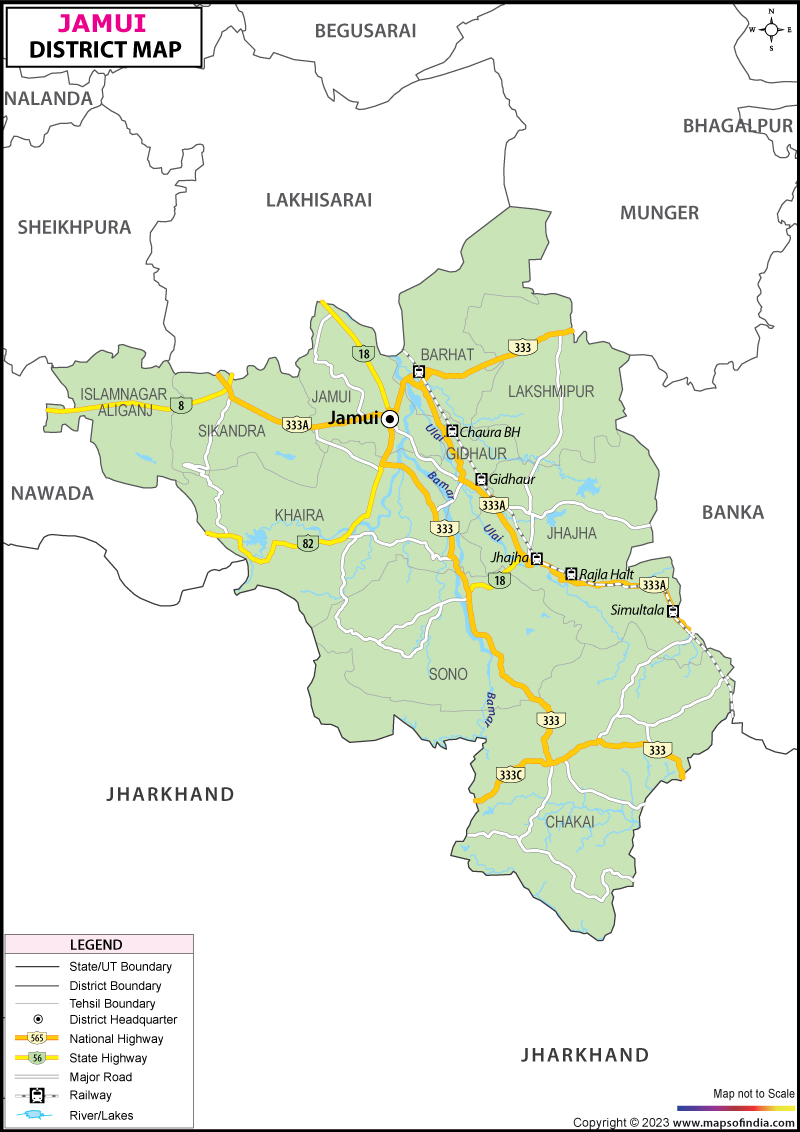
Within Jamui district, administration splits into subdivisions and blocks for coverage across differing landscapes. Among these divisions stand Jamui, Jhajha, and Sikandra as key areas. Governance adapts where terrain shifts beneath structured oversight. Among the key areas are Jamui, followed by Jhajha, then Chokai comes into view. Sono appears next, while Sikandra stands nearby. Khaira is included, whereas Gidhaur follows after. Islamnagar Aliganj emerges later, with Barhat marking the end.
Over fifteen hundred villages lie within the district's boundaries, most scattered across countryside areas near wooded regions. Governance at the grassroots level relies heavily on Panchayati Raj bodies, particularly when distributing social benefits, managing schools, or building public facilities. Among key goals stands rural advancement, supported through structured forest oversight. Education receives focus alongside efforts to enhance communication networks. Priority unfolds where land use meets learning initiatives. Connectivity strengthens as forests undergo careful planning. Development takes shape mainly in less urbanized regions.
| Facts of Jamui District | |
|---|---|
| Official Name | Jamui |
| Location | Bihar |
| Area (km2) | 3122 |
| Population | 1760405 |
| Language | Hindi, Urdu |
FAQs
Q1: What number of villages exist within Jamui district?
Across the administrative blocks of Jamui district, over 1,500 villages are located.
Q2: What are the population figures for Jamui district at what level?
Jamui district records more than 1.7 million residents as per Census 2011 data. Despite its size, official figures remain unchanged since that count.
Q3: What is this district famous for?
Jamui is famous for its Jain religious significance linked to Lord Mahavira, its forested hills, tribal heritage, and diverse natural landscape.
Last Updated on : June 24, 2026
