






About
Situated in northeast Bihar, Katihar stands out due to its strategic location and economic energy. Not just part of Seemanchal, it holds strong ties - geographic and cultural - with West Bengal, Jharkhand, and nearby areas in eastern Bihar. Transportation flows through here; so does farming, commerce, movement. Rail networks define much of its profile, yet wide flat fields grow plenty too. People from different backgrounds live together, shaping a varied community life. It links North Bihar to broader eastern regions, acting more like a bridge than a boundary. While trains and crops draw attention, the essence runs deeper. Migration has left marks on how things work, who lives here, what languages are spoken. Trade routes, old and new, feed into daily rhythms. History unfolded quietly, layer by layer, forming today’s landscape without fanfare. Identity here grows from motion - from people coming, going, staying. Linguistic mix reflects centuries of contact across borders near and far. Change arrived slowly, woven into routines rather than announced. What you see now emerged from connections, not isolation. This place matters because paths cross, not because it stands apart.
History and Culture
Situated in northeastern Bihar, Katihar mirrors wider shifts across the region yet holds a character unique to itself. Ancient eastern Indian realms once reached into what is now Katihar, particularly under the sway of Magadha, followed by medieval authorities affecting both Bihar and Bengal. Its proximity to Bengal meant steady exposure - not through force but flow - to practices and structures from Bihari and Bengali societies alike. Over time, these overlapping currents wove together, forming a local identity still evident in present-day life here.
Long before modern times, farming shaped life here, villages taking root where rivers left rich soil behind after floods. Because of its location, movement of goods began to matter more - paths linking Bihar to Bengal and lands beyond ran through these parts. When Mughals held power, better roads and crop-based taxes helped the wider area thrive economically. Only later, under colonial oversight, did Katihar step into a clearer view as a notable place.
Back then, colonial rule shifted Katihar in deep ways. Rail lines spreading across eastern India turned the town into a key transit hub. Thanks to British-built networks, connections grew between this area, Assam's tea corridors, Bengal’s trading zones, and northern tracks. Movement of goods changed - so did movement of people, as groups with distinct languages and customs settled here.
After gaining independence, Katihar grew steadily, shaped by its role in rail networks and farming. Though quiet at first, its status rose when officials began treating it as a key administrative node. Over time, trains brought more than passengers - sacks of wheat, barley, and rice started flowing through. Jute dealers set up shops near freight lines, drawn by access to markets beyond state borders. Movement defined the region: goods moved out, supplies came in, people passed through. Infrastructure followed need, not planning - stations expanded, warehouses appeared, roads adapted.
Language here does not just guide talk - it steers stories, songs, and how people see themselves. Some regions echo with Bhojpuri rhythms and Maithili expressions through folk art. Elsewhere, festival colors shift toward Bengal, flavors grow richer, shaped by long-standing Bengali customs. Festivals in Katihar bring people together, cutting across religious lines.
Littoral flavors meet inland grain in daily meals across Katihar. Not only rice appears on plates but fish, steamed or fried, shows up just as often. Jute leaves simmered with spices sit alongside bowls of dal. Lentils blend into rotations that include seasonal greens and root crops.
Economy
Built on fertile alluvial soil, Katihar supports varied crops like rice, wheat, and sugarcane thanks to ample water supply. While farms feed many households across villages, the region stands out especially for growing jute - a key crop shaping its agricultural identity. Maize harvests add steady income for local growers. Bananas too play an increasing role in village-level earnings. Transport, trading activities, alongside farm work, together shape a mixed economic base distinct within Bihar. Rural life still turns largely around seasonal planting cycles and land productivity.
Flooded fields often ruin harvests; still, those same waters enrich the earth below. Where water flows each year, farmers face loss - yet gain nourishment for future yields. Because of this balance, agriculture persists even under shifting conditions. Though danger arrives with every rising stream, so does renewal. In Katihar, the public sector covers areas like district management, schooling, train operations, policing, healthcare, along with countryside improvement units. Railways play a central role - this branch brings many job openings across the region. Employment remains steady thanks to institutions such as educational centers, city-run offices, plus support programs for residents. A large share of locals find work within these established systems.
Most jobs in the area come from government operations like rail networks, banks, farm support centers, grain supply chains, and public works. Employed by the Katihar division of Indian Railways, many residents find stable income within this branch. Growth here leans heavily on medical access run by authorities, fresh roads built over time, water channels aiding crops. What stands out is how deeply state-run functions influence daily livelihoods across the region.
Among India’s regional hubs, Katihar stands out because of how deeply services shape its economy. Driven by movement and exchange, the area thrives through commercial activity linked to transportation networks. Markets dealing in bulk supplies play a central role, tied closely to rail-based distribution systems. From storage solutions to delivery coordination, logistical operations support wide-reaching supply chains. Small stores dot neighborhoods, serving daily needs while forming part of larger retail patterns. Stays for travelers, along with food service spots, meet demand sparked by constant passenger flow. Schools and training centers add another layer, offering pathways beyond manual labor. Work connected to trains - ranging from track upkeep to dining car staffing - brings varied income sources. Grain trading flows steadily here, alongside deals in jute materials and household products moved through local outlets.
Movement of people for work influences economic patterns, yet jobs appear in Katihar due to its role in transit networks. Repair shops grow alongside tutoring centers, then so do neighborhood food producers. Agro-based processing units follow a similar path upward.
Despite minimal heavy industry, Katihar's economy stands out among rural areas because of transport links, farm output, along with trade systems. While most similar regions lag, this district leverages location to boost activity. Its roads and rails connect farmers to buyers more directly. Surpluses move fast, reducing waste while increasing income. Markets thrive not through size but by being well-placed. Growth comes quietly, built on movement rather than factories. Distance weakens many villages; here it creates opportunity instead.
Tourism
Though quieter than Bihar’s major tourist zones, Katihar draws visitors with history, faith-based sites, and natural settings. Rail fans find meaning in Katihar Junction - not just for its past, yet because of how it moves goods today. Home to centuries-old rituals, Gorakhnath Temple draws pilgrims across nearby regions. While rooted in local belief systems, its influence extends through ongoing worship events. Gatherings here unfold regularly, shaped by long-standing devotional customs. Spiritual life pulses steadily within its stone walls. Perched close to the Ganga, Manihari carries weight through time and place. With vistas of flowing water tied to writings of note, beauty blends into heritage here. Where rivers meet shapes how people see themselves nearby. Though monuments draw little attention, Katihar finds its travel appeal through local customs. Spiritual practices add depth to the visitor experience. Transport history shapes part of the city's identity. Culture stands out where grand sights might not. Regional life becomes the main attraction here.
Demographics
With nearly 3 million residents counted in the 2011 census, Katihar ranks among Bihar's most densely settled areas. Most people live in villages, yet city-like growth spreads steadily near Katihar town. While rural life remains typical, change creeps in through gradual urban expansion. Though just over half of adults can read and write, signs of progress appear in school construction. Girls’ access remains limited, yet classrooms multiply each year.
Among the tongues used daily are Hindi, Urdu, Surjapuri, Maithili, and Bengali. What stands out most in Katihar’s population makeup? Its wide mix of languages. Though often overlooked, speech patterns here trace deep cultural roots across communities. Among those living there are Hindus, Muslims, together with others, forming a mix where daily life unfolds through mutual presence and common livelihoods.
Administration
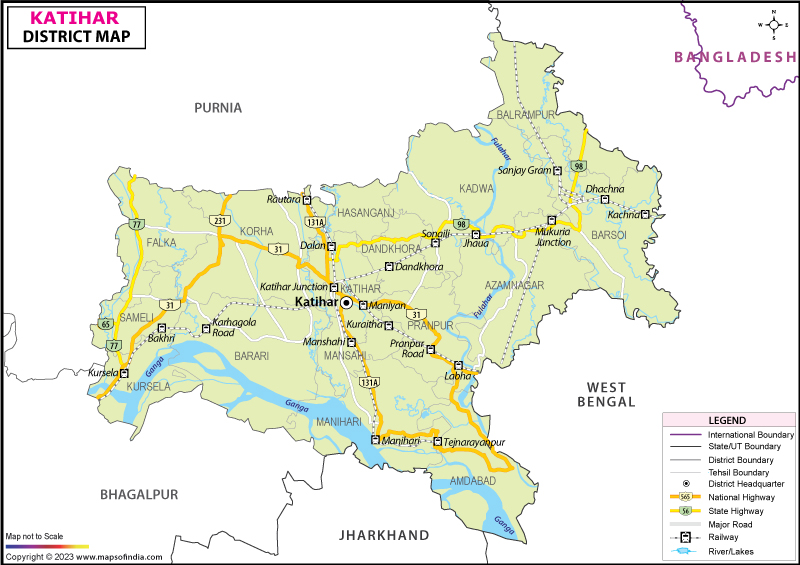
Split into parts for easier management, Katihar district organizes its areas under subdivisions and blocks. Among these, Katihar stands out along with Barsoi and Manihari as key administrative zones. Governance flows through such divisions to support local needs. Besides Katihar, key hubs are found in Barari - also linked through Korha and Kursela. Moving north, Barsoi connects with Azamnagar while Balrampur stands near Pranpur. Dandkhora appears alongside Kadwa; farther west lies Falka. Sameli joins Hasanganj, each paired closely with Manihari across the region.
Over twelve hundred villages lie scattered across the region, most tied closely to farming and access to markets. While local councils manage village affairs, town governance rests with elected city authorities. Besides local institutions, railway oversight shapes how Katihar functions - its economy leans heavily on rail operations. Governance here shifts subtly when tracks demand attention or freight schedules tighten. Because trains move so much of the region's goods, administrative priorities often follow their rhythm instead of resisting it.
| Facts of Katihar District | |
|---|---|
| Official Name | Katihar |
| Location | Eastern Bihar |
| Area (km2) | 3056 |
| Population | 3071029 |
| Language | Hindi, Urdu |
FAQs
Q1: What number of villages exist within Katihars borders?
Beyond its main towns, Katihar holds well over twelve hundred rural settlements spread through the area's governing zones.
Q2: How many people live in Katihar district?
Some three million folks lived in Katihar district when census workers counted heads back in 2011.
Q3: What is this district famous for?
Fertile fields stretch wide here, feeding a farming economy that thrives on maize. Jute grows in abundance, adding to what the land yields year after year. A busy rail hub pulses at the center, linking far places through constant movement. People speak many languages, each voice carrying different roots, yet all part of one place.
Last Updated on : June 24, 2026
