






About
Bordered by powerful rivers, Khagaria district sits in northeast Bihar, where life flows with the rhythms of monsoon and soil. Not far from the Ganga’s curve, this place draws strength from flood-fed fields that sustain seasons of sowing and harvest. The Kosi, Bagmati, and Kamla weave through it, bringing water - and risk - with every seasonal shift. Floods shape more than land here; they mold choices, routines, and lives across generations. Transport routes now stretch further into its villages, linking isolated pockets to wider movement and trade. Far from static, the area shifts subtly - roads improve, markets grow, yet farming remains at the core. People stay rooted not out of habit, but because adaptation has become second nature when waters rise without warning. Its story unfolds less in records, more in patterns: plowed rows, boat trails, homes rebuilt on higher ground. Geography may limit, yet within those bounds, activity persists - a mix of caution, effort, and quiet continuity.
Centered around Khagaria town, the district's core functions unfold where governance meets trade. Though administration clusters here, most of the region stretches outward in village patterns that anchor daily routines. Roads and rails cut across watery landscapes, linking northern and southern Bihar through this patch. Settlements thrive close to rivers, a legacy echoed in old shifts tied to Mithila and Anga cultures. Over time, farming rhythms, movement of people, and efforts to control flooding have quietly redefined what the place now stands for.
History and Culture
Across fields shaped by time, Khagaria's past ties closely to rivers and farming life in Bihar. While left out of many well-known political stories where places like Patna or Rajgir appear often, its land still felt shifts from the cultures of Mithila, Anga, and Magadh. Positioned near strong river flows, it drew people who grew crops over generations. Because waters moved unpredictably, movement among residents happened regularly - brought on by shifting streams rather than choice. Trade passed through too, guided more by geography than design.
Back then, farming villages grew along the rivers, shaped by yearly floods and boat-based commerce. Not far away, old Bihar’s cultural spheres reached into this place, bringing traits from northern Mithila with its Maithili speech and eastern regions where people spoke Angika.
Later on, Khagaria gained administrative significance in Bihar due to its advantageous position. During colonial rule, changes emerged in governance structure alongside shifts in land ownership rules, while railways began shaping movement across areas. Although transport networks expanded under British influence, linking regions more effectively over time, handling floods continued to resist improvement.
Music carries weight here: farming chants, wedding verses, and Chhath prayers pass down stories that textbooks rarely capture. Seasonal festivals act like anchors, holding meaning steady across generations. What gets sung at harvests or weddings sometimes tells more than what is written in records. Tradition lives strongest where people gather, not just where documents sit.
Farming rhythms shape what people eat in Khagaria. Alongside rice there is often lentil stew, flatbread made fresh each day, produce that changes with the season. In places near waterways, fish appear on plates just as regularly as dough roasted over flame. Sattu fills meals with substance, while litti paired with chokha adds an earthy taste. Sweetness comes through treats built around unrefined cane sugar. Trade happens freely at village gatherings every week, where goods pass hands without need for banks or screens. These markets tie neighbors together, doing more than moving crops from soil to table - they hold threads of custom intact.
Deep roots in village life define Khagaria, though change moves steadily through it. Shaped by yearly migrations, recurring floods, along with farming that never quite stops, its customs shift quietly over time. History here does not sit only in stone structures; instead, it flows through spoken stories, edges of rivers, repeated ceremonies. Resilience runs strong among residents - this keeps culture alive even when conditions turn hard.
Economy
Farming shapes Khagaria’s economy more than anything else, providing work and income for nearly everyone living there. Thanks to rich silt left behind by rivers, the land grows plenty even when floods strike year after year. Among what comes out of fields: rice, corn, wheat, beans, cooking oils, and greens take up much space. When rains arrive, planting begins - yet that same rain can sweep through fast, turning helpful into harmful overnight.
Flooding shapes Khagaria’s economy in layered ways. Though intense waters may ruin houses, fields, and roads, yearly layers of sediment renew earth quality, boosting later harvests. Because conditions shift unpredictably, growers lean on detailed awareness - of rain cycles, planting windows, and flexible farming methods. Farming animals plays a key role in local economies. In village homes, milk production, raising cows, keeping goats, or managing chickens brings money into families. Where lakes or rivers are nearby, fishing becomes a vital source of livelihood. Water-based communities often depend on fish harvests just as much as land crops.
Working in education, healthcare, or local governance offers jobs across towns and villages. Where rivers shape life, managing embankments demands careful oversight by officials on site. Schools, clinics, and policing need steady staffing year after year. Responding to monsoon threats pushes teams to organize before crises strike. Welfare programs reach households through networks built into rural structures. Irrigation systems require monitoring just as much as emergency plans do. Behind flood defenses, coordination happens quietly but constantly.
Where farming meets infrastructure, public banks help fund seeds, tools, and transport. When rains swell rivers, state-run networks step in to deliver meals and aid. Roads built by local governments link isolated towns to markets and clinics. Extension workers share crop tips through village meetings and radio alerts. Rail lines move grain even when roads wash out downstream. In these places, trust grows where services arrive reliably.
Nowhere is growth more visible than in how daily commerce reshapes Khagaria’s economy. Transport links bring movement, while retail fills demand across villages and towns. Education support thrives quietly, tucked into narrow lanes and growing neighborhoods. Healthcare access expands through clinics that blend necessity with availability. Local initiative powers many small ventures without fanfare.
Out there, migration drives economic currents more than most realize. Some folks head to big cities or cross state lines looking for work, their earnings flowing back to kinfolk left behind. Because of this movement, money arrives regularly - paying for roofs overhead, school fees, daily meals. Households reshape how they manage finances, simply due to distant labor. Life at home bends around those who are gone. Though industrial activity is still minimal, jobs emerge locally through rice and flour milling, brick production, and minor farm-based processing. Growth down the line hinges heavily on how infrastructure takes shape.
Tourism
Built on faith, tradition, and its riverside setting, Khagaria draws quiet interest through cultural depth rather than scale. Though lacking large-scale tourism infrastructure, the area holds value for visitors seeking meaningful local experiences. Perched quietly among fields, Katyayani Mandir draws visitors through its steady presence - more than just stone and prayer, it echoes how belief lives here. While festivals stir energy throughout Khagaria, small shrines tucked in corners of hamlets hold their ground, unchanged by time. Devotion unfolds slowly under open skies, shaped less by grand gestures but daily rhythms passed down. Believers arrive without fanfare; tradition keeps them returning.
Where rivers meet, flatlands shaped by water carry meaning for both nature and people, yet facilities serving mass visitors stay minimal. Events like seasonal markets, rituals honoring the sun, connect travelers to daily life in ways that feel grounded. Festivals rooted in heritage unfold without fanfare, drawing interest through authenticity rather than scale.
Floating through reeds or crouching by muddy edges reveals daily rhythms shaped by water and soil. Along winding banks, people trade stories instead of goods during slow afternoons. Gathered under banyan shade, voices rise not in protest but routine. Life unfolds where fields meet flow, unstaged, unscripted - rooted in cycles older than memory.
Besides grand buildings, Khagaria's appeal lies in holy sites, seasonal gatherings, its rivers and fields shaping how visitors experience the place. Though often overlooked, rituals held near water draw crowds year after year bringing life to quiet towns. While temples stand modestly, the rhythm of celebration fills gaps between stone and soil with meaning. Even during low season, pathways worn by pilgrims remain visible under monsoon light. Because nature shifts constantly, each visit reveals something unseen before patterns hidden beneath routine.
Demographics
Some 1.6 to 1.7 million people call Khagaria home, based on the 2011 headcount. While cities hold some, it is village life that shapes daily routines here - farming stands at its core. Though urban pockets exist, fields stretch wider, defining how most earn and eat.
Though male literacy remains well above female rates, gains are slowly emerging across the population. Around 57–58% of people can read and write, a figure shaped by deep-rooted barriers yet marked by steady forward movement. Efforts to reach more learners persist, especially where access has long been limited. Spoken by many, Hindi shares space here with the strong presence of Maithili and Angika. Because it sits where cultures meet, languages mix in noticeable ways. Across Khagaria, different caste, faith-based, and work-related groups shape daily life, where rural connections still hold strong social weight.
Administration
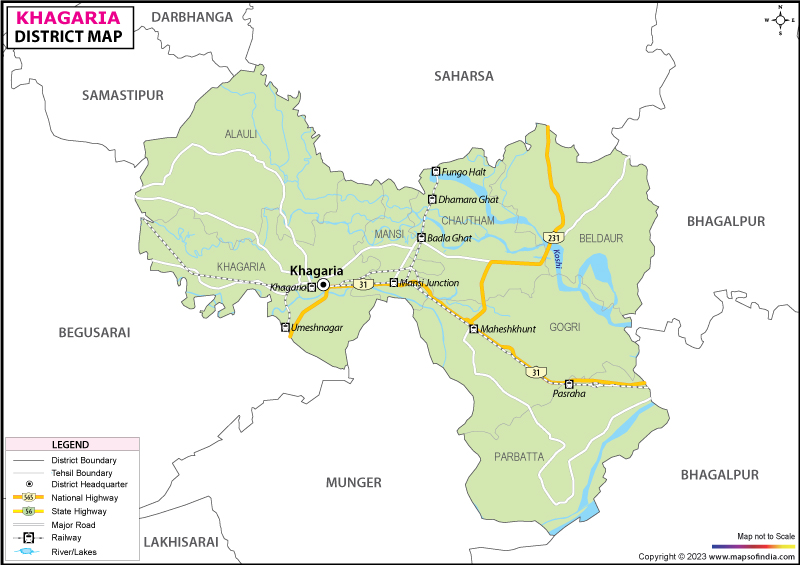
Besides administration, Khagaria district splits into blocks and subdivisions. Within this setup, areas like Gogri fall under major subdivisions along with Khagaria itself. Among the key administrative areas are Khagaria, followed by Gogri and Parbatta. Beldaur appears alongside Alauli in official listings. Mansi is part of this group, just as Chautham is included. Several other regions share similar status within the structure.
Over 1,200 villages lie within the region - local self-governance shapes how resources reach people. Governance unfolds through village councils that manage growth alongside social support systems. Flood control ranks high among government concerns, followed by farming policies. Infrastructure development shapes daily operations in many regions. Education systems receive steady attention across departments.
| Facts of Khagaria District | |
|---|---|
| Official Name | Khagaria |
| Location | Bihar |
| Area (km2) | 1485.8 |
| Population | 1,666,886 |
| Language | Hindi |
FAQs
Q1: What number of villages exist within Khagaria district?
Beyond twelve hundred hamlets dot Khagaria's map, scattered through its governing zones. Villages here stretch wide under regional oversight. Across subdivisions they sit, some tucked close, others miles apart.
Q2: What is the population of the district?
Around 1.6 to 1.7 million people lived in Khagaria district, the 2011 census showed. People counted back then made up its total number.
Q3: What is this district famous for?
Fertile fields define Khagaria, thanks to soil richness from yearly floods. Rivers shape the landscape, carving paths through flat expanses. People gather by water during Chhath, honoring tradition under open skies.
Last Updated on : June 24, 2026
