






About
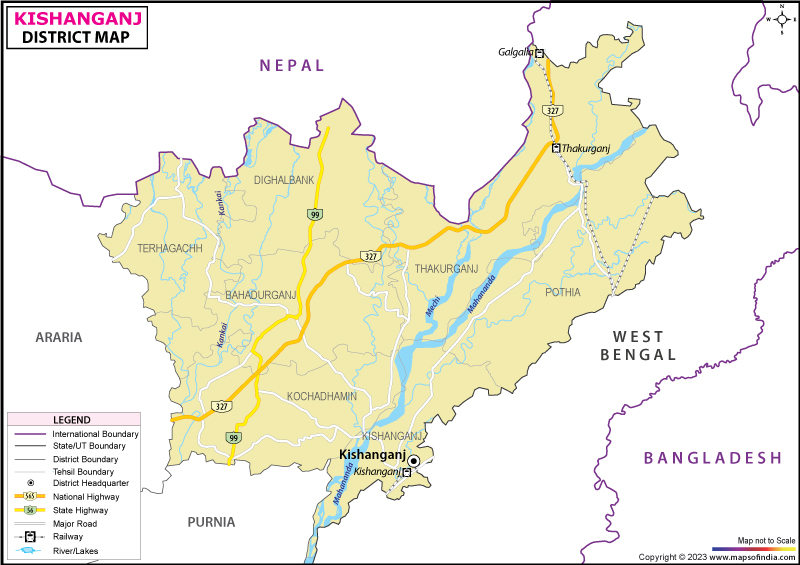
Situated in northeast Bihar, Kishanganj belongs to the administrative region known as Purnia division. Created from territory once within Purnia district, its separation followed years of persistent effort by residents - among them activists, elected figures, and agricultural workers - with recognition taking effect on 14 January 1990. Spanning approximately 1,884 square kilometres, the area meets several neighboring zones: Araria and Purnia lie nearby within state bounds, while beyond, Uttar Dinajpur and Darjeeling of West Bengal appear, along with international proximity to Nepal toward the northern edge - an alignment shaping its unique transboundary identity.
Predominantly rural, the area relies heavily on farming; tea plantations along with various crops cover much of the arable terrain. Home to a significant number of Muslims, it stands out as one of India's rare districts where they constitute the majority. Close proximity connects it to places like Kishanganj Fort, Khagra Mela, alongside numerous lakes and sacred locations - each enriching its heritage value. Though facing hurdles in progress, gradual expansion persists in governance, trade, and learning within this remote northeastern part of Bihar.
History and Culture
Eastward reaches of what today forms Kishanganj district once shifted hands across eras, molded less by central rule than by movement and contact along borderlands. At one time part of greater Purnea, it rested where flat lands met foothills near Nepal and Bengal edges. Power belonged not to empires directly but to local lords whose loyalty changed with distant decrees. Under Mughals, authority filtered through appointed deputies; land tied to Nepalgarh passed into oversight from Surjapur’s officers. That official gave it a new name - Alamganj - a title preceding its current identity. Among older residents, word has long passed down about a Hindu holy man who took issue with certain nearby designations - Alamganj, the watercourse known as Ramazan, and landlord Fakiruddin - names perceived too closely tied to Muslim origins. Because of his objection, territory once renamed Krishna-Kunj emerged under authority of the regional ruler. Over time, speech patterns shaped that title into what is now called Kishanganj. During periods governed by Britain, this area stayed grouped administratively within Purnia, developing little beyond farming settlements without major foreign-backed initiatives. Its classification as a minor subdivision persisted for decades inside that larger unit. Only after organized efforts, unfolding across years through gatherings of village elders, agricultural workers, and community advocates, did change take root. Instead of fading quietly into routine governance, momentum built toward autonomy. By 1990, official boundaries shifted; separation occurred. From Purnia came forth a new district, established shortly prior to year two thousand
Hindu shrines stand within walking distance of Sufi shrines; joint presence at gatherings, seasonal events, or rites occurs more by habit than announcement. Shared participation unfolds naturally during festivals - not staged, simply part of how things have always unfolded here. Voices rise in folk melodies sung in native tongues, telling stories of work, departure, longing, defiance - each tune anchored in lived experience. Seasonal fairs tied to farming cycles persist as moments when expression, movement, and memory converge outside urban control. Livelihoods once built on fields and tea plantations continue shaping values, even as old patterns shift under pressure. Rural existence remains central, where ties based on blood and marriage often matter more than official systems ever do. Over generations, proximity has produced quiet understandings - neither perfect nor proclaimed, just present. Hindi, along with Urdu, Surjapuri, and Bengali, forms the linguistic fabric here - the latter emerging due to closeness to the borderlands near Bengal. Spoken traditions thrive on proverbial expressions, regional idioms, yet remain grounded in everyday interaction patterns unique to the area. Hospitality often takes precedence in personal conduct; respect toward older individuals appears consistently across communities. Politeness shows itself subtly, present even within modest village environments where resources are limited. This cultural texture stands apart when compared to cities in Bihar shaped mainly by market influences. The presence of layered speech habits contributes quietly to how relationships unfold among neighbours
Economy
In Kishanganj, most people rely on farming for their living, given that fields stretch widely across the region. Thanks to rich silt deposits, regular rain, and moist air, staples like rice, corn, grain, and fiber plants thrive here. Alongside these, roots such as ginger and turmeric are cultivated, along with garden-grown items, adding value at market level. Work tied to planting cycles dominates job patterns; however, shifting rains often bring uncertainty, especially when rivers overflow or skies remain dry too long.
What sets the local economy apart is its focus on growing tea. Only one area in Bihar produces tea, and that is here; plantations have grown sharply in recent years, particularly around Thakurganj and nearby zones. Work tied to tea includes managing fields, gathering leaves, moving goods, along with minor processing tasks. These roles offer villagers extra income options outside usual agriculture. Support from public programs has treated tea as central to progress plans, deepening its importance in shaping the region's future.
Near West Bengal, Nepal, and the northeast passage of India, the area gains economic strength through movement of goods. Because of its position, exchange of products helps sustain community finances. Urban hubs see business flow from farm trading posts, compact shops, delivery networks, along with dealings across nearby regions. Living off poultry care, animal husbandry, or home-based crafts brings extra earnings to numerous families. Even so, factory growth lags when measured against major commercial zones. Limited manufacturing marks a contrast to more developed locations.
Tourism
Found among the north’s terrain, a stretch dedicated to tea farming stands out. Across gentle slopes, fields unfold - rare within Bihar - and reveal how tea thrives here alongside rural routines. Near Thakurganj, such estates draw those who favor quiet views over crowded sites. Open land and clean breezes shape conditions favorable to nature-based travel experiences.
Significance attaches itself to religious tourism here. Within this region rest numerous mosques, temples, and shrines - silent witnesses to enduring cultural harmony across centuries. During festivals or ceremonial events, people arrive from nearby towns and farther reaches, drawn by spiritual resonance rather than mere curiosity. Though seasonal, such visits shape patterns in travel movement throughout the year. Depth emerges not through monuments alone, but in how rituals unfold alongside shared customs among communities. Moments linger where meals carry ancestral recipes, market lanes breathe authenticity, and village routines speak volumes without spectacle. Experience grows quietly within these unscripted instances.
Flowing waters cross the area, while marshes and scattered woodlands nearby sustain birds and shifting patterns of life across seasons. Among these settings, walking becomes a way to encounter animals and spend calm hours outdoors. When protection measures exist alongside basic amenities for guests, locations like these may draw more interest from those studying ecosystems or seeking learning journeys tied to natural diversity.
Demographics
Young people form a large part of Kishanganj’s residents, most living in villages where farming shapes daily life. With nearly 1.69 million inhabitants counted in 2011, its numbers rank among the highest in northeast Bihar. Growth during the decade up to that year reached close to 30.4 percent, outpacing numerous regions across the state. Such increase has led to crowded conditions - nearly 897 individuals occupy each square kilometer. Land faces strain under this load, especially in countryside areas dependent on traditional livelihoods.
Most people call villages home - over ninety out of every hundred dwell outside cities. Town life touches just a fraction, leaving urban growth minimal. The countryside shapes how jobs form, where homes stand, how schools operate, and who reaches hospitals. Work ties closely to farming; daily survival links to soil and seasons. Households stretch wider here compared to elsewhere, often holding many children under one roof.
Of every thousand males, nine hundred fifty females reside here - a proportion seen as stable when measured against nearby areas. Among children, the balance between boys and girls appears slightly better than average. Despite this, reading and writing skills across the population show lagging progress. Slightly more than half the people can read, though the number shifts sharply by gender. Over sixty-three percent of men demonstrate literacy, compared to less than forty-seven percent of women. Where education falls short, it does so most clearly along lines of gender. Improvement may depend on sustained support systems that reach underserved communities first.
In terms of religion, diversity marks the region - Muslims make up most, while Hindus form a notable share, along with people following several other beliefs. Shaped by this mix, culture thrives in shared celebrations, daily customs, and neighborhood interactions. Youth define much of the area; growing skills, better learning access, and rising numbers suggest lasting societal momentum ahead.
Administration
Within Kishanganj, administration unfolds through systems designed for governance, services, public progress - spanning towns alongside villages. Governed as part of Bihar, oversight flows through the District Magistrate, titled Deputy Commissioner within official usage, holding primary executive duties regionally. From this position stems responsibility: managing civil peace, guiding land and tax matters, aligning growth initiatives, directing emergency responses, carrying out policies from higher levels of government. Such authority operates where regulation meets community support, shaping how direction takes form locally.
Divided for ease of oversight, the area organizes governance through tiers - subdivisions, blocks, and gram panchayats - that extend authority into rural settlements. Three such subdivisions make up Kishanganj district: Kishanganj, Bahadurganj, and Thakurganj. Because these divisions exist, tasks like collecting land dues, managing legal matters, and delivering services grow more manageable locally. Beneath them operate community development blocks, each serving as hubs where farming guidance, school initiatives, medical outreach, road work, and regional planning take shape. Where elected councils hold responsibility, village-level progress gains structure; under the Panchayati Raj model, locals guide choices, set priorities, and carry out social benefit efforts. Though distant from urban centers, these layers ensure decisions do not drift far from those affected.
Managing cities happens via local institutions responsible for trash collection, path upkeep, runoff systems, light posts, clean water delivery, because they handle everyday community functions. Because populations rise, such organizations become necessary to meet demands while preserving shared structures across neighborhoods. Education, medical care, farming support, well-being programs, construction tasks proceed using regional branches so state aid accesses varied population groups. When those divisions exchange information, progress strengthens within villages along with metropolitan zones.
From time to time, stability in society depends on organized oversight led by the Superintendent of Police. Under this authority stands a network of officers tasked with monitoring conduct, discouraging unlawful acts, with safeguarding residents as a central aim. Scattered throughout rural zones and administrative divisions, outposts serve as contact points linking civil operations to community needs. When storms arrive without warning, leadership shifts toward handling water surges that follow intense downpours. Rivers beyond capacity often test readiness, requiring structured aid delivery when conditions worsen.
| Facts of Kishanganj District | |
|---|---|
| Official Name | Kishanganj |
| Division | Purnia |
| Area (km2) | 1,884 |
| Population | 1,690,400 |
FAQs
Q1: How many villages are there in the district?
771 (revenue villages).
Q2: What is the population of the district?
1,690,400 (2011 census)
Q3: What is this district famous for?
It’s the only region of Bihar producing tea.
Last Updated on : April 17, 2026
