






About
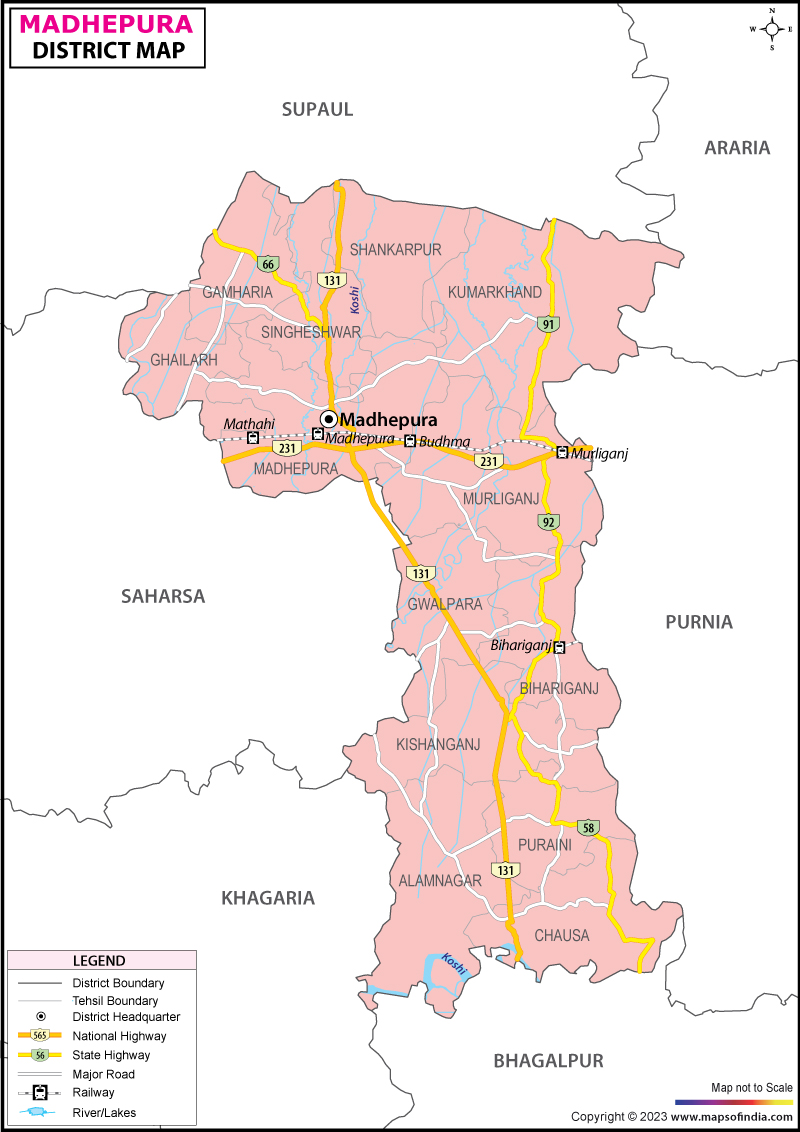
Madhepura district is the important district of Bihar state which is in the North Eastern part of the state, in Kosi region. Madhepura is headquarter of this district. The district has fertile soil, a riverine topography and educational institutions, it is also famous for its rural Bihar culture and traditions. Kosi basin rivers' presence has made the social and economic life of the Kosi affected area as unique one. The Madhepura district map, displayed by many researchers and travellers is helpful in preparation of geography of north Bihar and Kosi belt of the flood prone plains.
Madhepura district can be bordered by some districts like Supaul, Saharsa, Purnia, Khagaria etc. It has a rural character and an area of 1788 sq.km. Agriculture accounts for most engagements and a few small-scale industries, transport, and the education sector are growing. The Madhepura district map is also informative, as it illustrates the building of blocks, villages, roads and rivers that link Madhepura to the neighbouring districts in Bihar.
History and Culture
The story of Madhepura District is linked with the history and culture of Mithila and Kosi region. The district has always been an integral part of the ancient Mithila region, with a heritage of scholarship and spirituality, traditional learning and education. British colonial and Mughals rulers, along with other rulers and chieftainship conquered the area many times.
The area went through significant reform of land administration and agriculture during the British rule. Periodic changes in the course of the Kosi River leading to a recurrent flood of the river with devastating effects, and shifting the human settlements in the district. Such flooding impacted village life, communication and the cultivation of agriculture, but also added to the fertility of the land. The District map of Madhepura is used to build up knowledge of the role of rivers in habitation and transport at different time periods in the study of riverine settlements.
Madhepura is also important in modern history of Bihar because it had formed a great political significance during that period. The district has a number of association with popular political figures like Bindeshwari Prasad Mandal who gave its name to the famous Mandal Commission. The commission marked a historic milestone in the policy making of the socially and educationally backward classes in India. This history leads to the district's significant role in issues of social justice and democratic participation.
The cultural life of Madhepura is in accordance with the tradition of village of Bihar. Festivals like Chhat puja, Holi or Diwali, Eid, Durga puja are celebrated in good manner with the participation of the community. Chhath is a special puja undertaken in the name of Sun God which is of much importance in this district. There are activities of villagers around water bodies and ponds where they are worshipped with devotion and discipline. Traditional folk music, cultural expressions of Bhojpuri culture and Maithili and fairs of the village continues to be a significant element of the region's identity.
Hindi, Maithili and local dialects associated with Kosi region are the predominant languages in the district. The social character of the district is highlighted by the traditional hospitality, hospitality and community life of the countryside. The map of Madhepura district is regularly consulted by cultural researchers in the process of documenting the fairs, the temples, settlements as well as the traditional routes related to their cultural heritage.
Economy
The economic activities of Madhepura district are mostly agriculture-based and for majority is the main source of livelihood. The main crops grown in the district are paddy, wheat, maize, pulses, sugarcane, and oilseeds. The alluvial soil of Kosi carries water and nutrients which make the land fertile for farming; however, the inundation frequently causes problems for the farmers. Agricultural markets and rural trade centres are available in many places throughout the district, and planners are frequently able to make use of the Madhepura district map, to support the identification of irrigation patterns and transport connections.
The Government Sector has jobs in district administration, education, healthcare, the police, and local government. With the last few years the number of Government Schools, Colleges and Welfare Schemes has increased with great leaps. Other economic activities, such as public investment in roads, bridges, rural electrification, and flood management have also helped the economy. The administrative development projects are generally designed taking the Madhepura district map into consideration, to ensure proper connectivity between the blocks and villages.
The Public Sector has developed slowly, with infrastructure for railways, education which has been supported by the State, and rural development schemes. Madhepura is especially famous for the industrial development of locations around it linked to the manufacture of locomotives and iron rails. Agricultural, housing and employment generation support mechanisms continue to have an impact on the district economy.
There has been steady growth in the Services Sector with the establishment of banks, retail trade and transport services, coaching centres, medical facilities and communication facilities. Coaching institutes and private as well as semi-urban schools are emerging as the key employers in the urban areas and semi-urban areas of the district. Household incomes are also generated from small businesses, local stores, transport companies and mobile service centres.
There is also migration as an important economic factor. A majority of people migrate from Madhepura to bigger towns and cities in India to find jobs in the construction, transport, hospitality and other sectors. Remittances of migrant workers contribute to rural households and local markets. In spite of the problems of infrastructure, the district still makes a move towards economical integration towards better economy of Bihar and India.
Tourism
Though Madhepura district is not extensively promoted as a tourist area, it does have its religious, cultural and natural appeal with some features which are common to the identity of Koshi region. The Madhepura district map serves as a guide for travellers and researchers to find temples, centers of pilgrimage and rural heritage sites located throughout Madhepura district.
One of the most important religious places in the district is the Singheshwar Temple located in Singheshwar. This Temple is dedicated to Lord Shiva, many visitors especially during festival of Shivratri visit. It is a yearly fair that is held around the temple and brings traders and pilgrims from various parts of Bihar and other neighboring states. The temple town is a vital centre of religion and cultural interaction.
Some water bodies and wetlands can be interesting in the winter for nature enthusiasts and those looking for countryside views. Traditional festivals and fairs are held to motivate cultural tourism and social events. Madhepura district map is a map that can be used to identify the route for tourists, between rural landmarks and religious places, in the Madhepura district.
Frequently visitors and scholars visit educational institutions and historical places associated with political figures of Bihar. Two major groups of people visit the sites connected with the Mandal family and Bihar's participation in democratic politics: There is little attention being paid to rural tourism, associated with traditional village life, local food and local culture.
Gradually, the development of the transportation system has increased accessibility to the district from its cities nearby like Saharsa, Purnia and Patna. Inner mobility has been improved by roads linking the main blocks of land with the main towns. The features of the Madhepura District map are constantly used by travellers when they are planning to visit and travel to the Madhepura district as several attractions are situated in the rural areas away from the main highways.
Demographics
Census 2011 data has shown that there were around 2001762 people residing in Madhepura district. Its population density was of the order of 1120/ km2 which is quite dense for north bihar. The population is mainly rural, and the urbanisation rate is relatively small. Madhepura district map is normally used by the demographers for analysing population concentrations and settlement distribution with block and villages.
As per the 2011 Census, the district's literacy rate was around 52.25 per cent. Overall, male literacy level was higher than female literacy, but there was steady progress in years towards the awareness in education. The government schools, colleges and literacy programs have helped in the development of education both in rural and urban area. This Madhepura district map is widely used to develop planning in education and in agro-statistical studies to understand development.
The main administrative language of the district is Hindi and the local communities use Maithili and regional dialects as their native language. Urdu is also spoken at a few places. The linguistic makeup of the district is a reflection of the overall cultural makeup of the Mithila and Kosi regions. They have a variety of communities and caste groups within the social structure of the district, which adds to its cultural and social fabric.
Administration
Madhepura is one of the districts of Bihar and it has been organised in to various subdivisions and community development blocks. The District Magistrate heads the administration of the district and is responsible for over-seeing the rule of law, programme of development, welfare of the public and administration of revenue.
Alamnagar, Bihariganj, Chausa, Gamharia, Gwalpara, Kumarkhand, Madhepura, Murliganj, Puraini, Shankarpur, Singheshwar and Udakishunganj are some of the significant tehsils blocks of the district. Madhepura district map is frequently utilized at the administration offices, planning office for organizing governance and building the infrastructure, and in the event of disaster in the flood prone region.
There are hundreds of villages in Madhepura district spread in the fields and villages. The district has over 400 villages as a whole, as per different sources the number of villages varies according to the inhabited and uninhabited classification. The panchayati raj is a dynamic system in the area of local government, rural development. There is a lot of use of a mapping of Madhepura District is used widely by local authorities to delineate boundaries of villages, forms of road and embankment tracks and administrative blocks.
FAQs
Q1: What is the total number of villages in Madhepura district?
Madhepura district has more than 400 villages, with administrative records commonly mentioning around 421 villages.
Q2: What is the population of Madhepura district?
According to the 2011 Census, Madhepura district had a population of approximately 2,001,762 people.
Q3: What is Madhepura district famous for?
Madhepura district is famous for the Singheshwar Temple, its agricultural economy, and its association with the Mandal Commission legacy.
Last Updated on : June 24, 2026
