






About
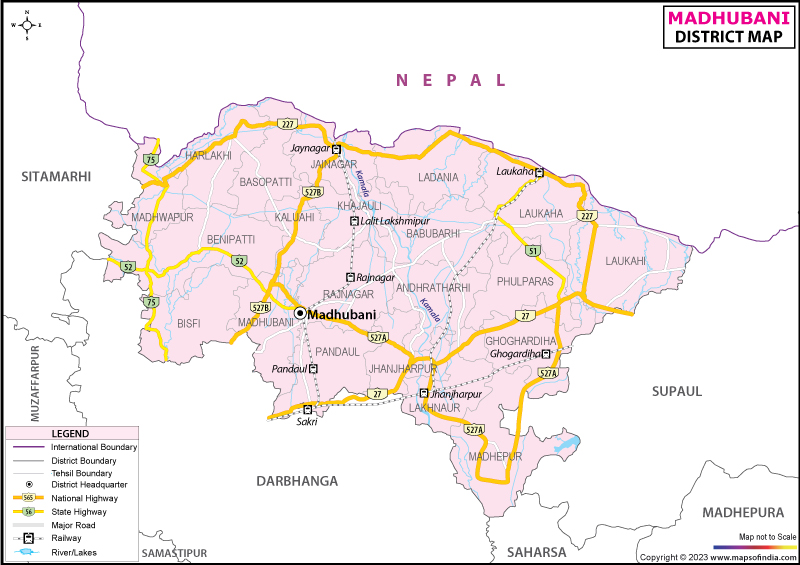
Madhubani district, situated at the northern corner of Bihar towards Nepal, is proud of its cultural heritage and fertile agricultural environment. The area is in the Mithila region, a historic area with regard to ancient learning, art, and tradition. It is also intersected by a number of rivers among which are tributaries of the Kosi and as such the soil is highly suitable in farming though seasonally prone to flooding.
Internationally famous is the traditional style of the district in terms of painting which is famously referred to as Madhubani art. Locally produced art with unique patterns and natural colors makes this type of expression practiced by local artisans and has become internationally acclaimed. The economy of the area is primarily agricultural in nature with crops like rice, wheat, maize and pulses being extensively cultivated.
History and Culture
Madhubani district is situated in Bihar (in the North-Eastern region) and is part of the ancient Mithila region that has served as a centre of culture, place of learning and artistic expression ever since ancient times. The region has traditionally been linked to the old kingdom of Mithila that was under the rule of King Janaka who has high frequency reference in early Indian literature. This relationship has also led to the ancient history of the area as a center of intellectual and philosophical life.
Mithila grew to be a centre of learning, especially in religious studies, philosophy and logic, in ancient and early medieval times. Local scholars made numerous contributions to the various schools of thought and the culture of learning persisted through the centuries. This legacy is the continuation of cultural practices which still can be seen in the social tradition and the local practices.
The painting tradition of the district, popularly referred to as Madhubani art, is one of the most prominent cultural characteristics of the region. This type of decoration on the wall and floor began as a kind of decoration that was produced in rituals and special events, principally weddings. With time, it advanced to become a legitimate art form that is practiced on paper and canvas and has become well known internationally. The paintings are characterized by complex designs, symbolic themes, and application of natural colors, and usually depict mythical, natural and everyday life themes.
The community practices, rituals and the emphasis on festivals of the seasons are the strong bases of the cultural life of the region. The music, dance, and other traditional practices used during the celebrations are generation-old. Marriage rituals are grand and there is a strong belief in following ancient customs and they are usually accompanied by ritual decorations and paintings.
Language is very important in upholding cultural identity, and the Maithili language is popular together with Hindi. The Maithili literary traditions have over time been very fruitful, enriching the local culture.
The district has managed to maintain its culture despite changes in political control in history, which have seen the district being under several regional and colonial regimes. The impact of various periods could be seen in the local architecture, social life organization and arts.
Economy
Madhubani is a district whose economy largely relies on agriculture, which sustains most people. The area is also suitable in the cultivation of crops like rice, wheat, maize and pulses due to the fertile alluvial soils and supply of water through various rivers. The production in the agricultural sector is seasonal and Monsoon greatly determines the production levels. This notwithstanding, there is a challenge of agricultural stability due to the frequent occurrence of flooding in some areas which in most cases impacts on crop yields and livelihood.
Livestock rearing is also a significant part of the rural economy along with crop farming. Rearing cattle, goats and poultry is also a common practice, which absorbs an additional income and provides for the household. Fisheries too, are a source of economy in the area with fish ponds and water bodies being used in fish farming, especially in areas where agriculture is unpredictable due to flooding.
The art tradition of the area is another distinctive characteristic of the economy that is known worldwide. Madhubani painting has also grown to be attained as a domestic ritual, as well as a major income generator to numerous families. Artisans create pictures on paper, cloth and other surfaces to sell to the local and global markets. This industry does not only maintain the cultural heritage, but it also provides a source of livelihood particularly to women.
There are small industries and cottage businesses but in limited size. The market centers are local and here agricultural products, handicrafts and daily necessities are traded. Much of the economic activity is informal and large industries or manufacturing enterprises are small.
The growth in infrastructure has been slow and development of roads, connectivity and accessibility to neighbouring towns have contributed towards economic events. Nevertheless, the district still is challenged with underemployment, seasonal reliance on farming, and the lack of industrial development. Migration to cities and other states for better employment opportunities is common.
Economic development has been aided by government programs to bring rural areas into development, train on skills and advancement of handicrafts whose benefits vary in different areas. There are continuous efforts towards development of irrigation, increased accessibility of the market, and so on.
Tourism
Madhubani tourism is focused on its rich cultural heritage, the traditional art forms, and religious sites hence can be an essential destination place to visit in the region to learn about the history and living traditions. In comparison with other large urban touristic centers, the district is a more immersive cultural experience, which is based on the daily life of the Mithila region.
The major attraction here includes the Madhubani tradition of world-famous painting. This kind of art work has attracted tourists visiting the villages where it was first evolved and where it has since grown to this day. Homes have their walls painted, with elaborate patterns containing mythology, nature, and such symbolic designs. Tourists can also view artisans working and buy handmade paintings as cultural souvenirs and a source of generating livelihood to the local populations.
The other sector is religious tourism which is quite prevalent in the district. Some of the well-known temples like Kapileshwar Temple and Uchchaith Bhagwati Temple are great tourist attractions that receive locals in the areas. These locations are linked to long-standing customs and beliefs of the areas, and they become particularly alive during the festival times. Visitors come all year round, which adds to the year-round visitor flow and local economy.
Occasions such as the Saurath Sabha, which was traditionally referred to as a gathering to arrange marriages among some communities, throws some light on some interesting social practices. Despite the fact that its role has changed throughout history, it continues to attract visitors interested in the practices of the region.
The rural environment by itself is a tourist draw, and its farmlands, local markets and the local community offer a peep into the traditional life forms. The visitor experience is also enhanced with seasonal festivals, music and rituals, making cultural interaction possible.
Tourism infrastructure is improving slowly with roads being upgraded and primitive accommodation facilities. The sector has however had the problem of less high end hospitality services and a need to market it better at the national and international levels.
Demographics
The demographic profile of Madhubani district depicts the majority of population as rural with most of the population residing in villages and relying on agriculture as their means of living. The Census of India 2011 gave the district population of more than 4.4 million people, as counted, and this means that the district is one of the more populated areas in Bihar. Population density is elevated, in line with the overall trends on the north plains of the state.
The district sex ratio is a bit lower than the parity point, having fewer females as compared to males but it is similar to the general state pattern. There has been a gradual increase in literacy rates and these are still lower than the national average. Male and female literacy are visibly differentiated with men enjoying more access to education than women. Government and non-governmental efforts have helped in improving school attendance, particularly by the younger generations.
Socially the population is varied as it includes different caste groups and communities. A considerable part of the population includes Scheduled Castes and a considerably small minority Scheduled Tribes. Religiously, most residents are Hindus with a significant Muslim minority and small communities of other religions.
Linguistics is a significant ID in the area. Maithili is frequently used in the daily life, and on the official and educational levels, it is also covered with Hindi. Today, the continuation of Maithili is important in preserving the culture.
The working-age group constitutes a big percentage of the population, but jobs are frequently scarce, seasonal since agricultural services are relied upon. It is usual to migrate to other states, or urban areas, to work.
Administration
Madhubani district, the administrative system, is a typical model of district administration in Bihar, which is a mixture of state and local institutions. District Magistrate (DM) is the chief administrative officer in charge of the district. The DM oversees the administration of revenue, maintenance of law and order and the implementation of the government policy and programs of development. The Superintendent of Police is in support of this role; he manages policing and public safety.
To provide effective governance the district is partitioned into a number of subdivisions each headed by a Sub-Divisional Officer (SDO). These divisions can further be divided into blocks which serve as essential administrative units to the rural administration. At the grassroots, Block Development Officers (BDOs) organize development work, such as agricultural development, rural infrastructure development, health services, welfare schemes.
The Panchayati Raj system is at the grassroots stage and is at the centre of governance. Gram Panchayats composed of elected officials must deal with local problems, resources, and development projects in the villages. This is a system whereby the government encourages the people to be involved and governance is brought to the rural people.
Municipal bodies in the district, including nagar panchayats and municipal councils control the urban areas. These institutions are dealing with civic services such as water and sanitation, garbage collection and local infrastructures. Administrative officials are elected to work with the elected ones in controlling urban governance and development.
| Facts of Madhubani District | |
|---|---|
| Official Name | Madhubani |
| Division | Darbhanga |
| Area (km2) | 3501 |
| Population | 4,487,379 |
| Region | Mithila |
FAQs
Q1: How many villages are there in the district?
1,115 villages.
Q2: What is the population of the district?
4,487,379 (2011 census).
Q3: What is this district famous for?
Naulakha Palace, Kapileshwar Temple, Saurath Sabha Gachhi, Mithila Haat, Uchaitha Bhagwati Temple, Bhawanipur Ugaranath Temple, Ranti Village, and the Madhubani Railway Station art gallery.
Last Updated on : June 24, 2026
