|
||||||||||
| ||||||||||
|





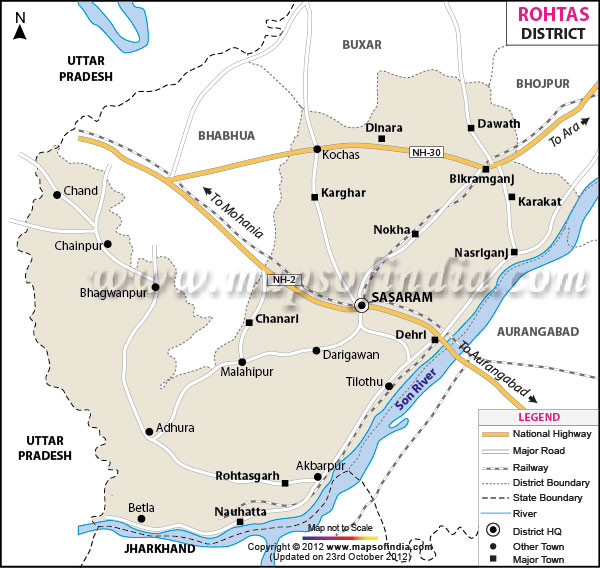
| *Rohtas District Map highlights the National Highways, Major Roads, District Headquarter, etc. |
About
Situated in southwest Bihar, Rohtas district carries deep roots in history, nature, and tradition. Named for the prominent Rohtasgarh Fort, it reflects enduring significance through time.
Sasaram holds the role of main office for the region, standing out as a hub where governance and business meet. From a long time ago, its name links closely to Sher Shah Suri, a leader whose reach shaped much of medieval India's course. Connections by road and rail stretch toward large urban areas such as Patna and Varanasi without delay. Movement of goods, people, and growth follows these routes with steady rhythm.
Standing apart, the district draws distinction through layers of past life, traditions, then wide green landscapes. While old fortresses rise near winding waterways, quiet mounds hold stories beneath their surface. This balance - between what remains from earlier times and present development - shapes much of its character. Not far removed, economic currents flow alongside cultural roots, shaping how people live now. Seen from another view, Bihar's sense of self finds an anchor here, not by force but by steady presence.
History and Culture
Long before modern borders took shape, Rohtas held quiet significance through shifting eras. Ruled by forces far-reaching as the Maurya and Gupta, its soil saw layers of imperial ambition settle. Position mattered - perched where trade and troop movements crossed, oversight came naturally. During medieval centuries, prominence rose sharply, tied closely to a leader shaped in Sasaram: Sher Shah Suri. Noted less for conquest than structure, he reshaped governance while laying pathways others would follow. One such route - the Grand Trunk Road - brought distant regions into steady contact, altering movement across the north.
Perched high in the hills stands the Rohtasgarh Fort, notable among the region's historic landmarks. Its elevated position made it a favored defensive site through many reigns. Found in Sasaram, the tomb dedicated to Sher Shah Suri draws attention for both scale and heritage significance. Though separated by terrain, each structure reflects enduring influence across time.
Rohtas carries forward Bihar's cultural roots, yet stands distinct in character. With particular intensity, celebrations unfold throughout the year - Chhath Puja being central due to spiritual significance. Along riverbanks and beside still waters, groups assemble at dawn and dusk to honor Surya. Beyond that observance, Holi brings color, Diwali lights homes, Eid gathers families, Durga Puja fills neighborhoods with rhythm - all marked across community lines. Such occasions reveal quiet coexistence woven into daily life.
In Rohtas, speech centers on Hindi, though Bhojpuri appears often in everyday exchanges. Music shaped by tradition holds weight here, particularly when celebrations gather momentum. Weddings bring out voices raised in folk tunes - moments where sound carries heritage forward. Movement matters too; local dance steps echo a way of living both humble and rich in color. Customs unfold slowly, revealing patterns older than memory through quiet ritual.
Folks here eat much like people across Bihar do - litti-chokha turns up regularly, alongside bowls of dal, steamed rice, together with whatever greens are in season. Khaja along with thekua sweeten moments, particularly when celebrations arrive. Life flows around customs passed down generations; kinship matters deeply, so does shared existence among neighbors.
Economy
Farming stands at the core of Rohtas district’s economic activity, followed by manufacturing units shaping its industrial base. Alongside these, service-oriented functions have slowly gained ground over recent years. This mix supports broader progress within Bihar, contributing in quiet but steady ways. Influence spreads beyond local borders, linking rural output with regional needs. Here many find work within public institutions. Offices, schools, clinics, and regional bureaus employ significant numbers across locations. Support flows through state-backed programs focused on farming, learning, countryside growth, and structural upgrades. Roads, water channels, power access - each contributes quietly to daily life in villages and towns alike.
Once home to bustling factories, it saw economic life centered around places like Dalmianagar. Cement production stood alongside paper mills, chemical plants followed close behind. Thousands found work because of these operations, livelihoods tied directly to factory output. Over decades, activity slowed, machinery fell silent in many zones. Yet recent moves aim at restarting momentum, new plans slowly taking shape across the region.
Despite their size, small industries sustain economic activity across the region. Brick production, milling operations, among others rooted in agriculture form part of this base. Owing to deposits found close by, minerals further enhance what the area can offer economically.
Steady growth marks the services sector across the district. In places such as Sasaram, education alongside health offerings see gradual expansion. Employment emerges through schools, colleges, and tutoring institutes, drawing learners from surrounding districts. Meanwhile, banking operations, shop-based trade, and movement of people or goods back the regional economic structure. Growth unfolds without sudden spikes, yet remains consistent.
Rooted in Rohtas, cultivation shapes daily life. Wheat appears in fields alongside rice, pulses fill storage spaces, while oilseeds grow between seasons. Fed by river currents - especially from the Son - the soil stays rich enough to nurture harvests year after year. Livestock care turns into quiet earnings for families living beyond city limits. From barns tucked behind homes, milk flows steadily into local networks.
Tourism
Few places carry history like Rohtas, where ancient traces meet quiet landscapes. Its sites unfold across time, shaped by tradition rather than trend. Stone remnants stand alongside fields untouched by haste. Culture here moves through gesture, not display. Nature appears without announcement - simple, unframed. Each location holds space without demand. The past remains present, though never loud.
Perched within the Kaimur range stands Rohtasgarh Fort, a site widely recognized across regions. Its vast construction emerges amid sweeping natural views, capturing attention through scale alone. Visitors drawn by heritage often arrive alongside those pursuing rugged terrain experiences.
A different highlight stands at Sasaram - the resting place of Sher Shah Suri. Positioned within an expansive reservoir, the structure rises as a key instance of Indo-Islamic building tradition across India. From afar, its scale draws attention; up close, calmness takes hold. Because of both form and setting, visitors often find themselves returning. Though centuries old, the presence feels undiminished by time.
Among temples honoring Lord Shiva, one finds the Taraknath Temple standing out. Devotees arrive steadily across months, though numbers rise sharply when Shravan begins.
Among the area's natural features are waterfalls alongside hilly terrain within the Kaimur zone - these form quiet backdrops suited to walking through forested slopes. Standing along the Son River, the structure at Indrapuri rises as a feat of design where water meets landscape in balanced contrast.
Among these sites lies a quiet balance of past, belief, and landscape. Where old stones meet devotion, green valleys stretch beyond view. One finds traces of empires under banyan shade. Temples rest beside rivers shaped by time. Each location carries weight without display. Through layered rock and prayer alike runs continuity. Not far from ruins grow forests thick with stillness.
Demographics
Spread across fields and small towns, Rohtas holds nearly 3 million residents. This number comes from up-to-date records showing its size. Culture here carries many shades, shaped by lives in hamlets and modest settlements. Most individuals reside beyond city limits. Villages house the greater part of those counted. Diversity marks daily life where traditions blend without fanfare.
Among districts in Bihar, Rohtas stands out with a literacy rate near 73%. Because of sustained focus on learning, youth now face broader prospects. Progress unfolds slowly where classrooms serve as quiet engines of change. Among spoken forms, Hindi holds official status across the region. Yet it is Bhojpuri that fills homes and streets in routine exchange. Each tongue shapes how people connect, not only through words but also tradition. Rooted in usage, they form quiet pillars of belonging.
A blend of varied communities defines the region, coexisting through shared regard and peaceful interaction. Though growth appears steadily in centers such as Sasaram, village-rooted customs remain influential across social life. Despite modern shifts, heritage practices continue shaping daily conduct in quiet yet meaningful ways.
Administration
Among administrative units, Rohtas district organizes its structure through subdivisions alongside blocks. Notable among these are Sasaram, followed by Bikramganj and Dehri. Within each subdivision exist blocks together with gram panchayats managing grassroots tasks. Local oversight along with developmental activities operates at this level.
Among the many villages lies a form of administration led by local panchayats. While carrying out state initiatives, these bodies also respond to community-specific concerns. Because authority is spread across levels, progress often extends into distant regions. Each settlement functions under its own council, contributing to broader regional management.
At the top of local governance stands the District Magistrate, tasked with upholding legal stability while guiding policy execution alongside regional progress efforts. Security across the area falls under the supervision of the Superintendent of Police, whose role centers on public protection through structured enforcement measures.
Across multiple tiers, education, health, farming, alongside public infrastructure function to advance societal progress. Lately, steps toward digital administration have emerged, enabling smoother entry into state-run systems. Growth in physical networks - roads, power supply - is unfolding at a steady pace, driven by needs for wider reach and integration.
| Facts of Rohtas District | |
|---|---|
| Official Name | Rohtas |
| Location | Southwestern Patna, Bihar |
| Area (km2) | 3881 |
| Population | 29,59,918 |
| Language | Bhojpuri, Hindi, English |
FAQs
Q1: How many villages are there in the district?
Rohtas district has around 1,400–1,500 villages, which are managed under different gram panchayats.
Q2: What is the population of the district?
The population of Rohtas district is approximately 3 million people.
Q3: What is this district famous for?
The district is famous for the historic Rohtasgarh Fort, the tomb of Sher Shah Suri, and its rich cultural and historical heritage.
Last Updated on : June 24, 2026
