






About
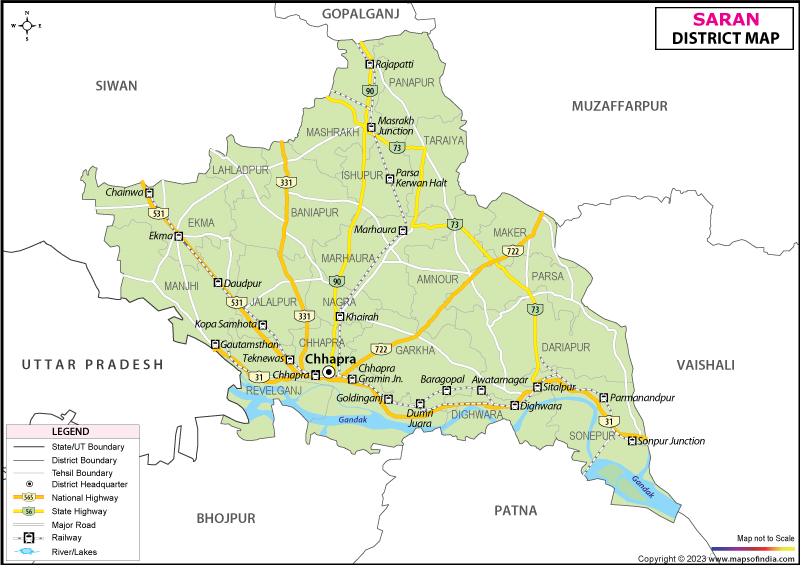
Located within Bihar, the Saran District holds significance due to geographical placement along major rivers. Shaped largely by the flow of the Ganga and Ghaghara, it presents broad stretches of rich soil where farming thrives. Because of these conditions, villages appear close together across flat expanses. Over centuries, movement of goods and shifts in governance left deep marks on local identity. Chhapra serves one such focal point - where decisions are made, commerce occurs, routes converge. History here unfolds through layers rather than single events.
History and Culture
The historical as well as cultural context of Saran depicts a long period in the form of geographical location in the fertile plains of modern-day Bihar. People have been living in the region since prehistoric times; it is blessed with the closeness to major rivers like the Ganga River and the Ghaghara River.
The area was part of strong political organizations like the Magadha kingdom in the early historical period and this had a significant influence on the development of the early Indian civilization. Under the rule of the Maurya Empire, administrative structure, trade routes and cultural organizations were greatly diversified. This was then succeeded by the Gupta Empire commonly known as a golden age, as art, literature and education thrived throughout the region. The area was not at all continuously at the political centre, but was, nevertheless, associated with these bigger imperial structures and picked up their cultural influences.
In the medieval times, the area fell under the jurisdiction of other dynasties that had been either part of the Delhi Sultanate or the Mughal Empire. These periods brought new forms of administration, architecture and cultural experiences, especially through the influence of Indo-Islamic cultures. The presence of multiple religious groups during this period led to the creation of a multi-dimensional cultural context that remains present in local culture and social behavior.
During the colonial era, the district became famous because of its agrarian policies. It was incorporated in the Bengal Presidency, where colonial economic policies had a great impact on agrarian relations and rural society. It was also a part of the nationalist movement as a whole, with local involvement in both anti-colonialism and social reform movements. These experiences defined contemporary political awareness and society.
The culture of the region is well rooted in the culture of the Bhojpuri speaking belt. Bhojpuri language is a major source of daily communication and cultural expression which is manifested in folk songs, oral tradition and festivals. Local folk theatre and seasonal songs are all important in the preservation of the local heritage. Festivals such as the Chhath Puja have great cultural importance and they focus on the connection between people, nature as well as spirituality, especially in terms of rituals performed on the riverbanks.
Agricultural cycles, religious beliefs, and practices within the communities still affect social life. Fair, local markets and religious meetings are places of cultural exchange and continuity. The limited scale of handicrafts and traditional practices aids the conservation of the skills and systems of knowledge of indigenous people.
Economy
Saran and the economy of the state is largely agrarian as it reflects the economic model prevalent in the north of Bihar. The plains with rivers like Ganga River and Ghaghara River deposit fertile alluvial soil as well as water. Agriculture is the primary source of income for a large part of the population and the agricultural production comprises crops such as rice, wheat, maize and pulses. However, seasonal changes and the reliance on monsoon still affect productivity, but to some degree irrigation is done by the river channels and local water sources to supplement rainfall.
The economy follows traditional agricultural practices with some gradual adoption of modern agricultural techniques which include use of improved seeds, fertilizers and the use of mechanized tools. The agrarian structure is dominated by small and marginal farmers which tends to restrict large scale productivity and investment. Besides agricultural production activities, livestock farming, especially cattle and goats has an auxiliary role in supplementing rural incomes and sustaining the household economies.
Local markets and local town centres are the focal points of trade and commerce in the district, with Chhapra being a major centre of commerce. These networks also trade agricultural produce, dairy products, and the daily goods, between the rural producers and the consumers in the locale. It is also supported by weekly markets and periodic fairs that circulate goods and services thus making an indispensable segment of the informal economy.
Industry has not been developed and only small-scale industries and cottage industries are involved in economic activities. These consist of agro- based units, food processing, handicrafts and traditional manufacturing practices. Although such industries offer local level employment opportunities, the scale and infrastructure are not present as in bigger industrial areas.
Tourism
The scale of tourism in Saran is small when compared to the Bihar pilgrimage centres but its regional significance lies in its cultural heritage, riverine landscape and historical identities. The confluence of several large rivers including the Ganga River and the Ghaghara River offers a picturesque and spiritual place which draws a crowd of people especially during religious events.
Harihar Nath Temple which is located near Sonpur is one of the main attractions. This is a significant Hindu worshiping place. The renowned Sonpur Mela, one of the biggest customary fairs in South Asia is held every year during the period of Kartik Purnima and attracts thousands of pilgrims, traders and tourists. The fair, which had a history of trade in cattle large-scale, has now become a colorful representation of cultural celebration with folk music, art, local food and religious practices.
Chhapra, the administrative centre also provides a point of entry and gives a glimpse into the local life and local markets. It is not a significant tourist destination; it links others in the surrounding areas and helps in travelling facilities including transport and accommodation networks. The rural setting of the district, that has been interlaced with riversides and fields, enables the view, and the festivals that take place during the seasons.
Demographics
The 2011 census of India shows the population of the district to be more than 3.9 million people and is one of the most populated in the state of Bihar. The population is distributed with majority people living in rural areas and the rest are concentrated in urban centres like Chhapra which serve as the seat of administering, trade and services.
The density of the population is also quite high and as such there has been strain on land and resources especially in agrarian environments where land holdings are usually small and divided. The sex ratio in the district is a little less than national average in the sense that the ratio shows fewer females per one thousand males. There is a gradual improvement in literacy rates over time although it is still below the nation average. A pronounced gender difference continues to exist where men are highly literate compared to women, underscoring the existing differences in access to education.
The social set-up is heterogeneous and different caste groups constitute a part of the population structure. A major percentage is composed of Scheduled Castes and a minor percentage is composed of Scheduled Tribes. Such social diversity determines the settlement, occupation, and resource access. The religious makeup is mainly Hindu with a significant number of Muslims and minorities of other religions which have made the society pluralistic.
The language is dominated by the Bhojpuri language which is used as the main medium of normal communication. Hindi is used extensively for official and educational purposes, which provides a bilingual linguistic space to promote local identity and administrative operation. These linguistic practices are closely associated with cultural expressions like folk songs, oral traditions, and festivals.
A big percentage is the working-age population, which has a potential of economic productivity. Nevertheless, jobs are scarce in the district, and one of the causes is that they rely on agriculture and did not develop any significant industry. This has led to migration to urban centres and other states as a characteristic especially by the young people in search of better jobs. Migrant workers remittances serve to help boost household incomes.
Administration
The district government of Saran is a typical system of the district government that comprises state administration along with the local self-government institutions. The district is led by a District Magistrate (DM) or Deputy Commissioner who is in charge of law and order, implementing government policies and development programs. The Superintendent of Police (SP) helps to maintain the safety of people and to control the law enforcement.
To provide efficiency in administration, the district is divided into the subdivisions that each have a Sub-Divisional Officer (SDO). These subdivisions are further subdivided into blocks. The government schemes that are implemented by Block Development Officers (BDOs) are those that apply to the agricultural sector, rural development, welfare programs as well as infrastructure at the grassroots level.
The village level of governance is implemented by the use of the Panchayati Raj system that promotes decentralized government and allows people to get involved in decision making. As democratically elected structures, Gram Panchayats are highly important in the utilization of the local resources, and their roles are to settle petty disputes and carry out development projects locally. Through this system, democratic governance is reinforced and the needs of locals are well met.
Municipal corporations and municipal councils are the municipal bodies in charge of the urban areas within the district. These institutions have the role of supplying crucial civic services which include the supply of water, sanitation, waste management and city planning. The administrative officials collaborate with elected representatives in order to facilitate effective governance at the city level.
The district is represented in the state legislative assembly and the national parliament meaning that the district has a say in the wider processes of politics. Government departments (health, education, agriculture, and social welfare) operate at various administrative levels to provide public services in the district and foster development.
| Facts of Saran District | |
|---|---|
| Official Name | Saran |
| State | Bihar |
| Area (km2) | 2,641 |
| Population | 3,951,862 |
FAQs
Q1: How many villages are there in the district?
1,807 villages.
Q2: What is the population of the district?
3,951,862 (2011 census).
Q3: What is this district famous for?
Sonepur Cattle Fair, the ancient archaeological site of Chirand, and religious sites like Aami Temple.
Last Updated on : June 24, 2026
