|
||||||||||
| ||||||||||
|





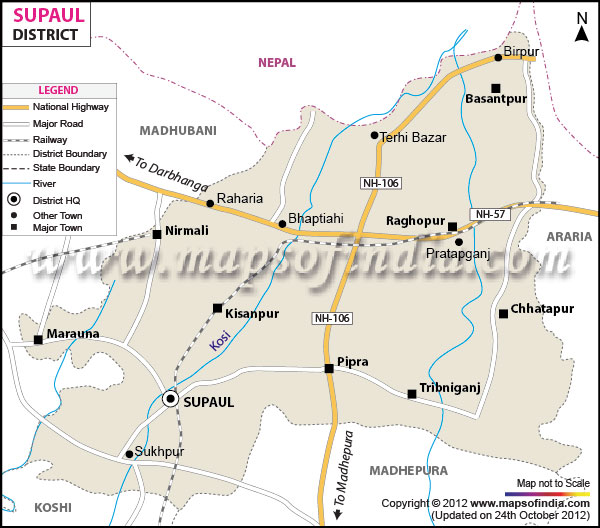
| *Supaul District Map highlights the National Highways, Major Roads, District Headquarter, etc. |
About
Supaul district is one of the crucial administrative districts to the north-eastern side of the Indian state of Bihar. Being cut out of Saharsa district in 1991, it constitutes a significant part of the Kosi division. The district is also geographically and strategically located, since it also borders Nepal border. Supaul has been characterised by its huge alluvial plains that have been formed through the deposition of sediments that are brought by Kosi River and by its tributaries. Agriculture is the main sector of local economy because these fertile lands make it the main cause of severe flooding and displacement historically caused by the same river.
History and Culture
Historical background of the Supaul district has its roots in the ancient civilisation of Mithila which has been a centre of learning, spirituality and culture over the centuries. This is an ancient region of the Videha kingdom located in ancient times, but is directly related to the epic Ramayana. Such an association provides the region with robust mythological and cultural identity that is still able to impact on the traditions and practices of the region.
With time Supaul became a part of such major empires as the Mauryan Empire and the Gupta Empire which led to management organization and the advancement in the cultural sphere. The area during the medieval times was under the influence of the Delhi Sultanate and later Mughal Empire, which came with a new system of governance and cultural interactions. The district was also a component of bigger administrative entities during the time of British colony rule and the colonial policies had immense influence on its agrarian structure and economy.
Supaul is culturally called the part of Mithila region and its identity is determined by the Maithili language and culture. Maithili is a popular language that contains a rich literary tradition, that is, classical poetry and folk literature. The district boasts of rich folk life that manifests in through songs, dances, and rituals that are highly embroiled in terms of rural life. Traditional music and involvement of the community characterize the marriage ceremonies, harvest festivals and seasonal celebrations.
Festivals are an important aspect of the cultural existence of Supaul. The Chhath Puja which is devoted to the Sun God, and celebrated with a lot of devotion on banks of rivers and water bodies, is the most important festival. The rest of the festivals such as Holi, Diwali, Durga Puja, Makar Sankranti are also based on the zeal of the subject. These festivals are not only descriptive of the religious harmony and the cultural richness of the district.
Economy
Supaul district is mainly an agricultural economy, which absorbs most of its citizens. That fertile and moist soil makes it appropriate in the cultivation of multiplicity of crops. The paddy, wheat, maize, pulses, and oilseeds are some of the major crop products grown in the district. The seasonal changes and the patterns of the monsoons contribute to a major issue in establishing agricultural productivity. Nevertheless, frequent flooding due to Kosi River is a significant threat that has often destroyed crops leading to the destruction of livelihoods.
In the government sector, employment is mostly created under the administrative services, education, healthcare and the public welfare programmes. The developmental efforts of the government towards rural development, infrastructure building and flood control are important to the development of the district. The former schemes associated to housing, sanitation, and job creation have helped to alleviate the living conditions in the rural areas.
Supaul has a public sector comprising of banks, cooperative societies and state run institutions, which assist in supporting economic activity. Through these organisations, financial aid is provided to farmers, small traders as well as small business entrepreneurs so that they can invest in agriculture and small scale industries. The availability of regional rural banks and cooperative credit societies has enhanced the financial inclusion in the district.
Services sector is slowly becoming a significant part of the economy. Retail business, transport services, schools and health facilities are also involved in the employment and income generation. As the digital services, and mobile connectivity continue to grow, new opportunities are opening up in places like online commerce and information services.
Other allied activities, like livestock rearing, dairy farming and fisheries are also other major contributors to rural economy. The activities are also a source of supplementary income, and also livelihood diversification. The Supaul district map is specifically helpful in determining the agricultural areas, irrigation systems, and flood affected areas, which are both significant in economic planning and disaster management. It also indicates the transportation systems which assist in transporting goods and services throughout the Supaul district map.
Tourism
Despite Supaul is not renowned as a popular tourist destination, it has a few attractions, which can reflect its beauty of nature and its culture. The district has the prospects of developing tourism, especially in the eco-tourism, religious tourism, and rural tourism.
One of the most outstanding attractions is the Kosi Barrage that is located near the Bhimnagar and towards the border of India and Nepal. The barrage is an important infrastructure project, which is going to regulate water resources, flood control. It is also a scenic location, where people can visit and marvel at the river and landscape surrounding the river.
The conscious attraction of the local followers through the local locality contributor the religious places within Supaul. Scattered all over the district, too, are temples devoted to various Hindu deities, and made the focal point of activities during festivals. Those locations may offer us some insight into spirituality and traditions of local people.
Fields, rivers and villages characterize the rural landscape of Supaul and provide a unique experience to individuals who might want to explore conventional ways of life. Tourists can observe farm activities, local market and cultural activities which are very hard to find in a city. Rural tourism with enhanced infrastructure and marketing may end up playing a key role in the economic welfare of the district, as a whole.
Supaul district map is a valuable tourist guide, being able to locate the most important attractions in the area, and help visitors plan their routes. It also gives us details concerning road connections and their distances between different points of interest. Through the Supaul district map, visitors can learn the lesser known regions and the geographical setting of the culture of the respective districts. Other natural features which are also revealing in the Supaul district map are rivers and green zone which is also vital in the development of eco-tourism.
Demographics
The population of Supaul district is highly rural and this also supports much population relying on agriculture and allied activities. The Census of India 2011 has estimated that the population of the entire district is about 2.23 million. The population density is high, because of the fertility of the land and because of compactness of the rural settlements.
Supaul district has a literacy rate of about 57.67% which falls below the national average. There is a push towards enhancing literacy standards within society by increasing the number of educational institutions such as schools and colleges. The government programmes that focus on enhancing education, particularly to girls have realised slow improvements.
The most popular language in the district is called Maithili and it is one of the major sources of the cultural expression. Hindi also comes in common use, especially in administrative and academic use. The cultural diversity through the Supaul district map can also be seen to be represented by the linguistic diversity as the historical ties with the Mithila area.
The gender ratio in the district is comparatively equal but gender equality and access to resources are still challenged. The healthcare facilities are getting better but there is a need of proper infrastructure and services and this is especially needed in the rural regions. The Supaul district map will assist in the distribution of population in the various blocks and in the various villages which is paramount in planning of such public services and development initiatives.
Administration
The district of Supaul has its administrative units to guarantee good governance and service delivery. The headquarters of the district is the town of Supaul which is the centre of administration, commerce and social life.
The district is further divided into subdivisions and blocks which are also known as tehsils. The key administrative blocks consist of Supaul, Triveniganj, Nirmali, Birpur, and so on. The individual blocks have the responsibility to implement the policies of the government, uphold law and order and monitor development projects on the local level.
At the grassroots level, the district is arranged into various villages that are run by gram panchayat. These are local governing bodies which take a major role in administration of rural areas whereby they address issues concerning rural infrastructure and sanitation and community development. The institutions of Panchayati Raj have empowered the decentralisation of governance and promoted involvement of the people in the decision making process.
A significant source of data used in an administrative level is Supaul district map that reflects boundaries of the blocks, villages and network of infrastructure as seen on the Supaul district map at an administrative level becomes really helpful. This particularly can come in handy when it comes to disaster management since the district has a tendency to flood.
The authorities may use the Supaul district map to draw evacuation lines and where to allocate the resources and coordination of the relief operation. In addition, Supaul district map can be combined with long term planning, by taking into account the areas, which will have to be developed in terms of infrastructures and improved connectivity.
FAQs
Q1: What is the total number of villages in Supaul district?
Supaul district has approximately 525 villages, which form the foundation of its rural administrative structure.
Q2: What is the population of the district?
The population of Supaul district is about 2.23 million according to the 2011 Census of India.
Q3: What is this district famous for?
Supaul district is famous for its association with the Kosi River, its fertile agricultural lands, and its rich Maithili cultural heritage.
Last Updated on : June 24, 2026
