




About
Draping long across the sun heated tiles of Old Market, the feverish rhythm of trade beats in the dusty red avenue. Whitewashed walls echo church bells sounding many miles away and a poem of tropical breeze fills the air with the perfumes of dried fish, roasting cashew nuts and the clinging soil. This is the colourful hub of the commercial heart of South Goa, Margao, also known as Madgaon. The name itself resonates with ancient spiritual profundity, as it comes from the Sanskrit term Mathagrama, a village of monasteries, where Hindu temples and seats of Vedic study once flourished until the Portuguese colonialists drastically changed its architectural destiny.
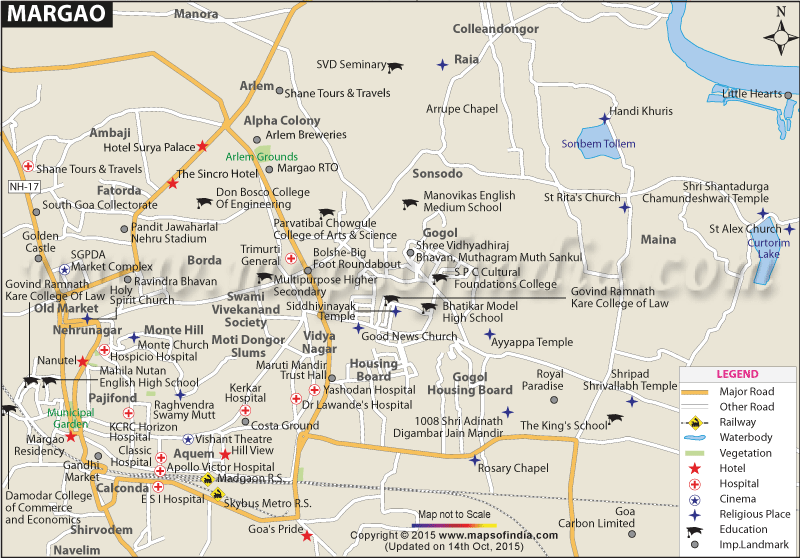
The architecturally significant nature of this urban sprawl opens up numerous layers of interest, the colonial elegance meeting the rustic Konkani vitality. Looking closely at a Margao map will immediately bring to light the city's unique layout, with the older parts radiating out from the green leafy Municipal Garden and the historic Largo de Igreja, out towards lively modern commercial areas.
History & Culture
By the centuries of fire and faith of dramatic upheaval, conquest, and spiritual transformation, the cultural soul of Margao was shaped. Ancient scholars from various parts of India used to be attracted to Mathagrama which was then an intellectual colony, long before Portuguese galleons used to come to the ocean. Long before Portuguese galleons used to come into the Indian Ocean, Mathagrama flourished as an intellectual stronghold, and at this time, several prominent Hindu monasteries used to be in Mathagrama.
Then the Portuguese Conquistador came in the 16th century, and everything changed for good; Portuguese Roman Catholic churchmen toppled the ancient shrines, constructing giant Catholic structures. It is an amalgamation of violence and devotion that when the grand church of the Holy Spirit was constructed in 1565, ousting the demolished Temple of Ramnath, it was on the very spot of the destroyed temple! When the Portuguese rulers began to overtake the town, it became the main stronghold of Salcete, ending up with the Iberian architecture, the Latin Christian spirit and a unique Creole identity that still exists today.
It's not just in museums; culture is in the form of seasonal festivities, theatrical performances and food celebrations here. The feast of the Holy Spirit, occurring before the monsoon, brings its own rain and turns bustling awnings into markets. Also, dried seafood can be bought from the legendary Purumentachem Fest, a practice that grew from surviving the pre-monsoon period. These colourful streets also feature lively (re-preached) dance styles such as ‘fugdi' and rhythmic ‘dhol' drums in celebration of the Hindu festivals such as ‘Shigmo', which serve as a testament to the enduring religious amalgamation of the region.
The Dalgado Konkani Academy and Ravindra Bhavan of Margao serve as cultural centers to Konkani literature and Tiatr, the unique musical theatre format of Goans. Walking the heritage trails on an old Margao city map reveals these grand colonial sobrados (aristocratic mansions) such as the Seven Gables House which tells stories, through the window panes of oyster shells and carved wooden balconies, of aristocracy and cultural survival. When planning their way through a Margao city map, visitors to the city find themselves encountering unique experiences.
Economy
The local economy is the definite money-motor of South Goa with the regional administration and trade & transport connectivity. Since tourism is seasonal, the seasonal tourist influx from the nearby beaches is not its sole economic base, but can only be relied upon to a very limited extent.
Government Sector
The South Goa Collectorate and other district government offices generate significant public employment. Thousands of civil servants are tasked with the care of regional infrastructure, public works, and civic governance at government ministries, tax offices, civil registration bureaus and municipal departments. The Margao city map shows how the administrative enclave is located in the vicinity of the main streets, enabling members of civil administration to serve citizens on the premises more efficiently.
Public Sector
The public sector footprint rests on nationalised banks, public utility companies and state-owned transit companies. Madgaon (Margao) Railway Station is one of the busiest stations on the Konkan Railway and an important railway hub in Goa, which boasts of huge direct and indirect jobs in the field of rail logistics and maintenance, as well as in the operations of the station. Likewise, the bus companies of the state, such as Kadamba Transport Corporation, have significant bus depots here. Using an infrastructure-related Margao city map, view where there are subdivisions within the city, where public utility headquarters, power distribution, conversion and water-related functions are located, and how these distribution points are found on strategic subdivisions, enabling suburban development as well as regional municipal services.
Services Sector
The city's financial life is predominantly of a private economy and services. Whilst the narrow alleys of this New Market (and Gandhi Market) host merchants dealing in spices, fabrics, sea fish and fresh produce, which sustain millions of rupees of daily turnover, centuries of merchant culture are in evidence. Along the 18th June Road and real estate development sites of Pajifond, the financial services industry—private banks, insurance companies, wealth management firms—flourished. This dynamic tertiary sector is complemented by modern healthcare services, the private education sector, legal firms, and hospitality. Commercial hubs are featured on a new modern Margao city map, showing how retail spaces are located within residential areas to facilitate the movement of labour and capital throughout Margao.
Tourism
Wandering through the urban settings of Margao is akin to perusing through a living history book - architectural splendour merging with tropical relaxed inoffativeness. It is at its heart, the Church of the Holy Spirit, an imposing baroque gem built in 1675, with a splendid gilded altar, and towers with white stucco carvings and a quiet square, lined with majestic mansions.
The so-called Church Square is followed to its opposite side by Largo de Igreja, featuring hopsia grand balconies such as the ones seen at historic residences with unfaded tiles. From the gotta-visit Margao city map, it is a simple matter to navigate to the marvellous Seven Gables House (Sat Burzam Ghor) of the seventeenth century, secreted away from a busy tourist trail.
The Margao Municipal Market, also known as the New Market, is a labyrinthine journey of smoky alleys and fragrant barks where consumers and gastronomers are able to indulge their thirst for adventure and culinary delights. In here, merchants stock narrow aisles with smouldering chorizo (sausages) from Goa, dark jaggery from coconuts, dried fish, feni and freshly crushed spices.
On the same Margao city map, you can find these colourful lanes so that you won't miss the spot to have a piping hot ros omelette with loads of fresh chicken or mutton curry. Post-interactive mapping of Margao enables the traveller to go on an unmissable Goan walk around that highlights sacred sites, heritage mansions, lush gardens, and local eating joints. The navigation of these historical alleys is effortless and an enriching cultural experience with the aid of a comprehensive Margao city map.
Demographics
The municipality is a rich collection of people, demographically reflecting Goa's unique circumstances and urbanisation. The official census records the number of residents in the city proper as about 87,650 people, and the number of inhabitants in the wider urban agglomeration is larger. This urban density lands it among the most populated urban settlements in the state. A look at the density of industry in each zone with the help of the Margao city map shows the geographic distribution of high-density commercial nucleus areas, followed by more residential areas with lower density, such as Borda, Fatorda and Aquem.
They are at a very high level of 91%, reflecting many decades of good educational provision and a high importance of education in the community, far exceeding the national average for cities. Literacy rates of males is around 93.7%, while the female literacy rate is around 88.4% (a very small gap between the genders).
The town devises its multiculturality through spoken languages. The Konkani language is spoken by all social strata and is taught to all the people as a state language and it is written in the Devanagari Script. English is the language used generally and understood widely in higher education, administration and commerce. Although Marathi and Hindi are not the primary languages for this region, they are well understood because of migration between states and due to the influence of the media. Overlaying the neighbourhood boundaries on a Margao city map, allowing for a visual comparison of linguistic and cultural communities, confirms the variety of different communities residing side by side throughout the municipal wards in harmonious co-existence.
Administration
Margao Municipal Council (MMC) is one of the premier civic organisations in the realm of civic governance and administration in Goa. The present council is a relic of the Portuguese Colonial Administration known as the Câmara Municipal de Salcete, which was one of the Municipalities established as a result of the enactment of the Portuguese municipal administration. This is now divided into 25 electoral wards with elected councillors representing them on a range of sanitation, public light, roads and urban planning issues within their own ward. Official maps of Margao city help the citizens and civic planners to monitor and locate all the public service zones, civic planners' property plots or accesses located in the urban space.
As an administrative function, the City is the revenue headquarters of the South Goa District and Salcete Tehsil (Taluka). From the administrative complex, the Deputy Collector and the Mamlatdar are tasked with the administration of revenue, maintenance of land registers, coordinating disaster management and police. A Margao city map featuring the Municipal Council details provides a good indication of how these governance elements are connected from the core of the centre of the city, that is, the Municipal building, outwards to these satellite villages, thereby creating a complete intra-urban-rural governance system for South Goa.
FAQs
Q1: Where is Margao located?
Margao is located in South Goa district.
Q2: What is Margao famous for?
Margao is famous for its markets and heritage.
Q3: What is the population of Margao?
Its population is 87,650 (2011 Census).
Q4: What is the literacy rate of Margao?
The literacy rate is 90.08%.
Q5: Which tehsil is Margao in?
Margao is in Salcete Taluka.
Q6: How many villages are in Margao?
Margao city has no villages.
Q7: Which is the main language of Margao?
Konkani is the main language spoken.
Last Updated on : August 03, 2026
