






About
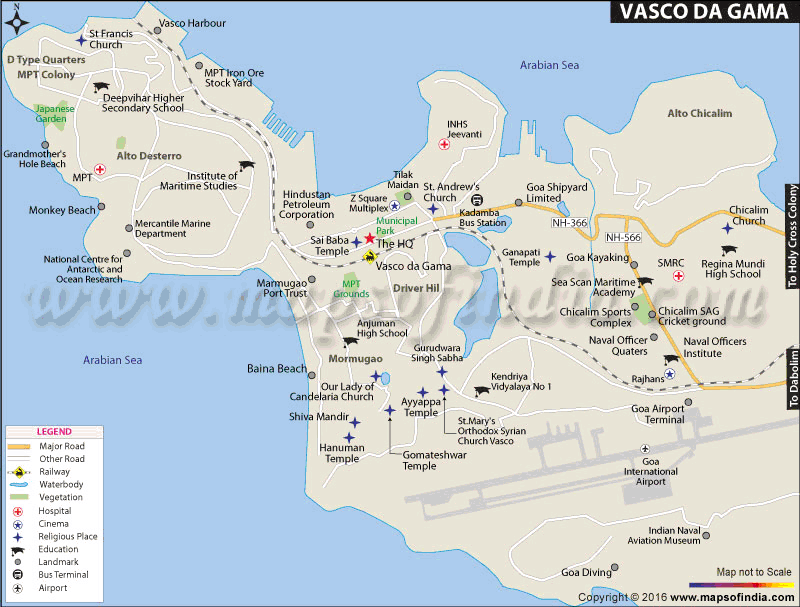
Vasco da Gama is often referred to as just Vasco since it is a port. It is the commercial center of the Mormugao subdivision in South Goa, besides being the main transport hub and administrative center. Situated at the western end of the famous Mormugao Peninsula, this port city looks over the estuary where the Zuari River enters the broad Arabian Sea. The main seaport of the state is located there is a great place that brings access to military facilities as well. Approximately 30 km towards the South lies Vasco da Gama, Goa's main city Panaji and it is also at a distance of 28 km in a northwest direction from Margao.
The city is named after Vasco da Gama, Portugal's greatest navigator who in 1498 discovered a direct seaway from Western Europe to India. At the time Portuguese colonies were erecting fortified seaport on the peninsula in the late 16th century - early 17th century they actually decided to honor the great discoverer by giving the name of their new town to him. Even today, the city's colonial name is being held internationally by the shipping records whereas, the local name 'Sambhaji Nagar' a sub-district reflects clearly its Maratha past and regional identity.
The city was renamed after Vasco da Gama, the greatest Portuguese navigator who found the direct sea route from Europe to India. The Portuguese then began building a fortified seaport at the time Portuguese colonies were being set up on the peninsula in the late 16th to early 17th century and it was a great privilege for them to pay homage to the great explorer by naming their newly founded town after him. The colonial name of this city continues to be known overseas on the records of the shipping industry, whereas a local name, 'Sambhaji Nagar', which actually is the name of a sub-district, clearly shows that this is a city of the Marathas.
History & Culture
In 1543 it was through Velhas Conquistas (Old Conquests) that Portuguese authorities finally acknowledged their claim to Mormugao, having already captured parts of their East conquests in different places. The Mormugao region with its elevated terrain and river view had been identified by the military and civilian authorities as a strategic spot for a large Portuguese fortress. As a result, in 1624 the construction of one of the most powerful forts in colonial times was begun there - Mormugao Fort. During the time when cholera outbreaks and Maratha invasions jeopardized Old Goa at the end of the 17th century, the Viceroy Vichero-Dom Francisco de Tvora made a decision to transfer the viceregal capital for a short while from here to Mormugao, and he even aimed at making Vasco the supreme colonial capital. Still, the change ultimately was rolled back.
That year 1888 brought about a dramatic metamorphosis of the region through modernization efforts exemplified by the simultaneous launch of Mormugao Port and the Meter-Gauge Railway. Due to this important change, Vasco was able to develop not only from a quiet bayhead but also as a commercial freighting hub on a global scale. World War II saw this otherwise tranquil little port become the centerpiece for international attention following what has now been called Operation Creek in 1943, when a clandestine British raid was carried out that aimed at disrupting the communications between the German merchant ships at Mormugao Harbour that were secretly transmitting movements of Allied ships to the Axis submarines. The colony's era came to an end on December 19, 1961 with Indian Armed Forces regaining Goa through Operation Vijay and the integration of Vasco da Gama with the Indian Union. The highlight of the city's cultural events is the renowned Vasco Saptah Festival, which happens every year at the old Shri Damodar Temple. It was first held out of a need - the villagers in fact had come together and turned to Lord Damodar during an outbreak of plague in 1899 as a way of seeking the Almighty's protection.
Economy
The economy depends on these three major fields of the Government, Public, and Services.
Government Sector
Vasco and Dabolim share the runways with INS Hansa, which is located on an island next door to Vasco, as one of India's leading naval air stations of the Navy. There are several fighter squadrons, naval aviation training units, and defense facilities at this station. Also, the Indian Coast Guard, which monitors maritime security of the sea, keeps the port headquarters and other facilities in Vasco to conduct operations. And, agencies of the central government like the Customs, Port Health Organizations, and the Central Industrial Security Force (CISF) units create a lot of government jobs.
Public Sector
Public Sector: The core of the Vasco industrial scene is made up of the Central and state Public Sector Undertakings (PSUs). The Mormugao Port Authority (MPA), which operates as one of the oldest and leading natural deep-water harbors of India, manages enormous traffic of dry and liquid bulk cargo such as iron ore, coal, petroleum, and international cruise tourism as well.
The Goa Shipyard Limited (GSL), one of the neighboring defense PSUs of the Ministry of Defense and classified as a Miniratna company, stands out as one of the main shipbuilders for the Navy and Coast Guard by supplying them with patrol vessels, missile frigates, and specialized sea vessels. Plus that, the fuel reserves and pipeline storage of a few major national energy companies (IOCL, BPL, HPCL) have tank farms and terminals connected directly to the port jetties.
Services Sector
Port and airport activities generate a lot of logistical needs from which the private and service sectors benefit a great deal. In Vasco's business centers, dozens of maritime, freight forwarding, customs clearing, and cold storage entities have their offices. The region also consists of sub-districts which have large industrial hubs at Verna and Sancoale, where multinational drug manufacturers as well as precision engineering and software units have their establishments. Also, the hospitality sector, air services, and rental logistics industry get benefited by regular commercial travels tied to defense work, shipping commerce, and corporates activities.
Tourism
Though often linked to industry and armed forces, the peninsula actually reveals a delightful array of natural beauty, historical remains, and distinctive cultural sites. Hollant Beach: Near Cansaulim, Hollant has gained its popularity as a sunrise spot in Goa as this bay allows people to witness one of the rare moments when the sea is bathed in the early morning light. Also, the quiet and shallow waters of Hollant make it a nice spot for a few hours of family swimming and water activities. Baina Beach: Located along the seafront near the city center, Baina Beach has been thoroughly upgraded with a nice walking path along the beach, various kinds of water activities, and wide open areas that are suitable for organizing cultural events and festivals.
Landing first by air or land you would notice this huge Portuguese fortress perched on a hill overlooking the northwestern coastline of Mormugao, facing the estuary of the Zuari River. A fortress that was built in the 17th century to safeguard this region, visitors can still walk within ancient bastion stones, old watch towers, or even the remnants of the former royal quarters located in a spot where ships have been arriving at the harbor all this while. St. Andrew's Church. Among the many buildings in the center of Vasco, this place of worship stands out with its history. It was the Jesuit missionaries who laid its foundation back in 1570 and its present-day form in a Neo-Gothic style is the result of its redevelopment over many years. Besides its clean white color and Truth is all four sides are beautifully decorated, the most notable part is definitely the ornate wooden carvings that adorn the altar and other parts of the church as well as the other elements of historical interest and architecture present. Their Japanese garden. Their garden, which overlooks the cliffside of Mormugao Ridge at an altitude has been lovingly designed to reflect Japanese landscaping techniques. It's a park where the landscape is so well maintained that each blade of grass is clearly visible, and stone pathways lead gently from one level to another while offering a magnificent panoramic view of the Arabian Sea. It is just one of the two museums of the naval aviation kind in the Asian subcontinent. It exhibits the naval aircraft that have been retired, like the Sea Harrier Vertical/Short takeoff Landing (V/STOL) aircraft, the Lockheed Constellation, which is the most famous photo-reconnaissance aircraft of World War II, and the anti-submarine helicopters. In it, there are the so-called interactive exhibitions that tell the story of the development of the Indian naval air force over generations, with the support of pilot simulators and equipment used for flying.
Demographics
The Mormugao sub-district population is characterized by an urban, educated, and cosmopolitan nature. The city's economic diversity opens its doors to professionals, defense and other workers from different parts of India. The Mormugao sub-district, as per official Census records, is inhabited by 100,485 (2026) people. A remarkable educational background is present throughout the sub-district. The literacy rate, on average, is about 89.30%, which is far above the national literacy rate. The literacy rate of males is 93.33%, whereas that of females is 84.84%. Even though Konkani is the official language as well as most of the native residents' first language, the historical multilayered cultural background of this town has led to the popularity of speaking English, Marathi, Hindi, and Kannada at the marketplace, military colonies, and other offices.
Administration
Administratively, Vasco da Gama is the centre where the Vasco Subdivision of the Goa State is governed and is also the base of operations where Mormugao taluka/municipal sub-division is handled. The city itself is going through planning and development for the urban areas and is under the governance of the Municipal Council of Mormugao (MMMC), which deals with city-level infrastructure, sanitation and garbage control, urban management, medical services provided by local public health units, and the city's market maintenance.
| Official Name | Vosco da Gama |
| Location | Goa |
| Area | 27.36 sq. km |
| Population | 100,485(2026) |
| Language | Konkani,Marathi,English |
FAQs
Q1: What is the total number of villages in the district/sub-district?
There are basically 03 small villages generating revenue in the administrative area of Mormugao sub-district.
Q2: What is the entire population of an area?
India's census data indicate that 100,485 people live in Mormugao.
Q3: Why is Vasco da Gama remarkable?
Vasco da Gama has become well known mainly due to one reason: Goa's principal logistics and transport center for shipping and airfreight.
Q4: How far is Vasco da Gama from Dabolim Airport, and how do I get to the city centre?
Dabolim Airport is located a distance of roughly 4-5 km from the center of Vasco da Gama.
Q5: When is the best time of the year to visit Vasco da Gama?
November and February.
Q6: What is the historic story behind the Vasco Saptah Festival?
The Vasco Saptah festival originated in the late 19th century (around 1898–1899) when a severe cholera epidemic broke out across the region.
Q7: Are there scuba diving and water sports facilities available in Vasco?
The closest and probably one of the main water sports resorts of Vasco that offers diving facilities is Bogmalo Beach.
Q8: Why is Vasco da Gama significant to the Indian Navy and defense forces?
It houses INS Hansa, one of the Indian Navy's premier air stations, which supports specialized fighter and reconnaissance squadrons.
Last Updated on: August 03, 2026
