

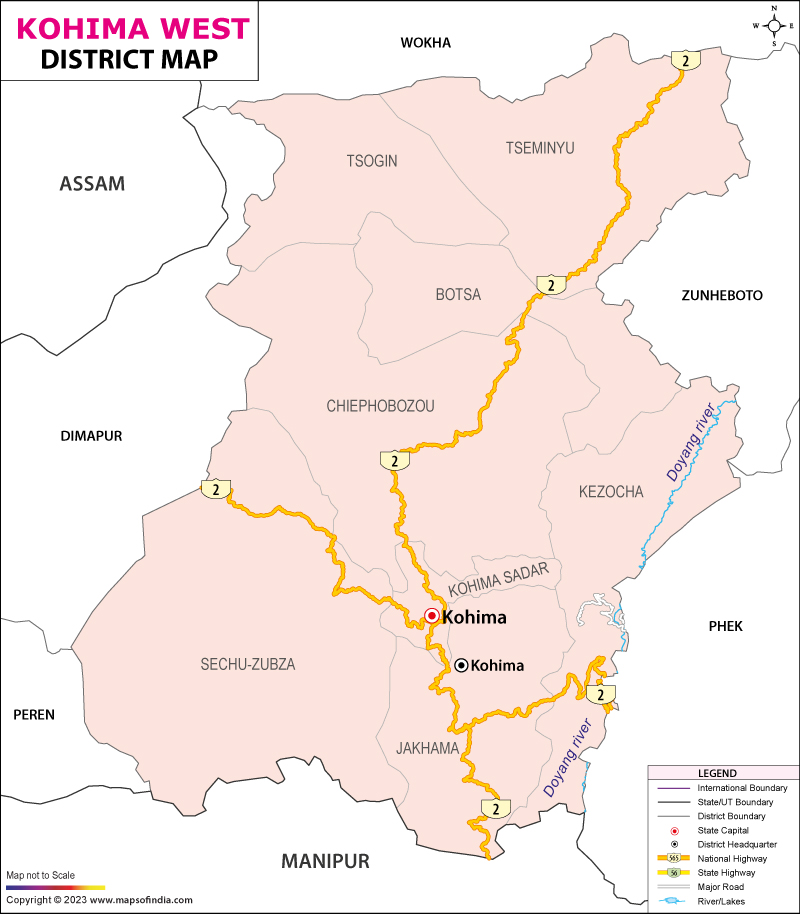





Kohima District is among historically rich and culturally rich areas in Nagaland, which is the administrative centre of the state. The district lies in the south of Nagaland and at an altitude of between 1,345 and 1,560 metres above sea level and covers an area of 1,463 square kilometres, which is the seventh-largest district in Nagaland. According to the 2011 Census, the population of Kohima has been 267,988, which is 13.55 percent of the total population in Nagaland, of which 45 percent live in urban centers. The topography is typified with rolling hills, thick forests, and terraced fields, which are cascading down the mountain slopes forming a beautiful scenery. Kohima comes to be known as Kewhira in Angami language meaning a place of collective gathering and village meeting.
The strategic location of the district has put it at the crossroad of history and culture with the Dimapur District at the west, Wokha District at the north, Peren District at the south west and Zunheboto and Phek Districts at the east and Manipur at the south. This strategic location has caused Kohima to become an intuitive trade, administrative and cultural center. The climate is subtropical highland with warm summers and cool winters but frost takes place in the months of December and January. The months between June and September are the monsoon seasons and it pours creating a green heaven.
History
The history of the Kohima District is a historic story of early settlements, colonial interactions and turning points. The native people were the Angami Nagas, who developed villages many centuries ago; oral traditions state that the village of Kohima is more than 700 years old, and is thought to be the second-largest village in Asia. Early settlers would be placed into communities based on a clan, and congregated around defensible ridges.
The field of modern administrative history originated in 1878 after British forces moved their headquarters out of Samaguting and set up a military base in Kohima. The 44 th Sylhet Light Infantry had been involved in this move to seize strategic passes. The Angami Rebellion of 1879 was caused by the occupation. Kohima became the first seat of modern administration as headquarters of the Naga Hills District under Assam Province when Guybon Henry Damant was made Political Officer.
Kohima has been the natural choice of the state capital when Nagaland got statehood on 1 st December 1963. The district has since been reorganised a few more times, Phek District was separated in 1973, and Dimapur in 1998, Peren in 2004, and Tseminyu in 2021. The most remarkable historical event in the district is the Battle of Kohima that was fought between 4 th April and 22 nd June 1944 during the Second World War. This conflict, and the Battle of Imphal were the turning point in the Burma Campaign. Japanese 31st Division, consisting of more than 12,000 men, went on an offensive to seize Kohima as part of operation U-Go, and to isolate the supply lines of the British.
What now ensued was fierce combat, and hand-to-hand battle at the tennis court of the Deputy Commissioner, where the opposing trenches were within shooting distance of each other. This defeat stopped the Japanese and was the largest defeat ever by the Japanese military with around 30,000 of the total population of 65,000 killed.
Culture
The cultural tapestry of Kohima District is mainly Angami Naga tribe and they have maintained their unique culture despite modernisation and Christianity. The Angamis are known to have the terrace modes of cultivating the steep hill slopes into viable farmland. The district has a high level of community and both the traditional governance structures coexist with the modern ones.
The greatest cultural festival is Sekreni, which is the Akaka festival of the Angami Nagas. This ten-day festival of cleansing that takes place in February on the 25th day of the Angami month Kezei has a strong spiritual connection. The festival is a period of body and soul cleansing, so that the village is united, and the young people enter adulthood. The traditions and rituals celebrated are Kizie, Zumho, and Dzuseva, sharing of communal meals, singing and wearing of traditional clothes. The diffusion of rice beer and meat among the village younger generation accompanied by singing folk songs is a major element known as Thekra Hie.
Kohima is the home of the famous Hornbill Festival that takes place at a place called Kisama Heritage Village, some 12 kilometres away Kohima. The most famous of these celebrations is called the Festival of Festivals and is held during which all 16 ethnic groups of Nagaland gather and share their traditions, dances, crafts and cuisines attracting thousands of visitors both national and international.
Angami culture has a set of traditions, which include Nanyu and Kenyu, observed at specific times after the completion of certain tasks and moral codes, respectively, which outlaws certain work during certain moments. The religious environment has been overtaken by Christianity whose religious followers are about 85 percent of the total population even though the traditional beliefs still exist in the day to day life.
Language
Kohima District is linguistically diverse due to its ethnic background and history. Their language is dominated by Angami or rather commonly referred to as Tenyidie, which is a language with a Tibeto-Burmese origin and mostly practiced by the Angami Naga. The 2011 Census indicates that around 45.34 per cent. of people in the district are Angami speakers (first language). The standardised form, the Tenyidie, a form of the dialect of such villages as Kohima, Meriema and Khonoma, is the prestige form used in education, literary and religious works. There are important dialectal variations village to village, and there are significant differences in phonetic inventories and tonal characteristics.
Tenyidie is a native language with about 152,796 speakers with its main concentration in Kohima District. The language has various dialects among them Khonoma, Dzuna, Kehena and Chakroma with the northern dialect based in Kohima as the standard. It is tonal, and it has peculiar phonetics with such characteristics as voiceless nasals that have aspirated sounds. Although there was no written text in Angami, during the 19 th century, missionaries used the Roman script and finally in 1970, the full text of the Tenyidie Bible was published.
Nagamese is used as lingua franca in Kohima, and the wider Nagaland, and is spoken by a majority of the Naga (estimated to be 90 per cent of the total Naga population) to engage in inter-tribal communication. The language is simple and has no grammatical complications; this has made it popular as a creole language formed by Assamese with the Naga substrate influences. Nagamese unites the different Nagaland tribal languages.
In Nagaland, English is the official language and it is generally commonly used in education, government and official communication. It is very common especially among the educated population in Kohima.
Geography
The geography of Kohima District is characterized by the location of the district being located in the Naga Hills, which is located at 25deg40 N, and 94deg07 E. It occupies 1,463 square kilometres, which is about 8.82 percent of the total area of Nagaland, with a mean altitude of 1,261 metres above sea level. The area is mostly mountainous, which has Kohima town occupying a high ridge, which cuts across the mountain ranges.
The summit top is the Mount Japfu, where the tallest rhododendron trees in the world have been formally recognised in 1993. Japfu range is a scenic range of trails, known to view Kohima city and on fair weather, the Himalayas, 15 kilometres away. Another geological treasure is the Dzuko Valley that is 25 kilometres south, 2,462 metres above the ground. This valley is covered with red and white rhododendrons and wildflowers between November and March which is why this valley is also referred to as the Valley of Flowers of the North East.
Geography The river systems define the geography of the district, with water resources being supplied by streams of Pulie Badze slopes and the river system of Zaru. The Puliebadze Wildlife Sanctuary is a natural habitat of the Blyths Tragopan the state bird of Nagaland, which is a 923 hectare area.
Subtropical highland climate has its own seasonal changes with cool winters as far as frost takes place in December and January and warm summers with an average temperature of 80-90 degrees Fahrenheit. Heavy precipitations are received in the monsoon period between June and September. The location of the district forms an abundant biodiversity, the dense forests of which cover steep slopes and terraced fields reflecting millennia of adaptation to agricultural activities.
Kohima District villages are usually located on hill tops or ridges. The district consists of 105 inhabited villages and it is divided into seven rural development blocks namely Kohima, Chiephobozou, Jakhama, Tseminyu, Sechu-Zubza, Botsa and Chunlikha. The Kisama Heritage Village where the Hornbill Festival is held and Khonoma, the first green village in India are notable villages.
Q.1:What is Kohima District famous for?
Kohima District is renowned for the Battle of Kohima during World War II, the Hornbill Festival, and being Nagaland's capital with rich Angami Naga culture.
Q.2:Which tribe primarily inhabits Kohima District?
The Angami Naga tribe is the primary indigenous community of Kohima District, known for its terrace cultivation and distinct cultural traditions.
Q.3:What is the best time to visit Kohima?
The ideal period is October to May, particularly during the Hornbill Festival in December, when the weather is pleasant and cultural celebrations are vibrant.
Q.4:How far is Kohima from the nearest airport?
Dimapur Airport is approximately 65 kilometres from Kohima, serving as the nearest air connectivity point for travellers visiting the district.
Last Updated on June 24, 2026
The strategic location of the district has put it at the crossroad of history and culture with the Dimapur District at the west, Wokha District at the north, Peren District at the south west and Zunheboto and Phek Districts at the east and Manipur at the south. This strategic location has caused Kohima to become an intuitive trade, administrative and cultural center. The climate is subtropical highland with warm summers and cool winters but frost takes place in the months of December and January. The months between June and September are the monsoon seasons and it pours creating a green heaven.
History
The history of the Kohima District is a historic story of early settlements, colonial interactions and turning points. The native people were the Angami Nagas, who developed villages many centuries ago; oral traditions state that the village of Kohima is more than 700 years old, and is thought to be the second-largest village in Asia. Early settlers would be placed into communities based on a clan, and congregated around defensible ridges.
The field of modern administrative history originated in 1878 after British forces moved their headquarters out of Samaguting and set up a military base in Kohima. The 44 th Sylhet Light Infantry had been involved in this move to seize strategic passes. The Angami Rebellion of 1879 was caused by the occupation. Kohima became the first seat of modern administration as headquarters of the Naga Hills District under Assam Province when Guybon Henry Damant was made Political Officer.
Kohima has been the natural choice of the state capital when Nagaland got statehood on 1 st December 1963. The district has since been reorganised a few more times, Phek District was separated in 1973, and Dimapur in 1998, Peren in 2004, and Tseminyu in 2021. The most remarkable historical event in the district is the Battle of Kohima that was fought between 4 th April and 22 nd June 1944 during the Second World War. This conflict, and the Battle of Imphal were the turning point in the Burma Campaign. Japanese 31st Division, consisting of more than 12,000 men, went on an offensive to seize Kohima as part of operation U-Go, and to isolate the supply lines of the British.
What now ensued was fierce combat, and hand-to-hand battle at the tennis court of the Deputy Commissioner, where the opposing trenches were within shooting distance of each other. This defeat stopped the Japanese and was the largest defeat ever by the Japanese military with around 30,000 of the total population of 65,000 killed.
Culture
The cultural tapestry of Kohima District is mainly Angami Naga tribe and they have maintained their unique culture despite modernisation and Christianity. The Angamis are known to have the terrace modes of cultivating the steep hill slopes into viable farmland. The district has a high level of community and both the traditional governance structures coexist with the modern ones.
The greatest cultural festival is Sekreni, which is the Akaka festival of the Angami Nagas. This ten-day festival of cleansing that takes place in February on the 25th day of the Angami month Kezei has a strong spiritual connection. The festival is a period of body and soul cleansing, so that the village is united, and the young people enter adulthood. The traditions and rituals celebrated are Kizie, Zumho, and Dzuseva, sharing of communal meals, singing and wearing of traditional clothes. The diffusion of rice beer and meat among the village younger generation accompanied by singing folk songs is a major element known as Thekra Hie.
Kohima is the home of the famous Hornbill Festival that takes place at a place called Kisama Heritage Village, some 12 kilometres away Kohima. The most famous of these celebrations is called the Festival of Festivals and is held during which all 16 ethnic groups of Nagaland gather and share their traditions, dances, crafts and cuisines attracting thousands of visitors both national and international.
Angami culture has a set of traditions, which include Nanyu and Kenyu, observed at specific times after the completion of certain tasks and moral codes, respectively, which outlaws certain work during certain moments. The religious environment has been overtaken by Christianity whose religious followers are about 85 percent of the total population even though the traditional beliefs still exist in the day to day life.
Language
Kohima District is linguistically diverse due to its ethnic background and history. Their language is dominated by Angami or rather commonly referred to as Tenyidie, which is a language with a Tibeto-Burmese origin and mostly practiced by the Angami Naga. The 2011 Census indicates that around 45.34 per cent. of people in the district are Angami speakers (first language). The standardised form, the Tenyidie, a form of the dialect of such villages as Kohima, Meriema and Khonoma, is the prestige form used in education, literary and religious works. There are important dialectal variations village to village, and there are significant differences in phonetic inventories and tonal characteristics.
Tenyidie is a native language with about 152,796 speakers with its main concentration in Kohima District. The language has various dialects among them Khonoma, Dzuna, Kehena and Chakroma with the northern dialect based in Kohima as the standard. It is tonal, and it has peculiar phonetics with such characteristics as voiceless nasals that have aspirated sounds. Although there was no written text in Angami, during the 19 th century, missionaries used the Roman script and finally in 1970, the full text of the Tenyidie Bible was published.
Nagamese is used as lingua franca in Kohima, and the wider Nagaland, and is spoken by a majority of the Naga (estimated to be 90 per cent of the total Naga population) to engage in inter-tribal communication. The language is simple and has no grammatical complications; this has made it popular as a creole language formed by Assamese with the Naga substrate influences. Nagamese unites the different Nagaland tribal languages.
In Nagaland, English is the official language and it is generally commonly used in education, government and official communication. It is very common especially among the educated population in Kohima.
Geography
The geography of Kohima District is characterized by the location of the district being located in the Naga Hills, which is located at 25deg40 N, and 94deg07 E. It occupies 1,463 square kilometres, which is about 8.82 percent of the total area of Nagaland, with a mean altitude of 1,261 metres above sea level. The area is mostly mountainous, which has Kohima town occupying a high ridge, which cuts across the mountain ranges.
The summit top is the Mount Japfu, where the tallest rhododendron trees in the world have been formally recognised in 1993. Japfu range is a scenic range of trails, known to view Kohima city and on fair weather, the Himalayas, 15 kilometres away. Another geological treasure is the Dzuko Valley that is 25 kilometres south, 2,462 metres above the ground. This valley is covered with red and white rhododendrons and wildflowers between November and March which is why this valley is also referred to as the Valley of Flowers of the North East.
Geography The river systems define the geography of the district, with water resources being supplied by streams of Pulie Badze slopes and the river system of Zaru. The Puliebadze Wildlife Sanctuary is a natural habitat of the Blyths Tragopan the state bird of Nagaland, which is a 923 hectare area.
Subtropical highland climate has its own seasonal changes with cool winters as far as frost takes place in December and January and warm summers with an average temperature of 80-90 degrees Fahrenheit. Heavy precipitations are received in the monsoon period between June and September. The location of the district forms an abundant biodiversity, the dense forests of which cover steep slopes and terraced fields reflecting millennia of adaptation to agricultural activities.
Kohima District villages are usually located on hill tops or ridges. The district consists of 105 inhabited villages and it is divided into seven rural development blocks namely Kohima, Chiephobozou, Jakhama, Tseminyu, Sechu-Zubza, Botsa and Chunlikha. The Kisama Heritage Village where the Hornbill Festival is held and Khonoma, the first green village in India are notable villages.
| Particular | Details |
|---|---|
| Official Name | Kohima District |
| Area | 1,463 km² |
| Population | 267,988 (as per 2011 Census) |
| Language | Angami (Tenyidie), Nagamese, English |
| Religion | Christianity (85%), Hinduism (11%), Islam and Others (approximately 2.37%) |
FAQs
Q.1:What is Kohima District famous for?
Kohima District is renowned for the Battle of Kohima during World War II, the Hornbill Festival, and being Nagaland's capital with rich Angami Naga culture.
Q.2:Which tribe primarily inhabits Kohima District?
The Angami Naga tribe is the primary indigenous community of Kohima District, known for its terrace cultivation and distinct cultural traditions.
Q.3:What is the best time to visit Kohima?
The ideal period is October to May, particularly during the Hornbill Festival in December, when the weather is pleasant and cultural celebrations are vibrant.
Q.4:How far is Kohima from the nearest airport?
Dimapur Airport is approximately 65 kilometres from Kohima, serving as the nearest air connectivity point for travellers visiting the district.
Last Updated on June 24, 2026
