






About
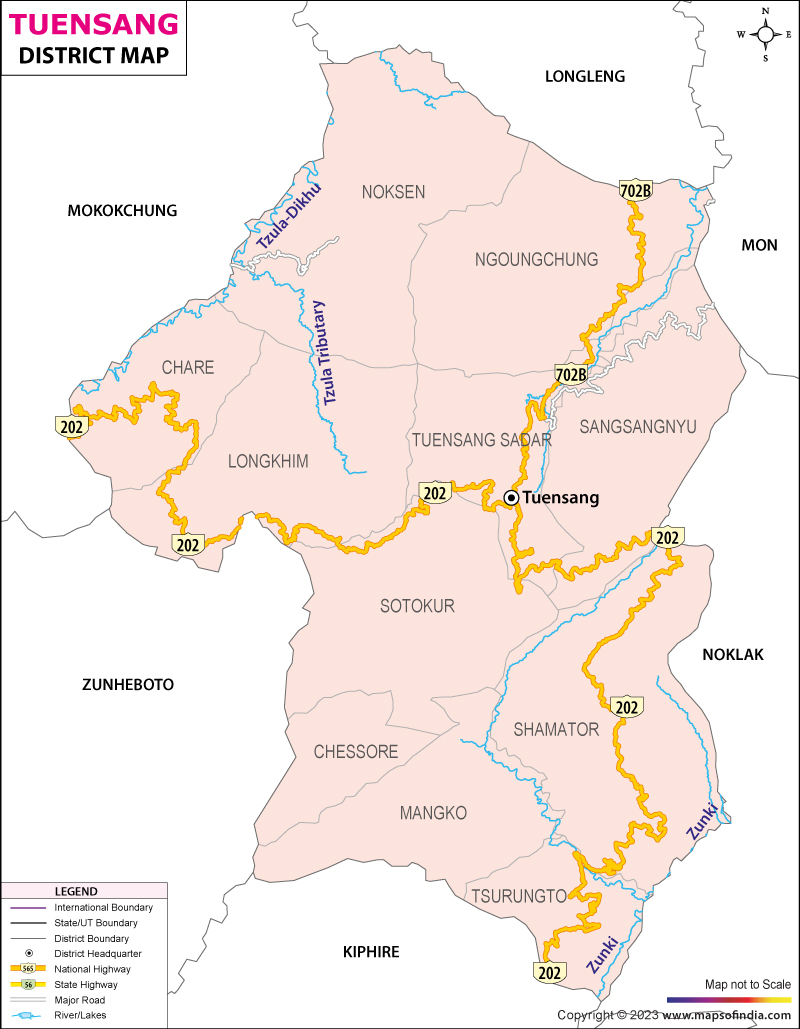
Tuensang District is one of Nagaland's districts, situated in the far east of the state, with an international boundary with Myanmar. Tuensang is a special place in Naga history, the administrative cradle from which the modern state of Nagaland eventually emerged; the erstwhile Naga Hills – Tuensang Area (NHTA) from which the state of Nagaland got its name. It is thus rich in historical significance, representing the confluence of tradition, tribal leadership and the state's path towards becoming a state.
The district’s headquarters is in Tuensang town at an altitude of approximately 1,371 m, about 200 km from Kohima, the capital of the district. At the time of independence, Tuensang was the largest district of Nagaland by area, but has been continually reorganised over the course of decades with the creation of Mon, Longleng, Kiphire, and then Noklak (2017) and Shamator (2022) districts from Tuensang's area. Tuensang is still important in its current mini form because it is the headquarters of the highest mountain in Nagaland, Mount Saramati, and also has the traditional area of several different Naga tribes.
Surrounded by Mon to the north, Longleng to the west, Mokokchung to the south and the international boundary with Myanmar to the east, Tuensang is a district of mountains, jungles, and a diverse array of indigenous cultures that make up its distinctive character in Nagaland.
History & Culture
The formation of Nagaland is an integral part of Tuensang's history. The region remained an out-of-the-way tribal region in the early twentieth century, even though the British colonial administration designated it an "excluded area" and its indigenous polities were left largely unaltered by colonial rule. Formal administration started only after the independence of India, when an administrative headquarters was set up at Tuensang on 16 June 1948. The Tuensang subdivision was merged with the districts of Kohima and Mokokchung in 1957 and formed the Naga Hills–Tuensang Area that was a stepping stone that led to the establishment of the state of Nagaland as a whole in 1963. The traditional societies in the district were traditionally organized around highly independent village republics which were led by a council of elders or, in some communities, by a hereditary chieftain. The activities of headhunting continued here longer than in other areas of the Nagas, the last case being recorded at Panso village in October 1963 that is an indication of how recent the change was in the older tribal system to the modern administrative phase in the region. Villages like Changsangmongko are recalled as the place where the world began.
The community of Tuensang is home to a number of different indigenous communities, including the Chang, Khiamniungan, Sangtam and Yimchungrü as well as the Tikhir sub-tribe and pockets of Phom and Sema. The district has an unusual internal diversity for its size and each tribe has its own language, weaving patterns, folklore and social customs and this diversity is reflected in the colourful festival calendar that includes the Chang tribe celebrating Naknyulüm in July, the Sangtam tribe celebrating Mongmong in September, the Yimchungrü tribe celebrating Metemneo in August, and the Khiamniungan tribe celebrating Tsokum in October, each revolving around farming cycles, communal feasting, traditional music and costume.
The cultural diversity of Tuensang District is reflected in the numerous local festivals held sparsely throughout the year, such as the Naknyulüm in July celebrated by the Chang tribe, the Mongmong in September popular among the Sangtam, the Metemneo in August observed by the Yimchungrü, and the Tsokum in October, which is dedicated to the harvest and brings the Khiamniungan together. The local tradition of Longtrok, a set of “living stones” worshipped by the locals, is an example of the region’s peculiar animism that has survived until modern times in the local Naga folklore.
Nowadays, the Christian faith has gained great popularity among the inhabitants of Tuensang District, substituting the ancient beliefs in gods and ancestors. The traditional crafts and art forms associated with the region are the production of cane and bamboo wares and weaving patterns preserved and perfected in the Tuensang’s villages, especially those located near the Myanmar border, as well as the wood carving performed by the Khiamniungan tribe.
One of the unique cultural aspects of the district is ‘Longtrok' or ‘living stones', which are worshipped as divine emanations by the local people and are a testament to the animism and ancestor worship systems which remain integral in Nagaland's current Christianized practice. Crafts like cane and bamboo work, handloom weaving and wood carving are still alive, being transferred from generation to generation, especially within the Khiamniungan communities close to Noklak.
Economy
With little industrialization and the mountains, Tuensang's economy is still largely rural and subsistence yet there has been a rise in both government presence and services.
The Deputy Commissioner's office, circle administrative office, and different state government departments are stationed in Tuensang town as the headquarters of the Government Sector. The district has a limited ability to provide jobs for the private sector in the difficult terrain that makes up most of the area, which is why government employment — in administration, education and healthcare — is one of the most important employers in the region in terms of the number of people employed.
The Public Sector comprises projects related to public infrastructure such as National Highways 202 and 702B, rural electrification, water supply schemes, and healthcare facilities, many of which are still underway to ensure access to the district's more remote hill villages. Local savings and small-scale credit demands are serviced by the public sector banks and cooperative banks and the district has a large forest cover, which is managed by forestry-related public programs.
Services Economy: Small trade in Tuensang town and local markets at subdivisional centres (Noklak, Chessore) along with transport services are the pillars of the services sector with an emerging growth in the tourism and handicrafts trade. Local service-sector jobs are also anchored by educational institutions like Fazl Ali College and Sao Chang College that are popular among the students in the state and country.
In addition to these three sectors agriculture is the major livelihood of most rural households in Tuensang that involves growing rice, maize, millet and vegetables in terraces and shifting cultivation (also known as jhum). Farm incomes are supplemented with horticulture especially oranges, pineapples and other fruits of the hills and livestock rearing and with more than 50% of the geographical area covered under forests the district also has forest-based livelihoods such as the production of cane and bamboo crafts which is seen more among the Khiamniungan craftsmen close to the Myanmar border.
Tourism
For those seeking more off-the-beaten-path and less well-known aspects of Nagaland's off-the-beaten-path area, Tuensang has a unique appeal, with its high mountains, culture, and natural beauty.
The highest peak of Nagaland is Mount Saramati, 3826 metres, which is one of the most prominent peaks of South East Asia, with a challenging trek along the Indo-Myanmar border with views of the Naga Hills and the eastern Himalayas.
Fakim Wildlife Sanctuary — It was opened in 1984 on the slopes of Saramati, which is the residence of rare birds as well as biodiversity enthusiasts.
Longtrok (Living Stones of Tuensang) – The Sacred stone formations of Tuensang district are one of the district's most unique cultural-natural monuments, revered by the district people.
Noklak — A town along the border which was basically a part of Tuensang district (now the new Noklak district), known for Khiamniungan cane work, handicrafts and artifacts.
Tsadang — Noted among the district's must-visit attractions for its scenic and cultural appeal.
Steeped in legend, the place connected to the start of the Chang tribe, Chang Sang Mongko Village will provide you with an insight into the oral traditions and the history of your own ancestors.
The main rivers of the district, Dikhu and Tizu, provide great scenic beauty in the riverine landscapes on the forested hills. Tuensang Town is the district capital, where visitors can experience the mix of several tribal cultures and purchase handlooms, handicrafts and artwork, as well as purchasing traditional jewelry.
Thus, it can be said that Tuensang is a destination different from the other districts in Nagaland. It is a destination for adventure sports and for those who are interested in experiencing extreme conditions. This place offers a unique opportunity to the tourists and the people who are willing to make the extra effort to reach this place can have a unique experience of a lifetime.
Demographics
The population of Tuensang district (before its division into Noklak district (2017) and Shamator district (2022)) was 196,596 (101,933 males and 94,663 females) as per the Census of India 2011 and therefore became the fourth most populous district of Nagaland. Depending on the source of figures consulted, the number of households in the district was between 36,742 and 38,987.
The Sex ratio was 929 females per 1,000 males which was near the Nagaland state average. The literacy rate reported in various sources has been reported differently, from an overall rate of about 73.08% (76.31% for males and 69.59% for females) from the official district data, to a lower rate of about 59-60% depending on the year of data compilation used or a different rural-urban baseline.
The population of Tuensang was and is overwhelmingly rural and over 90% of the population live in the rural villages, which are dispersed across the hilly landscape of the district, with very few people residing in the urban centres. The district had a high indigenous population (97% approximately) of the Scheduled Tribes with hardly any Scheduled Caste population.
Administration
The administrative setup of Tuensang district has undergone significant changes with various reorganisations over the years. Undivided Tuensang district had a population of 16 circles/tehsils during the 2011 Census and after the formation of the Noklak and Shamator Districts, the present-day Tuensang has a lesser number of circles, with the administrative headquarters being located at Tuensang town.
As per Census 2011, there were 144 villages (including 6 uninhabited villages) in the undivided district while the current sources show a lower number of villages, about 85, in the reconfigured district. The district has 1 statutory town, namely the district headquarters (Tuensang town ).
Legislative Constituencies: Tuensang is part of one Parliamentary Lok Sabha constituency of Nagaland and several Vidhan Sabha (state assembly) constituencies in the district.
This administrative history has been a gradual process from one enormous district to a bunch of localised and smaller districts, a move which highlights the administration's efforts to move closer to the scattered and multifolded hill communities of the region.
| Official Name | Tuensang |
| Location | Nagaland |
| Area | 915 sq. km |
| Population | 196596 |
| Language | Chang, Sangtam, Khiamniungan and Yimchungrü |
FAQs
Q1. How many villages are there in Tuensang district?
The total number of villages in the undivided Tuensang district was 144 (as per Census 2011).
Q2: How many people live in Tuensang district?
According to the 2011 Census the population of Tuensang district (undivided) was 196,596.
Q3: In which place is the headquarters of Tuensang district?
The district headquarters is in the easternmost part of Nagaland at Tuensang town.
Q4: In which year did Tuensang become an Administrative Unit?
The administrative headquarters was set up at Tuensang on 16 June, 1948 right after the liberation of India.
Q5: What is the sex ratio of Tuensang district?
According to Census 2011 the sex ratio of undivided Tuensang district was 929 females per 1000 males.
Q6: What language(s) do people speak in Tuensang district?
English is the language used for administrative functions, while in the district, there are major indigenous languages spoken such as Chang, Sangtam, Khiamniungan and Yimchungrü.
Q7: What are the main industries of the district?
Hill farming, Terrace and Jhum cultivation of rice, maize and millet, Horticulture, forest produce, cane and bamboo handicrafts are the main industries and occupation of the people along with the government. jobs, services etc.
Q8: Which are the major tribes here?
The four major tribes are Chang, Khiamniungan, Sangtam and Yimchungrü along with Tikhir Sub–Tribes, Phom and Sema (in a few areas).
Last Updated on October 27, 2026
