






About
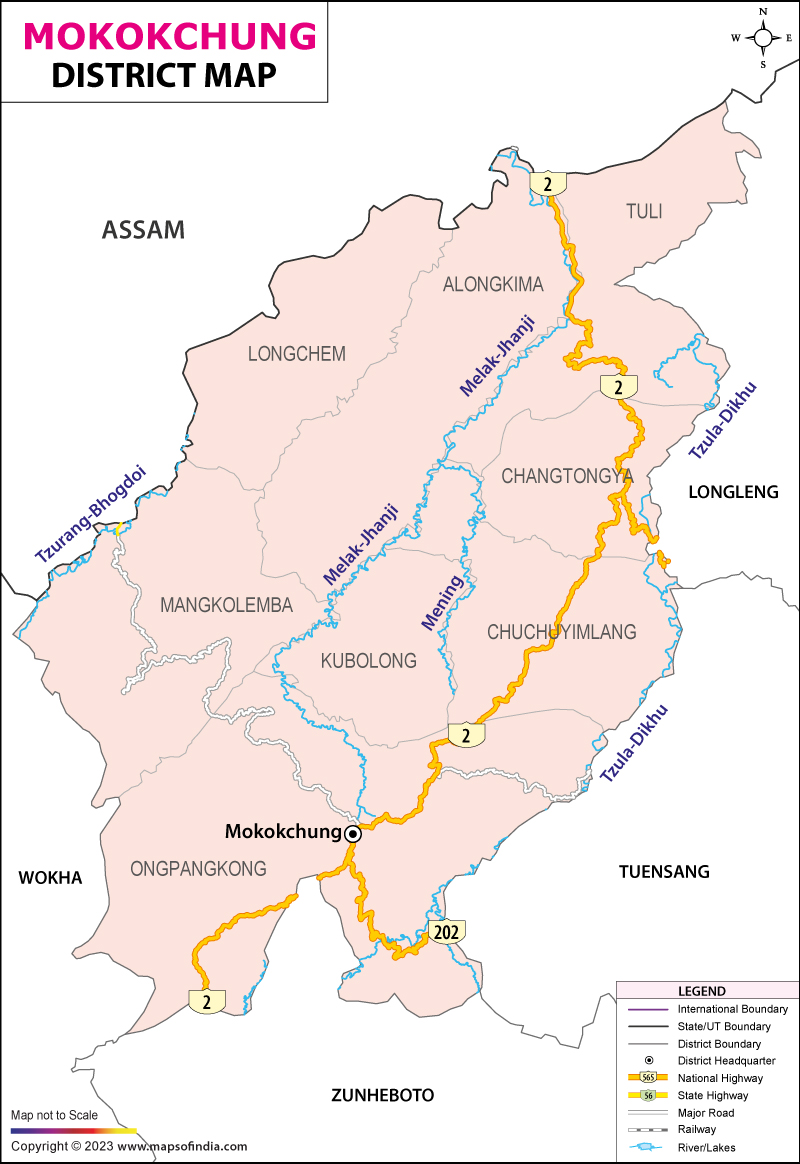
The district of Mokokchung is the highest inhabited district of Nagaland located at 26°20′N 94°31′E bordering the districts of Nagaon, Dimapur, Peren and Karbi Anglong in Assam. The district headquarters, Mokokchung town is significant for Naga history and identity as the original settlement of the Ao Nagas, the earliest educated, administrative and Christian missionary community in Nagaland. Henceforth known as "Land of Pioneers, " which testifies to the district's pioneering role, due to in reality the tribes of Ao inhabiting it were the first Naga groups who adopted formal education, written media and established an administrative system by colonial rule. The district is noted for its pine groves, tea gardens and old villages. The district has maintained its hill life with modernization over the recent years in old as well as new developments. Other notable features of Mokokchung are that it is one of the cleaner towns in the state, its abundant number of churches, Ao historical museum and its strategic location on the entry point to the cluster of historical villages like Ungma, Longkhum, Mopungchuket and Chuchuyimlang. For both the visitors and the inhabitants of the district, it has to be said that the district exemplifies one of the best models of how hill people can preserve their identity and establish modern institutions.
History & Culture
Origins and Historical Background
The origin of the Ao Naga tribe in the Konyaks' oral tradition began when a village called Longtrok meaning 'six stones', in present-day Tuensang district of Nagaland, was the site of the formation of the Ao Nagas from the six stones (fiang), which signifies the forefathers of the present Angami Nagas, which have been preserved till today. The out termed shifting people crossed the River Dikhu and affixed the name Aor (or rep. Ao, Konyak Custom) that means 'going' or 'gone ', to themselves. The other shifting people went to other Naga groups taking other directions. Arriving on the other side of the river, the Ao migrated initially to the Mokokchung Village, an already existing village today, and later further north to establish the village Ungma, now known as the oldest and biggest Ao village. This migration resulted in the creation of the present set of villages in Mokokchung district, each with a story of origin, a clan composition and a set of rules. Village life in Mokokchung remains rooted in traditional institutions like the morung which was a dormitory where young men were prepared through exposure to village principles, oral history, warfare and community values. Wood carving, weaving and bamboo craft are also common skills and these are still practiced in villages like Longkhum where handloom cloth and carved wooden objects continue to be produced using traditional methods. There are two major festivals that form the backbone of the community's annual calendar. Moatsu is held during the first week of May and is a harvest thanksgiving festival to thank the earth for its bounty, celebrate the Lijaba who is supposedly the creator of the earth, and exchange gifts and join in the age-old tradition of jhoom dancing around bonfires, singing folk songs that communicate old beliefs. The festival is most widely celebrated in Chuchuyimlang, a village that was widely known as 'the village of festivals' because of its association with Moatsu.
Economy
Economically, publication Mokokchung has its economy based on hill districts which is predominantly agriculture and services, although rapidly growing whereas government jobs and few industries.
Government Sector
Mokokchung town as the administrative headquarter of the district is the seat of various state and district administrative institutions, ranging from the Deputy commissioner's office, police administration, education and health department and various line departments of agriculture forest, rural development etc. Government service continues to be a major remunerative employment in the district. This is true for most of the hill districts in Nagaland where other than government employment private industries are almost absent. Departments with close linkages to education, districts established and known for their decades-long linkages with schooling and institutions with closer connections with horticulture and agriculture, due to the prevalence of terraced farming in the subordinate villages, continue to be major employers.
Public Sector
In the district, public activity also revolves mainly around the banking and postal sectors and the provision of public healthcare. Several dozen postal offices are spread throughout the district, housed within each of the villages that make up the district. Similarly, public sector banks have established a series of branches and ATM networks across the district's main town, expanding into neighboring circles as links between towns come into being. Finally, public hospitals and health centers, administered by the state's health department, offer the mainstay of medical care, complemented by smaller community health centers within a handful of circles.
Services Sector
There is also a services economy developing around trade and transportation, and the small-scale retail and hospitality sector. Mokokchung town acts as a marketplace for the valley where local produce and the sale of hand-loomed cloth, bamboo products and forest products like honey take place. These days, the town has seen the growth in the number of small-scale guesthouses, homestays and travel agencies catering to tourists visiting Longkhum, Mopungchuket and nearby villages. Services aimed at agricultural producers and consumers, and supporting people out-migration in the district, include the Kokoma and Chumukang transportation services linking Mokokchung to Dimapur and Kohima, respectively, and small-scale construction and retail entrepreneurs. Outside of the government work force, the cultivation of rice, maize and a range of vegetables and fruits on hillside terrace fields remains the main livelihood base in most rural households.
Tourism
Mokokchung is a place for cultural, historical and natural experiences, most of them centered on Ao village life rather than on big monuments or built up infrastructure. Ungma Village, which people say is the oldest Ao village in the region. Still present are traditional wooden structures, morungs and open community spaces, and guided tours are available for getting an in-depth feel of Ao traditions, stories and lifestyles. Longkhum Village the village of Longkhum is situated 17 and 18 Kms from the town, in the elevation of about 1,846 meters asl. It is said by the local" some of the best hill views of the north-east state can be found at Longkhum". It is well known for Rhododendron covered slopes, handloom weaving, woodcraft industries, and Ao language speakers; they call "Etangmung" the resting ground for spirits it is believed to go and not till they go to some other world. Chuchuyimlang: the village of festivals. Chuchuyimlang, known as the "village of festivals", in fact is where the main Moatsu celebration takes place every May; it is the place to see the festival of the Ao tribe firsthand. Langpangkong Caves, resting amidst hills in between the Dikhu and Tzula rivers, these caves can be called an added attraction for the district in the line of history and nature. People think an Ahom king from Assam took refuge here from his enemies once. It can be visited with local guides who could narrate about the caves both historically and geologically. The district museum, situated in Mokokchung town, completes the cultural triangle, for the museum has collections of cultural artefacts displaying Ao traditions and crafts. Together, these sites provide visitors a good enough reason to arrive in the district for experiencing not just a traditional sightseeing trip, but one to observe Nagaland hill culture firsthand.
Demographics
As per the 2011 Census of India, the latest available census, the population of Mokokchung was 194,622 with 101,092 males and 93,530 females distributed over 42,690 households. These figures are quite high and the district has been tied to education for a long time and has historical associations with missionaries also. The proportion of 0-6 year olds was as high as about 10.55% of the total population of the district. The population density in the district was towards 121 persons per square kilometre. The settlement pattern is almost same as the population distribution, where 71.37% were in urban local bodies and 28.63% in rural local bodies as per the 2011 count (a large city share for a hill district). The majority of the population in the district is Scheduled Tribe (about 91.68%) with no Scheduled Caste distribution. The languages spoken in the district are basically the Ao language and some of its dialects, which is the lingua franca in most villages and Nagamese which is also a lingua franca among the tribes, while English and Hindi have been language of instruction and administration in the school, offices and other formal human transactions. The dominant religious practice of the district has been Christianity which was rapidly embraced in the district after the coming of missionaries while it has become an integral part of the new Ao festivals and other social parameters within the old Ao traditions.
Administration
Tehsils and Circles
The entire district is divided administratively into nine taluks, called as circles/or blocks by the local dwellers. These sub-districts are Ongpangkong, Longchem and Mangkolemba with the highest number of holding records of the village in the district followed by other circles which might have a significant presence in the semi-urban and rural areas of the district. Each circle is regarded as a unit for revenue administration, development planning and village administration by the Block Development Officer.
Villages
Per the records, the Mokokchung district had only 107 inhabited villages with a single unoccupied village, among the nine circles given above. The villages are in two R.D. Blocks for the Ongpangkong circle; called the Ongpangkong North and Ongpangkong South circle, with nineteen villages. As we see in the list of all villages in the district, Ungma with 9,443 persons and 2,294 households, is the largest as the number of members versus the remaining 250 odd villages; followed by the Mokokchung Village and a few other older Ao villages mentioned above. Beyond the villages, the district has a few towns among which the town of Mokokchung is the premier urban center of the district. The village-level infrastructure ranges widely across districts. There are indicated primary schools in 106 of 107 villages, with mobile network reaching just about 100 villages, and all-weather roads linking 47 villages giving A2 access, numbers that suggest moderate use of educational resources with noted gaps in access to road infrastructure in the more remote hill circles.
| Official Name | Mokokchung |
| Location | Nagaland |
| Area | 1615 sq. km |
| Population | 1,94,622 |
| Language | Ao |
FAQs
1. How many villages are there in Mokokchung district?
Mokokchung district has 107 inhabited villages.
2. What is the population of Mokokchung district?
As per the 2011 Census, the district's population stood at 194,622.
3. What is Mokokchung famous for?
Mokokchung is known as the cultural home of the Ao Naga tribe, famous for its festivals, traditional villages, and its history as an early center of education in Nagaland.
4. What is the main language spoken in Mokokchung?
The Ao language and its dialects are the primary languages spoken, with Nagamese widely used as a common link language.
5. What are the major festivals celebrated in Mokokchung?
Moatsu in early May and Tsungremong in early August are the two main Ao festivals, alongside Christmas, which is widely celebrated across the district.
6. Which are the top tourist places to visit in Mokokchung?
Ungma Village, Longkhum, Mopungchuket, Chuchuyimlang, and the Langpangkong Caves are among the most visited attractions in the district.
Last Updated on October 27, 2026
