

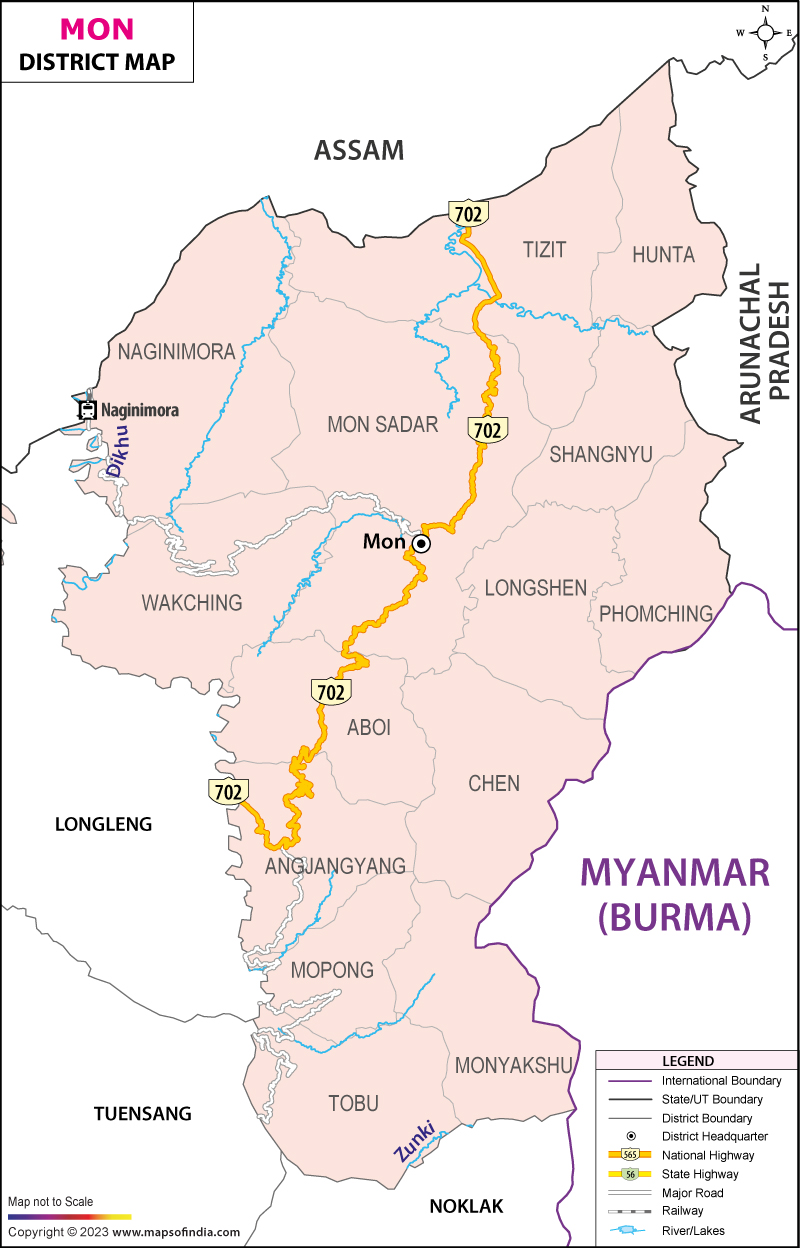





About
Mon district is named after the headquarters, Mon town. This is an administrative designation and the people of the district give it its identity: the Konyak Nagas, who comprise nearly all the district's population. Several writers refer to Mon as the land of the Anghs, a title that the hereditary village chiefs of the Konyak Nagas bore (and still do in some villages today). It is this system of chieftainship that makes Mon different from most of the rest of Nagaland.
Location and Boundaries
Located in Mon on the northern border of Nagaland, Mon district is a 1,786 sq km area with the district capital at approximately 898 metres AMSL. Arunachal Pradesh and Assam are to the north and west, Myanmar to the east, and Nagaland districts of Tuensang and Longleng are to the south and southwest. Dibrugarh in Assam is the closest major rail head about 115 kilometres away from Mon town, and buses and shared jeeps to Mon from Dibrugarh pass through Sivasagar while those from Mokokchung pass through Tuli.
Key Highlights
Here are some facts that provide a quick overview of the district. It is where the Konyaks, one of the biggest tribes in Nagaland, live. It is where there are villages with the international border passing right through a chief's house. It is where the annual Aoleang festival occurs in April. It is where there is a tradition of wood carving, ironworks, and tattooing. And it is where there is a coal-bearing belt right along the southern foothills.
History & Culture
The Konyak Nagas and the Angh System
The Konyaks have a social order built around the Angh, the chief of a village. In several villages, including Chi (also written Chui), Mon Shangnyu Longwa Tangnyu, Sheanghah Chingnyu and Jaboka, the Angh still holds a recognised place in village life.
Headhunting Past and Christian Present
Before the advent of Christianity, Konyaks were known for practising headhunting and displaying skulls to mark success and prosperity. Sheanghah Chingnyu, Langmeang, and Longwa villages and a few others have lots of skulls on display and wooden artefacts in their villages.
Arts and Crafts
Konyak wood carving is perhaps the best known art form in the state. Animal, human, and warrior figures are carved on morungs (meeting houses), log drums and other wooden objects. The Konyaks were also good blacksmiths; many items of metalcraft, even gunpowder, were produced locally. Brass and beaded necklaces (worn by men and women alike) are the most visible part of Konyak dress and even town-dwellers wear them on festival days.
Economy
Mon's economy is mostly based on agriculture. Over half of the population relies on farming for their livelihood, and one study of jhum farmers in the district found that more than 93 per cent of people depend on jhum for subsistence. Household income data from the Socio-Economic Caste Census identifies farming as the main income source in most blocks. In Angjangyang, Chen, and Mon blocks, more than 80 percent of households report farming as a source of income, while in Aboi, a higher proportion, around 42 percent, depends on casual manual labour. The district is also noted for lacking basic infrastructure, and in 2006 it was included on the national list of the 250 most backward districts.
Agriculture and Allied Activities
In the district, jhum, the age-old practice of chopping down forest by setting fire to it and then cultivating crops for a season or two, is the prevalent system. Jhum paddy is the main crop and the district's seed-saving practice also keeps various local varieties of rice alive. The district falls in three agro-climatic zones; Tobu, Chen, Longching, Mopong, and Longwa enjoy a temperate climate; Mon, Chi, and Aboi are sub-tropical and the others, Tizit Tiru Naginimora, bordering Assam, have a tropical climate. On this account, a great variety of crops, from rice and millet to vegetables, fruits, ginger, and other spices, can be cultivated and raising livestock (pigs, poultry cattle and others) is profitable. The rivers, of which the Dikhu, Tizit, Tehok, Tekang, Tapi, Kaimang, Yityong, and Telangsao are the chief, are abundant with fish.
Government Sector
Many formal employment opportunities in the district are via the state government, which employs teachers, health personnel, engineers, clerks, the police and the district administration. There is also a Krishi Vigyan Kendra established by the state agriculture department, which offers training to farmers and demonstrations. Government programs related to rural roads, rural housing, water supply and employment guarantee work all create paid employment and influence development progress. Since the district has relatively few formal jobs versus population, many families have both a government salary and livelihood via agriculture.
Public Sector
The district has a few units in the public sector and state sector. For instance, the Nagaland Plywood Factory at Mon figures in the state economic survey. Nagimora's open-cast coal mining industry elevates Mon to one of Nagaland's major coal-producing areas, with the mineral being transported by road into Assam. These industries are minimal and the coal mine concerns are typically about miner safety, regulation, and the quality of the roads, but they do provide hand-to-mouth wages for various local residents.
Services Sector
Mon town is the commercial focus. Its market brings in groceries, clothing, hardware and agricultural inputs from village customers. Banking, postal services, transport, small hotels and restaurants, and shops are all services. Tourism is an expanding part of the service industry. Homestays, small resorts (most of all the Konyak huts by the Longwa road), and guided trips to other villages support guides, drivers, cooks, and craftspeople. Items of Konyak and other cultures such as necklaces and carved woodpieces, and woven finished products sell to tourists, with the premium being around the April festivities.
Tea and New Activities
Tea is a relatively recent addition to the region's cash crop portfolio. Tea estates like Sayeang Tea Estate in the village of Shiyong now draw attention, and a tiny tea retreat on the estate provides accommodation. As with horticulture and bamboo-related work, many local planners see tea as a route to increasing incomes, not solely through reliance on jhum.
Tourism
Longwa Village
Longwa is the most popular place to go in the district. Located about 35 kilometres from Mon town by road (a ride of around two hours), it straddles the India-Myanmar border and a border crossing runs through the house of the village Angh, making it possible to sleep in one country and eat in another. Longwa is a hillside village with carved morungs, log drums, old totems and weapons. The house of the Angh and village areas nearby are interesting for photographic projects, mostly during Aoleang.
Shangnyu Village
Shangnyu is a thriving village close to the town of Mon and governed by its own Angh. It's known for its traditional morung, carved wooden artifacts and a large monolith linked to the village's distant past. A good place to stop for those wanting to see how the Angh's house is laid out and learn about carving traditions.
Chi (Chui), Wakching and Other Angh Villages
Chi is one of the oldest villages in the state and walking into the Angh's house here offers you an insight into how leaders have ruled the village for ages. Wakching is one of the biggest festival venues and the centrality of Aoleang to its culture cannot be missed. The chief's houses of Tangnyu, Sheanghah Chingnyu and Jaboka also open their doors for guests who come with good etiquette. You can also see skulls at Sheanghah Chingnyu and Langmeang with carved posts.
World War II Remains and Rock Inscriptions
Chiknyuho, Shawot, Ngupdang, and Longwa are famous for the artifacts dating back to the era of the Second World War and the rock inscriptions. For history buffs and history researchers, these places hold great historical significance as the spot of the district's association with the rest of the region.
Veda Peak and the Hills
Veda Peak, approximately 70 kilometres east of Mon, is the highest point in the district. The outlying ridges have trekking, picnic, and fishing sites and the hill views over layered forest are a scenic lure on their own. Mon is another destination to catch the last visible remnants of the older village life in Nagaland, with units of villages all within an hour or less of each other.
Demographics
Population
As per the 2011 Census, Mon has a population of 250,260 with 131,753 males and 118,507 females. This is a decrease from the 2001 population of roughly 260,652, giving a decadal change of about minus 4 per cent. The density is approximately 140 persons per square kilometre. About 215,816 people live in rural areas and 34,444 in urban areas.
Languages Spoken
The main language is Konyak, which is spoken by about 94.56 per cent of the population. Each village has its own sub-dialect and those from distant villages can easily discern them. English is the district administrative language and medium of instruction in most of the schools. Nagamese (a trade language that is already popular throughout Nagaland) enables communication between people of various tribes as well as with people from the border area of Assam. Hindi is also understood by many in town.
Administration
Administrative Structure
Mon district is administered by the Deputy Commissioner and Additional Deputy Commissioners in the district, with the sub-divisional officers and circle officers. Mon district comprises 14 sub-divisions or circles or tehsils and has a total of 2 towns and 131 villages.
Tehsils (Circles)
The 14 administrative circles are Aboi, Angjangyang Chen Hunta Longshen, Mon Sadar, Monyakshu, Mopong, Naginimora, Phomching, Shangnyu, Tizit, Tobu, and Wakching. Mon Sadar has the largest population at about 47,977 (2011) and Shangnyu the smallest (6,138). Monyakshu, Tizit, and Angjangyang have populations of over 20,000.
Villages
There are 131 villages in the district based on the Census. The village-level tables by circle occasionally include some current headquarters, wards, or recently separated settlements as separate entries so sometimes the counts are higher than expected in some circles. Angjangyang circle has 11 entries, Monyakshu and Tizit 12 and 16. Larger villages include Longwa, Monyakshu, Tizit, and Angphang. Traditional village council and elected body governance of many villages maintains customary law in practice while state law is in use.
| Official Name | Mon |
| Location | Nagaland |
| Area | 1786 sq. km |
| Population | 2,50,260 (2011) |
| Language | Konyak |
FAQs
1. What is the population of Mon district?
The 2011 Census recorded a population of 250,260, including 131,753 men and 118,507 women.
2. What is Mon district famous for?
Mon is famous for the Konyak Nagas, their Angh chieftainship, wood carving and the Aoleang festival.
3. What is the headquarters of Mon district?
Mon town is the district headquarters.
4. When is the Aoleang festival celebrated?
Aoleang is celebrated in the first week of April, usually from the 1st to the 6th.
5. Which tribe lives in Mon district?
The Konyak Nagas form the main population.
Last Updated on October 27, 2026
