

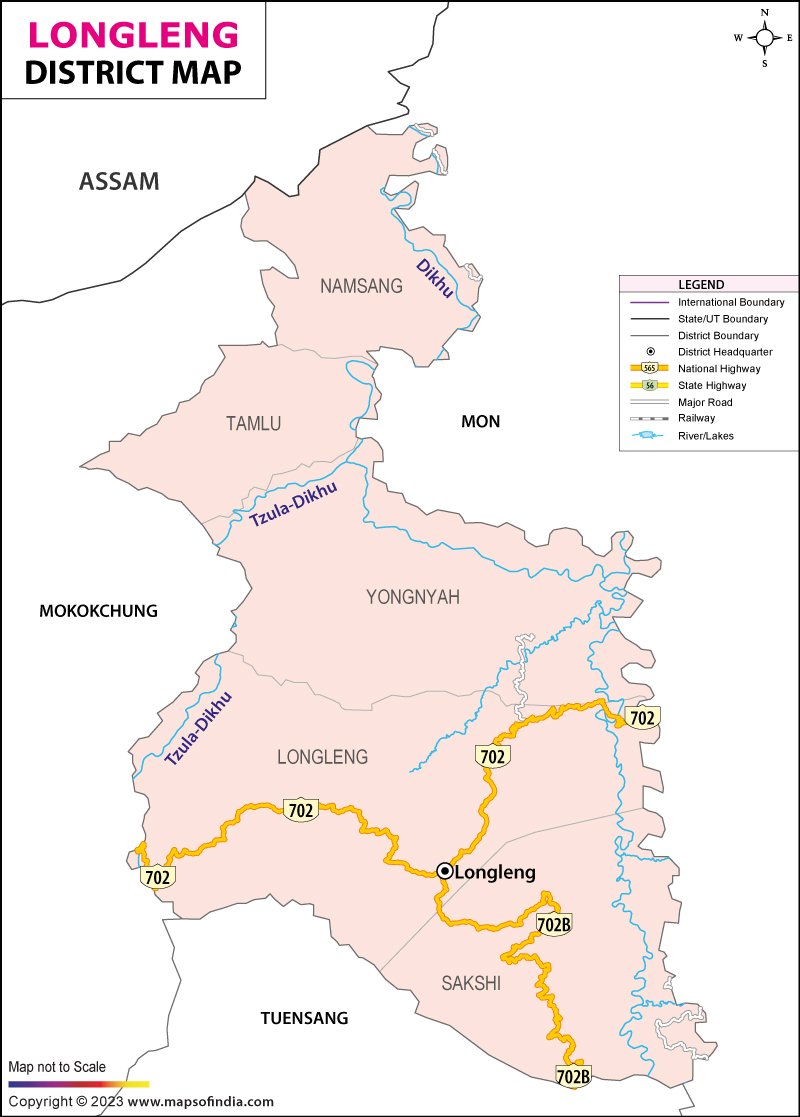





About
The district of Longleng is situated in the north of Nagaland, which is colloquially referred to as the "Land of Clouds" and is indeed surrounded by mist at its headquarters town, situated around 1,100 metres above sea level. Longleng District was carved out of the erstwhile Tuensang District in 2004, to become the tenth District of Nagaland and is now the sole district in Nagaland where the Phom Naga tribe is the sole indigenous community of the state.
The district is flanked by Mon District in the East, Mokokchung District in the West, Sivasagar District of Assam in the North and Tuensang District in the South, thus having a border with the Naga Hills as well as the Assam plains. The district encompasses an area of some 885 square kilometres, and its relief is very steep, ranging from about 150 metres to 2,000 metres, which are traversed by the Dikhu and Yongmon rivers, dividing the terrain into a succession of steep ridges and forested valleys. The least populated district in Nagaland based on the 2011 Census, Longleng has for a long time been recognized as "The District of Handicrafts" for its unique handicraft traditions.
History & Culture
The administrative history of Longleng is relatively recent and dates back to decades when it was a part of the larger district of Tuensang, before it was officially separated in 2004. The Phom people had lived there for many generations before this, and even before any formal Indian administration, when the villages were located on the ridgelines of the district, and each Chieftain and his council were leaders over their own village, typical of the Naga tribal system. The district's topography also has physical evidence of a more complex history: the Yongshem cave, also known as the Ahom Raja Cave, which is a mere few kilometres from Longleng town, is associated with the Ahom kingdom which once ruled the adjoining plains of Assam, and is a tangible link between the hill and valley communities that have inhabited this frontier region over many centuries.
Culturally, Longleng is an integral part of the Phom tribe and the district is the only abode of Phom in Nagaland. The Monyiü festival is the most important cultural event in the district and is traditionally celebrated in a very somber manner in the village of Pongo and is a key seasonal event in the Phom agricultural and social calendar. The communal dormitory, traditionally an integral part of Naga village life and youth education, is still preserved in a number of villages, especially in Yachem village (Yakang Morung) and Tangha village (Jechong Morung) which are the more prominent examples of the traditional architecture. Longleng artisans have also established their own identity across Nagaland for their craftsmanship, especially the Phom shawl, a product of their skill which is still in practice in villages across the district. Woodcraft and bamboo work are also practised traditions which are still in existence in the villages of Nagaland and have been handed down from generation to generation. On the other hand, Christianity has emerged as the predominant religion of the district, akin to the rest of Nagaland, and churches are now a focal point of village life in almost every village.
Economy
The economy in Longleng is still small-scale and subsistence-based, with little industrial development, but the handicraft traditions provide a genuine anthropological-economic thread to the area, albeit on a small scale.
Longleng town is the district headquarters, and the Nagaland state government departments are located in the town to supervise the three community development blocks and six administrative sub-units of the district. In a small district, with less private sector activity, Government employment is one of the most important and stable livelihoods available to the people.
Public Sector: There has been a significant investment in basic infrastructure in the public sector in Longleng, particularly in rural electrification, with 38 villages now connected, and in road connectivity between the district's scattered hill villages with 2 main villages of Longleng and Tamlu. The district has a difficult topography and the need for ongoing public funding for transport and communications is a key factor in economic development in the area.
The overwhelming majority of Longleng's rural population rely on the services sector primarily through traditional jhum (shifting) agriculture on the steep hillsides of Longleng district with some areas of terraced wet-rice cultivation where terrain permits. Improved livelihoods are generated by the district's officially recognised handicraft sector, woven shawls, woodcraft, and bamboo with many of the crafts linked to the district's identity. Longleng has been given the government tag of "The District of Handicrafts. In addition to these, higher education is ensured by the role of the affiliated Nagaland University and UGC approved Higher Education College (HEC) – Yingli College which has become an important educational hub for the youth of the district and a chain of schools established by various missions which continues to influence the education system in the district.
Tourism
Although Longleng's tourism image is still small and relatively unexploited for the general tourists, it is certainly an authentic blend of Phom tribal culture, traditional architecture and natural landscape.
Bhumnyu Village — an interesting Phom village with a glimpse of the traditional settlement pattern and the life of the hill communities.
Yongshem Cave (Ahom Raja Cave) is a natural cave, which is about three kilometres away from the town of Longleng and has a historical association with the neighboring kingdom of Ahom of Assam and is of interest to those who are interested in knowing about the historical linkages with the neighbouring states.
The traditional celebration spot of the Monyiü festival is Pongo Village, where one can experience one of the most important cultural events of the Phom community.
The preserved traditional communal Morung structure (Yakang Morung and Yachem Village): A direct architectural connection with the historic Naga village organisation and youth education system.
Another important traditional Morung is Jechong Morung, Tangha Village, also the remaining part of the architectural heritage of the district.
A group of villages, Yongnyah, Nian, Sakshi, Buranamsang and Hlikphang Villages, recommended for visitors who wish to experience the traditional way of life among the Phom Nagas, outside the busy tourist circuit.
Demographics
The population of Longleng district is 50,484 as per the 2011 census, with 26,502 males and 23,982 females, with a sex ratio of 905 females per 1000 male, which is below the state average of Nagaland. This was the lowest population in the state (9th) at the time and was a bizarre decline of 21.57% from the 2001 population of the district, which was due to boundary and enumeration changes after the bifurcation of the district from Tuensang earlier, according to various official reports. According to detailed statistical compilation from the census, the literacy rate in the district was 72.17%, which was 74.48% for males and 69.63% for females, but there is some level of discrepancy in the published figures, as older figures from 2001 show a literacy rate of 44.82% separately on the district's official website.
The population of Longleng district is reported to be completely tribal, consisting of the Phom Naga tribe alone. Phom is the most commonly used language, used by approximately 93.68% of the population, and Konyak is used by a smaller portion of the population, though there are some tribal populations from neighbouring tribes who also use this language. The district is largely dominated by the Christian community with around 96.76% of the population being Christians, similar to the pattern observed in most of Nagaland.
These combine to paint a picture of a small, cohesive and largely tribal population, living in isolated hill villages and linked together by an emerging road network and infrastructure network. The district's high cultural and craft presence, even though it is comparatively low-density, and its unusual demographic history in the decade between the 2001 and 2011 censuses suggest that the district continues to establish its administrative and developmental bases while maintaining its cultural and craft presence, even as it is shaped by the legacy of the historic period.
Administration
Longleng district is divided into 3 community development blocks, each having a Block Development Officer (BDO): Longleng, Tamlu and Sakshi, with each of the former two blocks having a Deputy Commissioner (DC) and the latter 3 having an Extra Assistant Commissioner (EAC). It is a district consisting of 63 villages and 1 municipality with its headquarters at Longleng town.
The District Executive Force, under the charge of the Superintendent of Police, Additional Superintendent of Police and Sub-Divisional Police Officer, is in charge of law and order throughout the district. There are 2 police stations at Longleng and Yanglok and a police outpost at Tamlu. The district administration (based in Longleng town) manages revenue and general governance in the blocks and administrative units of the district, with the traditional village council retaining an important role over issues of local governance, which are typical of Naga society.
| Official Name | Longleng |
| Location | Nagaland |
| Area | 885 sq. km |
| Population | 50593 |
| Language | Phom |
FAQs
Q1. How many villages are there in the district of Longleng?
There are 3 community development blocks in Longleng district, comprising 63 villages.
Q2. How many people live in Longleng district?
According to the 2011 Census, the district had the lowest population of 50,484 among all the districts of Nagaland.
Q3. What does Longleng district specialise in?
Longleng is popularly known as the exclusive land of the Phom Naga Tribe and is also the government-officially recognized handicrafts district.
Q4. What percentage of people in Longleng district are able to read and write?
The literacy rate, 2011 Census (Detailed census-based compilations), is 72.17%, while according to official sources of the district, it is 44.82% (2001 Census).
Q5. Longleng district has how many blocks?
The district has been divided into three community development blocks namely Longleng, Tamlu and Sakshi and into six administrative units.
Q6. When was Longleng district formed?
The district of Longleng was carved out of the erstwhile Tuensang district in 2004 to become the 10th district of Nagaland.
Q7. What do the Morungs in Longleng district mean?
Preserved examples of Morungs in the district, such as the Yakang Morung in Yachem and the Jechong Morung in Tangha, are traditional communal dormitories that historically played an important role in the education of Naga youth and the life of a Naga village.
Q8. What are the main activities in the economy in Longleng district?
The economy of the district is based on subsistence agriculture mainly in the form of jhum, and a well-established handicraft industry making woven shawls, woodcraft and bamboo crafts.
Last Updated on October 27, 2026
