






About
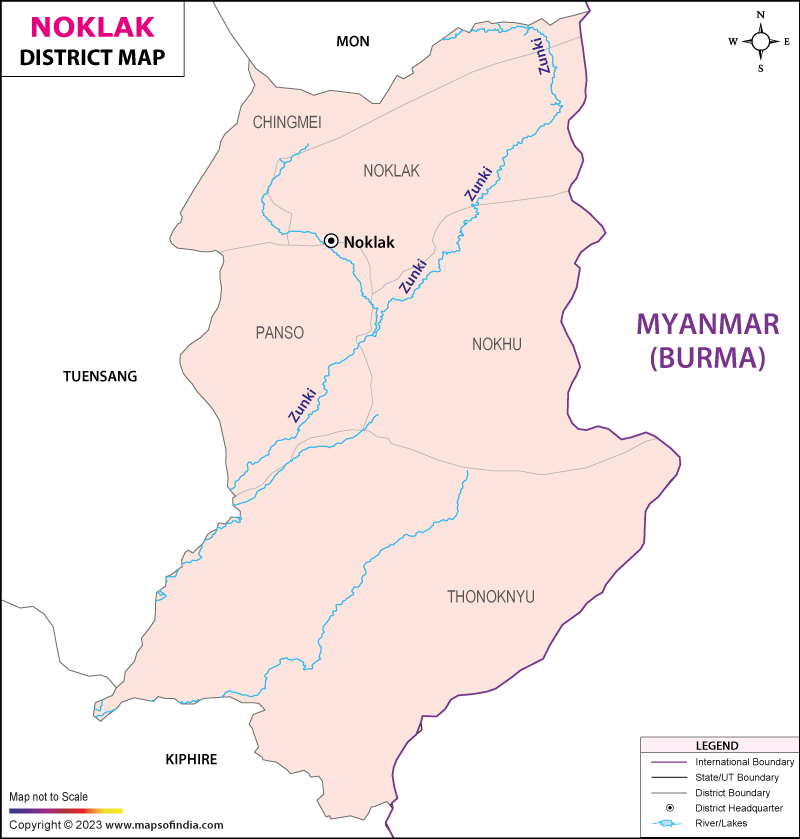
Nagaland's far-eastern frontier is the Noklak district, bordering the Patkai mountain range and Myanmar. With years of demand from the Eastern Nagaland Peoples' Organisation, Noklak was upgraded to a district of Nagaland on 21 December 2017, having the same boundaries as the erstwhile Noklak sub-division of Tuensang district. Noklak is one of the newer, farthest and truly out-of-the-way districts in Nagaland.
The district is flanked by the Sagaing Region of Myanmar to the east while the watershed of the Patkai range forms the Indo-Myanmar boundary to the rest of the district with Tuensang district of Nagaland. Noklak town, the district headquarters, is located approximately three hours' drive from Tuensang on Chendang Saddle along NH-202. The district consists of five administrative circles, Noklak, Thonoknyu, Nokhu, Panso and Chingmei, where the Khiamniungan Nagas are the major tribesmen, with the Chang tribe also residing in the villages of the Chingmei range to the north. The Khiamniungan homeland is unique in that about 50 Khiamniungan villages are in Noklak district, and the other 150 are in Sagaing Region, Myanmar (although about 32 are in Myanmar, rather than India), so that one of the most clear-cut examples anywhere in India of an international boundary cutting through a single indigenous community's ancestral territory.
History & Culture
Although the modern administrative history of Noklak is short-lived, it existed as a sub-division of Tuensang district until it was elevated in 2017; the Khiamniungan people have been residing in this rugged and mountainous area of the Naga Hills for many generations, with the origin of the people being told to have been around a place called Khiamnyunga, near the present-day village of Patsho, from where groups are said to have dispersed to settle the present-day villages in the district. Like other neighboring Naga tribes, the Khiamniungan Nagas were once great warriors, and village war and headhunting continued until well into the 20th century despite British efforts to put an end to them. Only two kilometres from the international border with Assam is Pangsha village, site of a notorious headhunting raid on the Chang Naga village of Kejok in 1936, which triggered a massive British punitive expedition involving Political Officer J.P. Mills and 500 sepoys, one of the final major colonial military operations in the Naga Hills.
The conversion of the Khiamniungan community to Christianity started in 1947 and in the past few decades it has become the overwhelming majority of the tribe, although a few other Khiamniungan dialects exist in the villages of the district and the Khiamniungan speak Thang as the language of communication. The role of Traditional Morungs, or Meya Kam, in village life is still the main place for the villagers to hold important discussions. The tribe is also well known for its cane work, handicrafts and artefacts, which continue to form a large part of the cultural identity of the district even today. To this day, there are active trade, cultural and even matrimonial ties with the people across the border at Khiamniungan, Myanmar, and these cross-border ties have not been significantly weakened by the formation of the international border.
Economy
Owing to its remote location and its location directly on the Indo-Myanmar frontier, Noklak's economy has remained one of the least developed and the most subsistence-oriented in Nagaland.
Government Sector: Noklak, one of the youngest districts in Nagaland, has placed considerable emphasis on establishing basic governance facilities since 2017 with the district headquarters at the town of Noklak where the district collectorate and other government services are operating from, with each of the five administrative circles having its own office.
Public Sector: While the villagers have traded cattle across the border for the past few centuries, there is no official public infrastructure to formalise and boost these activities except for the Dan, near Pangsha village, in the northern part of the district, where the International Trade Centre at Dan has been established to facilitate these activities. In the current scenario, the need for public investment in road connectivity, specifically for the Chendang Saddle road from Noklak town to Tuensang, is a continuing concern due to being in an isolated district.
Services Sector: As much as 90% of the population of Noklak is engaged in agriculture, and most of its population is engaged in jhum and settled paddy cultivation over the steep hill areas of Noklak district. The forest stands are very dense, with primary forest consisting of wild spices, especially cinnamon, which may provide some opportunities for forest livelihoods, which are not fully developed commercially. In addition, traditional occupations such as cane work and handicrafts, for which the Khiamniungan is renowned, are another source of income, albeit limited, among the villages of the District, where these activities are still practiced, and from which they continue to trade with the other villages of the Khiamniungan in Myanmar.
Tourism
Noklak's tourism image, although largely untouched for the masses, is largely defined by some of the most truly remote and historically significant frontier villages in Nagaland.
Pangsha Village — which has significant historical resonance from the Naga tradition of warfare, and the British punitive expedition of 1936, as well as more recent history in that it was attacked in 1957 and defended by determined villagers of Khiamniungan — is only two kilometres from the Myanmar border.
Noklak Town (the district capital) itself provides the visitor with its base from which to visit other villages in the Noklak area, including a base for sightseeing trips to the mountains and valleys of the eastern Naga Hills.
Border trading post Dan — a true, working example of the informal cross-border trade that remains the lifeline for many Khiamniungan communities on both sides of the Indo-Myanmar border, through a place known as International Trade Centre — Dan.
In the Wui Village, the pottery, blacksmithing, and the extraction and metallurgy of iron ore that have been performed for centuries are still visible.
Patsho Range Villages: an area of villages in the western part of the district, with distinct culture and rich natural resources, and closely related to the dialect and the oral culture of Patsho Khiamniungan.
Thonoknyu and Panso Circles are administrative centers with the opportunity of experiencing the life of the Khiamniungan village without the developed tourist infrastructure.
Combined, these locations create a tourism portfolio that is overwhelmingly about remoteness and culture, and is currently attracting mostly researchers, anthropologists and a small but growing number of culturally motivated tourists – those who are captivated by the scenic mountain setting of the Patkai and the fact that it sits at the most authentic border between India and the rest of the world. In recent times, the Indian government has been making efforts to formalize the India-Myanmar border demarcation and fence the border between the two nations, which has now given the district a political dimension in its tourism offerings; future access to the villages of Pangsha could be influenced by the evolution of the broader border policies in the upcoming years.
Demographics
Noklak district had a population of 55,434 as per the 2011 Census and the sex ratio stood at 921 females per 1000 males. Total workers stood at 9,785, of which 6,143 people were recorded as cultivators and the district was overly dependent on agriculture. However, later estimates made using the Aadhaar data put the district's population in 2021 at about 24,189, indicating that the population has continued to grow – albeit at a lesser rate – since the district's formation and the previous Census in 2011.
The Khiamniungan tribe comprises the bulk of the population of Noklak and the Chang tribe is also located in the villages in the Chingmei range to the north. Within the district a number of related languages are spoken in the villages, with Patsho Khiamniungan and the other dialects, such as Thang, Veulam and Tikhir, all being used in the villages, although there is some variation between the different clusters of villages. Thang is generally used in the villages as a common language. Christianity is the dominant faith with a mission beginning in 1947, but surprisingly animist faiths and practices remain in the Khiamniungan until well into the 20th century when organized Christianity began to take hold.
These numbers illustrate one of Nagaland's smallest and newest districts, its people spread out over what is truly a "frontier" state with rugged terrain, in cultural, if not political terms, separated from a much larger population of Khiamniungan nationals just across the international border in Myanmar. This transnational demographic reality is perhaps more defining of Noklak's population than any statistic would suggest, and is not found in many Indian districts.
Administration
The district of Noklak has been divided into 5 administrative circles, Noklak, Thonoknyu, Nokhu, Panso and Chingmei, in line with the former Noklak sub-division of Tuensang district, which gave birth to Noklak district in 2017. The district headquarters is at Noklak town from where it is connected to Tuensang through Chendang Saddle on NH-202 that takes about 3 hrs. of driving.
The district administration based in Noklak town carries out administration of revenue and general affairs in the five circles with the support of traditional Khiamniungan and Chang village councils, which retain a high degree of influence over local governance issues like that of Nagaland. The district is also located at the Indo-Myanmar international border and the administration therefore works closely with the Assam Rifles and other security forces regarding border security, trading control and lately, the sensitive issue of border fencing and demarcation, which has been a matter of concern for the locals as it has the potential of impacting the cross-border community and family ties.
| Official Name | Noklak |
| Location | Nagaland |
| Area | 1152 sq. km |
| Population | 55434 |
| Language | Khiamniungan |
FAQs
Q1: How many villages are there in Noklak district?
Noklak district is divided into 5 administrative circles, namely, Noklak, Thonoknyu, Nokhu, Panso and Chingmei, and the Khiamniungan and Chang villages are scattered in the frontier area of the district.
Q2. How many people live in the district of Noklak?
According to the 2011 Census, the population of the area now covered by Noklak district was 19,507 and as per the recent estimates of Aadhaar data, the population in the area in 2021 is around 24,189.
Q3. Which is Noklak district known for?
Noklak is mostly known as the habitat of the Khiamniungan Nagas, its geographical location right on the Indo-Myanmar border and the historical villages such as Pangsha, where a punitive expedition by the British was conducted in 1936.
Q4. In which languages do people speak in Noklak district?
All the villages of the district use Patsho Khiamniungan as their mother tongue along with its related dialects such as Thang, Veulam and Tikhir. Thang is used as a common medium of communication among the villages of Khiamniungan.
Q5. What is the number of circles in Noklak district?
The district can be divided into 5 administrative circles namely Noklak Thonoknyu, Nokhu, Panso, and Chingmei.
Q6. In which year Noklak district came into existence?
The Noklak district was created on 21 December 2017 and was the 12th district of Nagaland, with boundaries the same as the Noklak sub-division of Tuensang district.
Q7. Why is Pangsha village important?
Pangsha is only two kilometres away from the border of Myanmar, and it is of great historical significance in relation to traditional Naga warfare and headhunting practices one of which led to a large-scale British punitive expedition in the district in 1936.
Last Updated on October 27, 2026
