






About
Wokha is situated in the mid portion of Nagaland and is the home ground of the Lothas, the largest tribe in Nagaland. Wokha is wild, rustic and joyful. The location acquired its spot on Nagaland Tourism map in 1876 when it was marked by the British. A district with river and hills such as Mount Tiyi and Totsu Cliff, it is naturally still crowded with trekkers from different parts of the world. The land is a sight to behold for its carpet of bright flowers and orchards for the rest. Best places to visit in Wokha on holiday: Liphanyan Governor’s Camp, Vankhosung, Doyang Hydro Project and Water Pool.
History & Culture
In the year the British Government occupied Wokha as the District Hq. of Naga Hill under Assam.In 1878 the Hq was relocated to Kohima and Wokha remained as Sub – Division. In 1889, the Sub-Division was relocated again to Mokokchung. It was only in the year 1957 when Mokokchung was created as a District with the creation of NHTA Wokha again became a Sub-Division. In the first General Election of January 1964, there were Five (5) Assembly Constituencies in the Sub – Division, which was one of the total of 40 Constituencies for the State of Nagaland. Then Mon and Tuensang were under the direct supervision of the Governor for a period of 10 years. In 1973, Wokha District was created and the third General Election was held in 1974, with an additional 20 Constituencies for Tuensang and Mon District. In this election the number of Assembly Constituency for the Wokha District was reduced to 4 in the re - allocation of constituencies and it is still the same till date.
The Topography of the district is more or less similar with that of other district in the state. having ranges and ridges dissected by seasonal streams. the altitude varies from 304.3 Mtrs to 1313.67 Mtrs (MSL). The climate is mild in summer in the plain areas and relatively warm in the upper region but frigid in winter. Monsoon starts in May and continues into October. Average yearly rainfall varies from 200 cms to 250 cms.
The tallest mountain peak is Tiyi Enung at an altitude of 1970 mtrs. Many important rivers such as Nzhu and Nruk cut across the District. The district lies in a seismic active earthquake zone.
Wokha is also renowned for fruits including Oranges, Passion fruits, Plum and Banana. Soil types are recent Alluvium, old Alluvium Mountains valley Lateritic soil, brows forest and podzolic soils.
For the vast majority of people living in the rural area, agriculture and related activities constitute the main source of livelihood. Rice is the principal cereal crop and constitutes 77% of the total cultivable land. Other important crops farmed are maize, tapioca, pulses, soya beans and variety of organic vegetables, which are accessible in the local market year around.
The basic food habits of the people include Rice, Bamboo shoot of various varieties, fermentation of dried fish, yam, Molasses, Vegetables and meat which is a delicacy. Mostly foods are boiled and species are seldom used. They are highly picky, both as to the preparation of their meal and as to the habit of tasting.
The residents of the district also follow certain traditional cottage Industries usually in the off season to suit their local necessities like black smithy, traditional weaving, carpentry and handicraft etc. minerals like coal and cude oil are found at changpang area in the lower range.
If you are lucky to visit Wokha around the month of November, you will undoubtedly appreciate the hospitality of the people during their Principal festival”TOKHU EMONG” which is characterized by thanksgiving, sharing and reconciliation with enormous feasting.
Economy
The farmers of Wokha district have been involved mostly in traditional Agriculture. So, the rural economy is largely dependent on the success of Agriculture sector. Agriculture department strives to foster a technically sound, economically successful, environmentally non-degrading and socially acceptable sustainable agriculture development in the district utilizing the natural resources, land, water and genetic endowment based on the background reality.
The farmers mostly depend on Jhum/Shifting farming due to the geographical landscape. The type of farming system practices in the District is the traditional Jhum, Terrace Rice cultivation (TRC) and Wet Rice Cultivation (WRC) in the Foot hills and Plain area. In shifting cultivation mixed cropping pattern is followed with cereals, pulses, oilseeds, tubercrops, spices and condiments using native cultivars which are organic in nature.
The economy of Wokha in Nagaland is primarily agrarian with self-employment and informal livelihoods being the mainstay of the local economy. 1% employment in small and medium enterprises in registered MSMEs. 62% MSMEs in services and 38% in manufacturing. EPFO covers 6% of employment force. Bank deposits per capita of working age are far below the national average. The state's DPIIT One District One Product designations are Banana and Banana Products, Ginger, and Passion Fruit. Higher-secondary enrollment (classes 9-12) is 19%. The workforce is majority tribal.
Tourism
Adventure Camp at Doyang water sports zone (Doyang Hydro project)
And the potential and diversity it possesses is maybe considerably more than many existing places. Tourist amenities like Tourist Reception Center, Log Hut, Tribal Rejuvenation and Cafeteria are being developed in Doyang Water Sports Zone.
Doyang river is one of the important river of the district. The largest and longest rivers are near the southern border of the state. The Angami people in whose territory it rises calls it Dzu or Dzulu. It first flows practically directly north, gradually curve towards east when it acquired an addition of Saju, an eastward parallel tributary. The river then reaches Zunheboto district still flowing north westwardly. It later on forms a boundary line between Sema and Lotha areas. In the west of Litami it makes westward bend and emerged in the western Lotha area in Wokha district, and proceeds to the southern border of the district, it suddenly turns westward and then debouches the hills for the plains west of Koro village and then finally falls in the Dhansiri river of Assam valleys.
Many small hill streams from other districts have fallen into Doyang’s central and western parts. It has got three main tributaries such as Tsui, Tullo and Tishi.The Keleki and Tangki streams merge to form the Tullo, which is joined by the Tishi in the Sema area. Doyang is not only essential river for Wokha district alone but it is also equally an important river of Nagaland. In the valley along the Doyang river the modern system of cultivation like terrace is being carried out successfully, especially in two particular areas near Pangti village called “Pofu hayi” and “Tentsu hay”. Besides veggies, fruits like banana, pineapple, papaya etc are cultivated in plenty and luxuriance in these two places.
Bird Watching:
Roosting site of Amur Falcon (Falcon Amurensis) lies on the way to Pangti village near Doyang valley. It is also renowned as the Amur Falcon capital of the World. The optimum period to watch roosting of the birds is from second week of October to the first week of November. Camping place are offered by the villages for trekkers. Best months to visit are between October and May when the countryside wears a green carpet and the flowers light up the skies with their vibrant hue.
Liphanyan Governor’s Camp
About 45 kilometers from Dimapur, Assam, you may locate the tourist attraction, Liphanyan Governor’s Camp sitting in the slopes of Wokha, Nagaland. The camp is adjacent to the Doyang River and affords a fantastic view of the meandering ways of the river amidst the mountains and valleys. While the river twists and turns through the mountains, one may watch the trees and woods of the place. Liphanyan Governor’s Camp is a safe spot to visit while bonding with the untamed nature’s way of life.
Mount Tiyi
Mount Tiyi is one of the most popular tourist attractions of Wokha, Nagaland. While you are in North East India sightseeing and enjoying an experience up in the mountains and freshwater rivers, Mount Tiyi is surely one of the spots to visit. Mount Tiyi is a hot spot for tourism and education with amazing folklores and beautiful natural vistas. There is an educational institute at Mount Tiyi dedicated to teaching undergraduate collegiate subjects. One may definitely understand how great it must be to be surrounded by the magical, magnificent hills and learn amidst it. Mount Tiyi is fairly famous for its secret orchard which only few have been lucky to discover; who knows maybe you might be the lucky one once you visit Mount Tiyi. Even if you are not able to find the hidden orchard, the hill is filled with colorful rhododendrons which brightens up the entire view and gets everyone to exclaim wow. This mountain is supposed to be the home of departed spirits and many supernatural beliefs are associated with this area. This hill is also called "the mountain of life" because of the life-giving waters that flow from the summit of Tiyi.
Demographics
Wokha district is home to a sizeable population and high population density. From the 2011 Census which you can see in government reports the population is of the tune 1.66 lakh in present district report. Also the present district website reports a literacy rate of 87.69 percent.
A great portion of the population lives in rural areas. In that setting agriculture is very much a main source of income for rural households. Also fishing, animal husbandry, small scale trade, transport and crafts provide for their income.
Wokha district has a large number of rural villages. In these villages they put up with issues related to hilly terrain, heavy rainfall and road connectivity. Such conditions affect agriculture, homes, transport and access to public services.
Administration
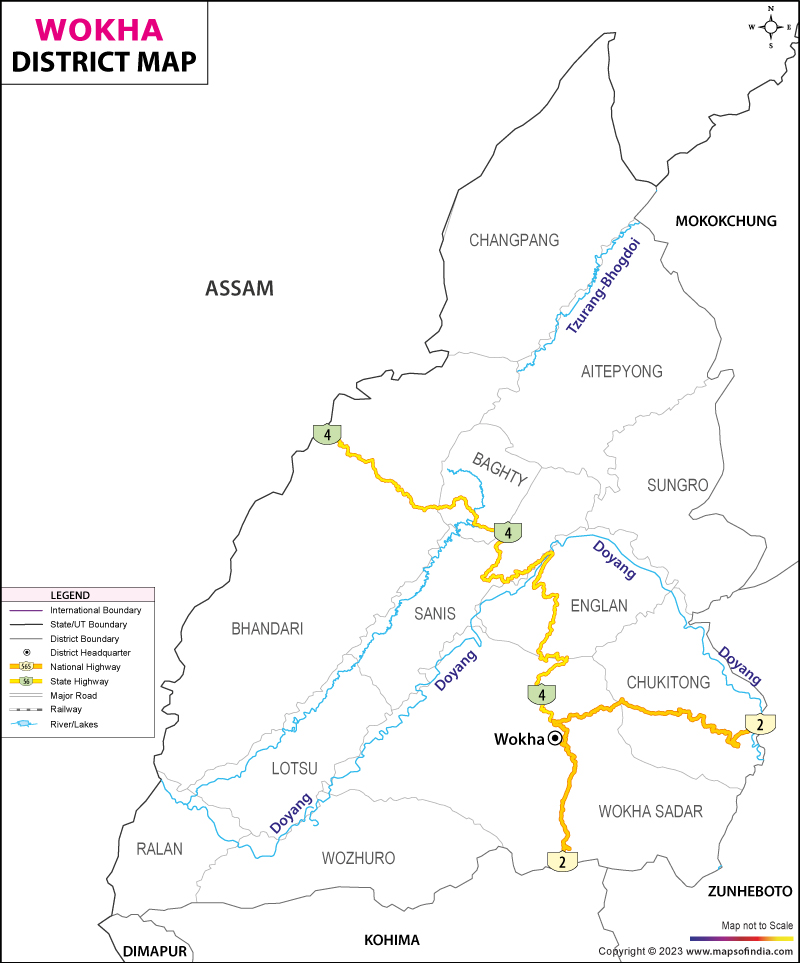
The district is administered by a Deputy Commissioner under whom there are administrative circles each headed by either Sub-Divisional Officer(Civil) or Extra Assistant Commissioner. The administrative circle are Changpang, Aitepyong, Bhandari, Baghty, Sungro, Sanis, Lotsu, Ralan, Wozhuro, Wokha Sadar and Chukitong.
The jurisdiction of some of the R.D. Blocks are spread over more then one revenue circle. The district Headquarter, namely Wokha is under Wokha Sadar circle. The distance of the district headquarter is 80 k.m. from Kohima the State capital.
There is an Additional Deputy Commissioner’s Office at Bhandari under him are 2 (two) E.A.C Hqs. namely Changpang and Baghty, Ralan E.A.C Hq. has recently upgraded to Sub – Divisional Hq. with S.D.O (C).
There is Sub – Divisional Hq. at Sanis with S.D.O (C) and under him are 3 (three) E.A.C Hqs. namely Sungro, Lotsu and Aetipyong. The entire establishment is administered from the District Administrative Hq. at Wokha. Wokha is the headquarters of Wokha district and the main centre for government administration in the area.
| Total Population | 166,343 |
| Male Population | 84,505 |
| Female Population | 81,838 |
| Population Density | 102 to 105 people per square kilometer |
| Sex Ratio | 968 females per 1,000 males |
| Overall Literacy Rate | 87.69% |
| Male Literacy Rate | 90.81% |
| Female Literacy Rate | 84.48% |
| Urban Population | Around 21.04% |
FAQs
Q.1: Which river flows through Wokha?
The Doyang and Chubi are in the group of important rivers which pass through Wokha. Also these rivers play a key role in agriculture and irrigation in various parts of the district.
Q.2: Which crops do we see in Wokha?
Rice is the main crop in Wokha. As to other crops which farmers grow are maize, millet, pulses, vegetables and also a variety of fruits which do vary by local soil and water conditions.
Q.3: What is Mount Tiyi known for?
Mount Tiyi is known for its natural setting, forested hills and cultural value. Also a very popular spot for those interested in nature and outdoor activities.
Q.4: Which communities live in Wokha?
Wokha is home to a diverse community which includes various tribal groups. The Lotha and other Naga communities play a large role in the district’s folk culture and village traditions.
Q.5: In which language do people speak in Wokha?
Lotha is the primary language in Wokha. Also spoken are Nagamese, English and other regional languages by different communities.
Q.6: Why should tourists visit Wokha?
Wokha has a bit of everything such as hills, forests, rivers, traditional villages, crafts and Naga culture. Mount Tiyi offers beautiful scenery and Doyang is known for its scenic surroundings which is what brings in the visitors.
Last Updated on October 27, 2026
