
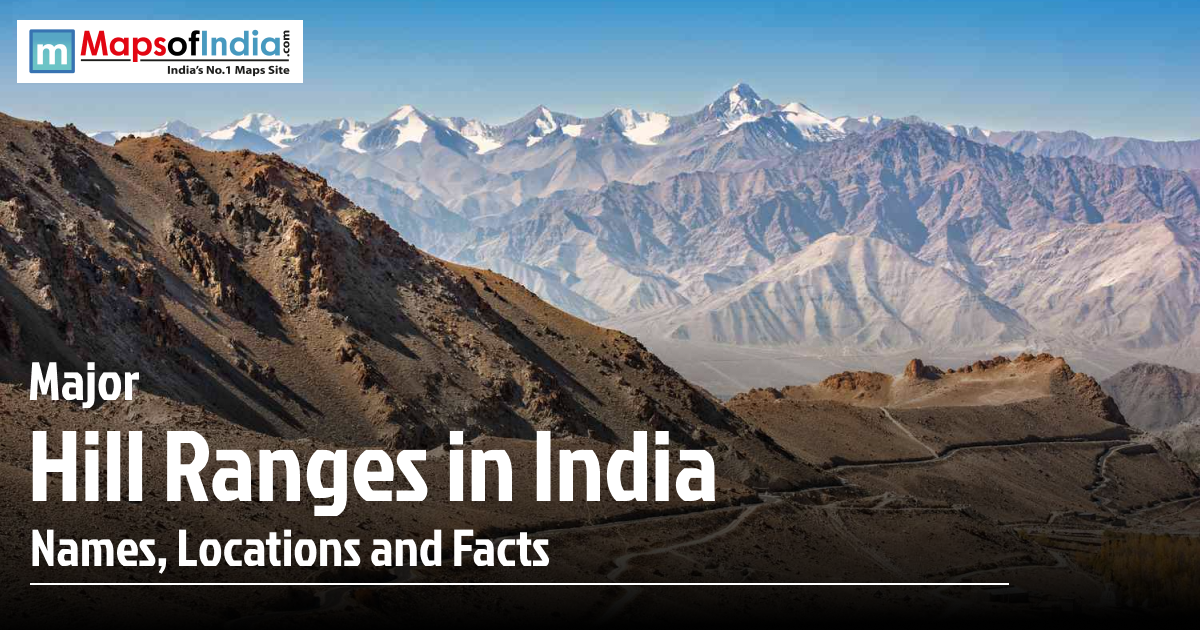
India is huge and experiences very dramatic changes in terrain. There is most diversified and important hill ranges of India. It forms borders and mountain chains that affect weather, river flow, a variety of life and people’s homes. The Himalayas rise above the ageing ridges of the Aravallis, which are covered in snow, and the Western Ghats, which are draped in green. The Himalayas tower above the old and worn-down ridges of the Aravallis, covered with snow and the green-draped Western Ghats, each carries its echoes of deep earth movements and its quiet wonders. These are the spots where beauty is seen when you walk by, creatures grow and flourish without one’s knowledge, and traditions blossom in various ways with each step one takes. The peaks are scattered all over India, having different elevations to influence the land.
The Himalayas: The Mighty Northern Crown
The Himalayas form a curved wall running through the northern part of India, the highest on Earth. They do not stop from Jammu and Kashmir to Arunachal Pradesh. Here rise peaks, such as Everest and Kanchenjunga, standing tall above clouds. These mountains guard against icy north winds and affect the yearly rainfall patterns. All rivers start their journey down these slopes, that lie filled with snow, Ganga, Brahmaputra, and Yamuna. Among these hills, there is the quiet Shimla, under pine trees. Manali waits beyond the passes of the mountains, where rivers flow through rock. Then there is the misty morn’s Darjeeling. They form a bar across the north highway and are still together. Not just scenes, there’s something older and deeper at each place.
Western Ghats: The Biodiversity Hotspot
Along the southern border of India, there is a mountain range running from Gujarat to Tamil Nadu. It is known as the Western Ghats, and is of greatest importance in the world because of its wildness. Much of it is covered by lush green woods, including the imposing Jog Falls. One of the peaks of note is Anamudi, which stands above the rest. The changes in the weather occur over the land around it, due to these heights. This is the starting point of flowing waters like the Godavari and the Krishna. Such places as Ooty attract visitors in all seasons as they are situated high up. On the west side of India, dense forests flourish in the folds of hills, where the living is suspended in passivity.
Eastern Ghats: The Broken Hills
To the East of India, there is a series of hills that extend from Odisha to Tamil Nadu. Not one solid ridge, these mountains are torn apart and splintered. Popular highlands are rising amongst them: Nallamala stands out, Shevaroy also. Home to forest reserves where animals roam, it also feeds great waterways, the Mahanadi flows through, just as the Cauvery winds its way below. Araku Valley lies among the greenery folds, to be experienced with the Kolli Hills. These are located in an ancient mountain belt, tall, eroded, yet sustaining life and tradition throughout the eastern part of India.
Aravalli Range: The Ancient Guardian
The Aravalli Range extends along approximately 692 km from near Gujarat to approximately Delhi, passing through Gujarat, Rajasthan, Madhya Pradesh, and Haryana. It is one of the oldest folded mountains in the world and crosses the state of Rajasthan, Gujarat, Haryana and the capital region. Its rocks contain mineral wealth, making it more than just geographical. Peaks like Guru Shikhar rise quietly, without the need for fame. It’s more than just sand blowing through the streets; it has a significant impact on the spread of Thar’s sands and on local climates. Mount Abu is the only hill retreat in Rajasthan, situated quietly.
Vindhya Range: Divides Central India
The Vindhyas are mountains which rise high up near the clouds, occupying central India largely in Madhya Pradesh, with arms extending into Uttar Pradesh. This ancient ridge, which lies between the “North” and “South,” was not marked on the maps with a sharp line. It is overgrown with thick woods and flat-topped hills where the animals move unseen. It is on these slopes that rivers start their journey; one of them, the Narmada, flows westward without any hurry. Old caves and sacred places, carved by time, hidden among the hills. This land is the sharp edge of custom and custom, that steers people undisturbed by the ages through central India.
Satpura Range: A Quiet Wonder
The Satpura mountain range extends from Madhya Pradesh to Maharashtra, deep in the interior of Central India, beyond the Vindhya hills. The narrow gorges are home to life in clumped greenery, and the highlands are beautiful and flat-topped. Tigers wander through protected forest, while visitors discover tranquillity in Pachmarhi, a hill town between peaks. The land is fed by flowing water; it begins here and winds through dense clusters of sal trees. Not as well-known as others, but as wild as natural wonders.
Shivalik Hills The Outer Himalayas
South of the big mountains, the Shivalik range extends across northern India, bordering areas of Jammu and Kashmir, right to Arunachal Pradesh in the east. They are relatively new geologically, but have also many homes for animals and rich forests. Places like the Doon Valley are located in this belt, and parts of Himachal are part of this belt. Imagine they’re the tranquil slopes of a mountain that hugs against the massive peaks, that provide vistas without all the fuss.
Nilgiri Hills: The Blue Mountains
In the southern foothills of India, there is a region of mists around the mountains. The air is cooler than in the lowland areas close by. The hill towns, such as Ooty, attract tourists as a respite from the heat. The village of Coonoor is quieter, nestled between green folds of land. Tea is planted on meandering terraces tended by patient hands. In the dense woods above, animals not seen elsewhere can be found. The Nilgiri Tahr is one such creature that can walk with ease on the rocks along the edges. A small railway track climbs gently through tunnels and curves. The journey is recognised by the world-renowned heritage organisations.
The major hill ranges form the land and life of the region
India’s mountain ranges influence weather systems over the land in the high elevations, where the air is thin. Rain has rhythm because of its presence, through the misty slopes and forested ridges. Not only do wild creatures find refuge there, but villagers also live with the soothing beats of nature. Time-worn tales play among the summits uncounted, and pilgrims follow the slender pathways. Don’t think of these as “landforms”, but think of them as “living guardians” of harmony under open skies. Their survival is intricately linked to the breathing, feeding and remembering of the whole region.