




Assam Election Dates 2026
Assam Election Results 2026
| Phase | Date of Poll | Date of Counting |
|---|---|---|
| Single Phase (All 126 ACs) | 09 April 2026 | 04 May 2026 |
Kerala Election Dates 2026
Kerala Election Results 2026
| Phase | Date of Poll | Date of Counting |
|---|---|---|
| Single Phase (All 140 ACs) | 09 April 2026 | 04 May 2026 |
Puducherry Election Dates 2026
Pondicherry Election Results 2026
| Phase | Date of Poll | Date of Counting |
|---|---|---|
| Single Phase (All 30 ACs) | 09 April 2026 | 04 May 2026 |
Tamil Nadu Election Dates 2026
Tamil Nadu Election Results 2026
| Phase | Date of Poll | Date of Counting |
|---|---|---|
| Single Phase (All 140 ACs) | 23 April 2026 | 04 May 2026 |
West Bengal Election Dates 2026
West Bengal Election Results 2026
| Phase | Date of Poll | Date of Counting |
|---|---|---|
| Single Phase (All 140 ACs) | Between 23 and 29 April 2026 | 04 May 2026 |
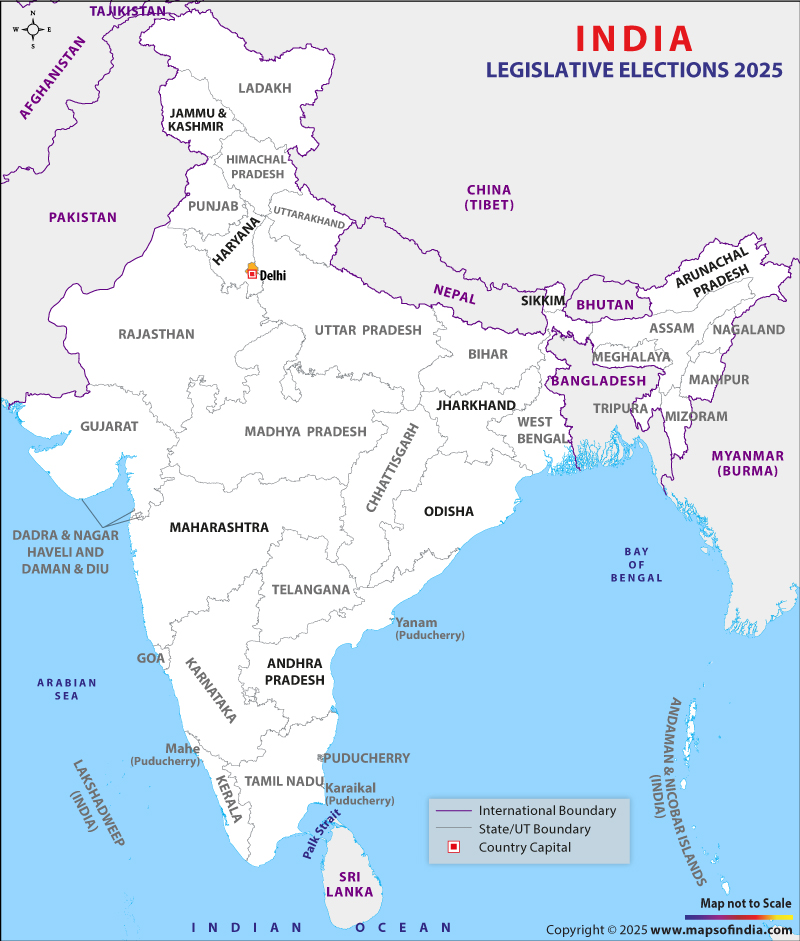
The map intends to give extensive visualization into the electoral geography of India through election results, voters' travel, and politics. This mapping would also help in understanding the region wise concentration of political parties with shifts in the pattern of voting and the geographical disbursement of votes across the regions over time. Such an illustration would be a handy reference for political analysts and policymakers, researchers, and individual citizens looking to analyze regional variability with respect to effects of demographic change on elections and the impact of socio-political issues on voting trends. It shall also encourage political awareness and engagement through the presentation of easily assimilated data and promote better informed and more active citizen participation in democracy.
The first-past-the-post electoral system, attendance of people, has its first-past-the-post magic-the-winner gets the highest votes of a constituency rather than getting an absolute majority. This is mainly confined to elections of Returned members of the Lok Sabha (House of the People) and State Legislative Assemblies. The total Lok Sabha comprises 543 elected members who represent 543 parliamentary constituencies, each defined by the population distribution, thereby providing fair representation to different regions. India has a Rajya Sabha (Council of States), mentioned, and within India, members are indirectly elected to this by State Legislative Assemblies through proportional representation. Some provisions in the electoral framework also include constituencies reserved for SCs and STs.
The elections in India are held repeatedly at various levels. Thus, the general elections in a five-year context are for the Lok Sabha, whereas elections to the State Legislative Assemblies are conducted by different time schedules, usually conducted every five years after dissolution. Local bodies, such as Municipal Corporations and Panchayats, have local elections held periodically as per different State laws. The entire election process in India is looked after by the Election Commission of India (ECI), an independent constitutional authority, ensuring free and fair elections by means such as the use of electronic voting machines (EVMs), identification of voters, and real-time control of campaign expenditure. The polls here are probably among the largest democratic exercises into which millions of voters pour, thousands of polling booths are established, and heavy security arrangements are made for maintaining the integrity of the democratic system.
A thoroughly organized electoral map of India is dependent on the outlines of states and constituencies in such a way that a user can easily recognize them. By demarcation of parliamentary and assembly constituency, it is distinctly marked up as per the guidelines laid down by the Election Commission of India. State borders are marked to a macro level, while delineated constituency patterns allow a finer understanding of the election trends. Each state, constituency, and major city are further enhanced to make reading easier with labels. With the inclusion of a legend, the meaning of all those many symbols, colors, and patterns becomes easy to understand making it accessible to wide audiences including policy makers, researchers, and the general public.
The map employs color coding to show the winning parties or alliances to communicate an election outcome. Every such relationship gets a unique color, permitting easy differentiation between political entities. The difference in shades or patterns indicates how much the winning party beats the losing party. A darker shade represents a victory margin, while a lighter one means a close race. This method indicates, in a practical way, how competitive the elections are. In some cases, symbols or icons will be used to highlight individual candidate performance, an independent candidate, or a political heavy-hitter candidate. These visual tools make it possible for users to-at-a-glance know of the very complicated election-to-elections results.
For detailed analysis, sociopolitical trends can also be reflected in the additional data overlays alongside election results in the map. It is in the demographic statistics, such as population density and urban-rural divide, that voter behavior can be understood. Economical conditions can be learned from the indicators of socio-economic levels such as those of literacy rate, income, and employment.statistics. Maps may also show the past election data, thus making it possible for the audience to see how trends and movements in voters' preferences have changed over election cycles. Certain times, where available to the public, caste and religious demographics can give an insight into more delineated electoral patterns in such regions where these have a considerable depth in politics.
The interactive features incorporated into the map enrich its usability, thus bringing it closer to the user in associating with election data. Zoom and pan functions allow users to explore a national view, as well as down to a very individual constituency level. In addition, the constituency can be clicked to get results such as vote share percentage and runner-up candidates. Historical voting trends appear to have also been included.
Key Election Trends A standout election in India has some certain trends that shape the country's political scenario. Dominant national parties like the Bharatiya Janata Party (BJP) and the Indian National Congress (INC) engage in fierce electoral battles while powerful regional parties such as Trinamool Congress (TMC) in West Bengal, Dravida Munnetra Kazhagam (DMK) in Tamil Nadu, and Telangana Rashtra Samithi (TRS) in Telangana play crucial roles in shaping regional or state politics. The voting pattern varies widely across various regions with deep influences such as caste, economy, and history. A few swing constituencies, which continuously keep changing the electoral results, hold significant importance with respect to results since they actually define the overall results of elections. These constituencies act as the amphitheater for political battles among all vested interests and keep changing voter sentiment depending on local governance, leadership, and national policy impacts; categorize them as important campaign foci.
Some major determinants of electoral results in India include political campaigns and strategies such as rallies and grassroots mobilization, along with digital outreach, which are critical in swaying voters. The advent of social media, say Twitter, Facebook, and WhatsApp, has transformed electioneering from various parties' oral communication to voters directly on a communicating venue. Local issues like water, unemployment, or infrastructural development outweigh national issues in most state elections. Besides, the overall political environment, especially economic performances, foreign policy decisions, and governance at the central level, affects voter sentiment. The coverage of media that can be traditional or digital gives shape to public opinion, criticism, or even just the existence of certain issues that may win extra last-minute votes.
They usually share an effect in which election outcomes have ramifications on state government as well as national politics. Usually, when the ruling party wins a state, the same benefits increase the inertia of its administrative agenda and consolidation of government policies while there may be turns in governance with a change in leadership and in that case priorities would change too especially in a couple of sectors like education, health care, and industrial growth. At the national level, election results from states announce the dawn of general elections and make the voters reveal themselves in emerging trends that may influence coalition making. A good performance by the opposition parties in state elections can elevate their stock at the national level and contest the ruling government's authority. Landslide victories for the ruling party, on the other hand, come to consolidate their importance and hence smoothen the implementation of policies with more confidence. These statistics also predict possible realignments in the future and hence decide the destiny of Indian democracy in the next elections.