




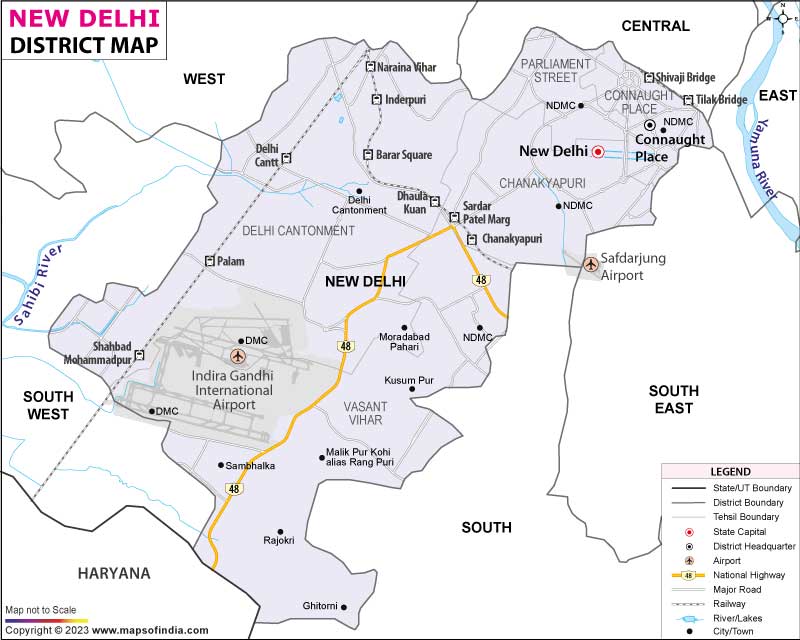





The capital of India is New Delhi, which is the administrative, political, and ceremonial center of the country. Being a district of National Capital Territory of Delhi, New Delhi is in a special place as not only it is a location where the central government stands but also it contains a carefully designed urban landscape that is unlike the older sections of the city. Delhi can be generally split into two historical and space units- the Old Delhi and the New Delhi. Compared to Old Delhi that is the representation of the medieval urban development with thick populations and old bazaars, New Delhi is the embodiment of the modern planned city developed at the time of the British colonization and modified according to the demands of the independent India.
The New Delhi District Map is important in the interpretation of this change. It graphically depicts the geographic cluster of administrative buildings, transportation networks, business powerhouses, residential areas, green areas and tourist attractions. In contrast to a mere location guide, the map shows the spatial organization of power, planning and accessibility in the capital. Wide roads, radial planning, open green spaces and density of the population are typical of the district and that is evident in its cartographic image.
As for tourism, one of the most frequented regions of the capital is New Delhi. It houses some of the world-known landmarks like Parliament house, Rashtrapati bhavan, Central business district known as Connaught place and the diplomatic enclave of Chanakyapuri. These locations will receive numerous domestic and international tourists. The district map assists the tourist to sift through this ample administrative terrain as well as provides an understanding of the way in which colonial principles of planning merged with a post-independent form of governance. The New Delhi District Map is, therefore, not only a practical resource but also a historical one that describes how the core of strategy, meaning, and structure of the Indian capital has been developed.
Location, Area, and Political Structure
The district of New Delhi is centrally located in the National Capital Territory of Delhi and it has a relatively small geographical area when compared to the other districts in the country like South Delhi and North West Delhi. Although it is so small it has as great a significance. The area is encircled by Central Delhi, South Delhi and south west Delhi thus making it well accessible on all fronts. The New Delhi has been reflected in the district map whereby it has a small but well-structured area with its symmetry, broad avenues as well as very defined administrative boundaries.
In administrative terms, New Delhi is separate from the majority of the rest of Delhi since it comes under the authority of the New Delhi Municipal Council (NDMC) to a great extent. This is in contrast to the areas that were under the Municipal Corporation of Delhi (MCD). This difference is clearly demarcated by the district map, that is, in the areas controlled by NDMC, there are the central administrative and diplomatic areas. Through this administrative singularity, improved infrastructure maintenance, improved civic services, and improved planning controls are maintained.
Other important administrative divisions that are exhibited in the map include revenue boundaries, police station limits and electoral constituencies. Such divisions are required in governing, law enforcement, managing disasters and conducting censuses. The existence of central government ministries, constitutional institutions and the diplomatic missions need so much coordination between the district administration, the municipal authorities and the security agencies. The district map is a crucial example of reference to manage this complexity.
The other key characteristic indicated in the map is the symbolic geography of power. Other important sites like Parliament House, North block, South block and Rashtrapati Bhavan are centralized reflecting that they have been of immense importance politically. Their control of space on the map serves to show how New Delhi was built not only as a metropolis but as a symbol of power, control and national identity.
Physical Layout, Transport Network and commercial Centres
Physical planning of the New Delhi district is one of its most distinguishable features which is evident in the district map. British architects Edwin Lutyens and Herbert Baker had a vision of a city to be designed in the first half of the twentieth century that reflected a capital of order, control, and imperial greatness. This vision made a geometrical and radial structure that had broad avenues of center points. Strategic roads like Kartavya Path (previously Rajpath), Janpath, Ashoka Road, and Sansad Marg can be seen overtaking the map and planning the traffic flow between people and vehicles.
The transport network as depicted in the map illustrates New Delhi as a big connectivity center. Facilitating the communication of the capital to every corner of the country is the New Delhi Railway Station which is one of the busiest in India. The district is served by metro lines passing through major places like Rajiv Chowk and Central Secretariat which provides ease when it comes to ensuring people have public transport. The most important arterial streets connect the district to easy commuting and ceremonial and diplomatic transportation.
New Delhi has a small number of commercial areas, the most popular of which is an area called Connaught Place. As we can notice through the district map Connaught Place is also at the center of the map and is one of the most significant commercial, financial, and social centres of the city. The construction took place in 1929 it is round in shape, with radial streets, which is also beautifying and efficient. The region is filled with existent state-owned departmental stores, private shops, offices, restaurants, and cultural premises and accommodates vast quantities of shoppers, tourists, and working people. Jantar Mantar which is located close to this commercial center also brings out the historical meaning to this commercial center.
Another characteristic in the map is the Parliament Street also called Sansad Marg. It takes its significance through the availability of Parliament House and some government offices. It is not only a political corridor but also a big tourist attraction in this street. The map assists visitors to know in which routes to access, restricted areas, and major landmarks around the area and the connection between the governance and urban movement.
Diplomatic Zones, Landmarks, Green spaces, and Tourism Significance
The most remarkable feature about the New Delhi District Map is the concentration of the nationally and internationally sensible landmarks. The spatial and symbolic landscape of the district is dominated by Rashtrapati Bhavan which is situated at the western end of Kartavya Path. It is at the center of the Indian executive government, together with North Block and South Block. The map indicates these landmarks with clear marks that are used in navigation and planning of a city.
Chanakyapuri is recognized as one of the most elite and modern places in New Delhi and seen as one of the most eminent areas in the city located on the district map. It is in the center of the district, and commonly referred to as the Diplomatic Enclave. The location of the embassies and high commissions of different countries is found to be clustered on the map, which indicates the international importance of the territory. Other commercial and residential areas of Chanakyapuri are Bhikaji Cama Place, R.K. Puram and Dhaula Kuan. This is even made stronger by the availability of high quality hotels such as the Taj Palace, Hotel Ashok and Samrat Hotel that are involved in accommodating diplomats, foreign tourists, and international events.
Green spaces are also a major aspect of the landscape of the district, which is evident in the map. Other parks like Lodhi Garden, Nehru Park, and the lawns of the Central Vista also help in creating a balance in the environment and aesthetical value. These green corridors were also included in the design of the city to ensure that there were visual corridors, control of temperature, and recreational areas. New Delhi has a better share of open and green spaces compared to other overpopulated parts of the cities of Delhi.
The New Delhi District Map cannot be ignored as far as tourist attractions are concerned. It assists tourists to find attractive places that are important, comprehend the distance, and make efficient routes. Security restricted zones are also reflected in the map as they direct the visitor on the area they can visit and the access points. The map provides students and researchers with understanding of the colonization concepts of planning, and changes to the scheme based on the post-independence of the country, and the modern processes of the redevelopment like the Central Vista project.
In general, the essence of the capital is captured in the New Delhi District Map of the city where governance and diplomacy, commerce and heritage, and tourism exist in a well-laid spatial network. It is a essential tool of comprehending the influences of geography and planning on the political and cultural life of the capital of India.
FAQs
Q.1:Enumerate the significance of the New Delhi District Map?
The New Delhi District Map aids in appreciating the spatial organization of the government, transport systems, land use, sightseeing spots or features and green spaces. It is needed in urban development, planning, tourism navigation, and academic research concerning studying geography and urban development.
Q.2:What is the role of Parliament street in New Delhi?
Sansad Marg or Parliament street is a major corridor in administration where the Parliament house and most government offices are located. It is a significant political landmark, and tourist attraction place, which is under security protocols.
Last Updated on : June 16, 2026
