






About
Landscapes are remembered in some districts; history in others. Mandi is the sole place found to have an abundance of both. This incredible area of the district is located in the middle of Himachal Pradesh, and is a natural link between the lower and higher Himalayas that has been inhabited by humans for a number of years. The district with its headquarters in Mandi has been a trading centre, cultural and administrative center for a long time now.
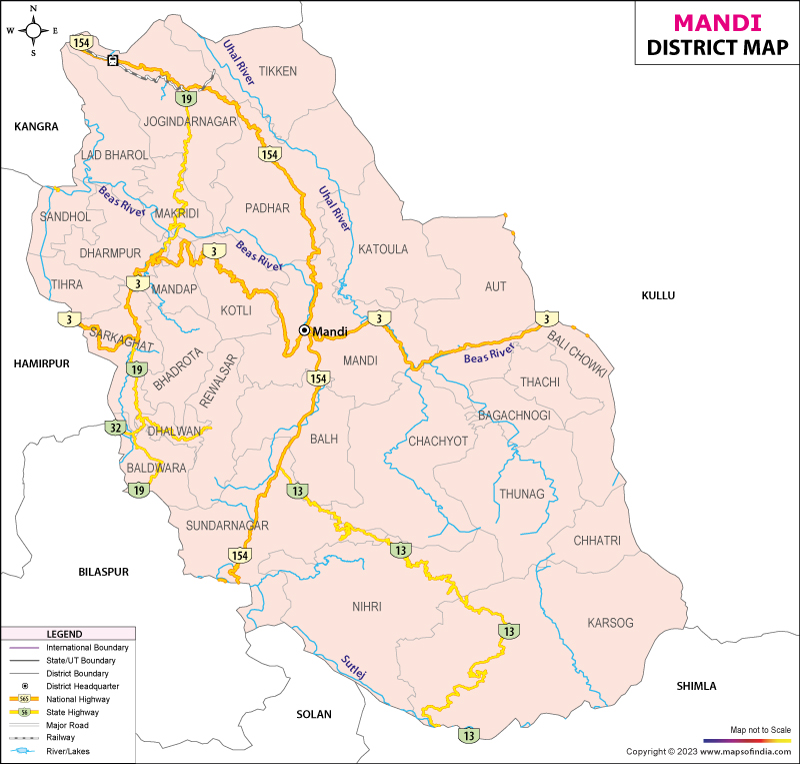
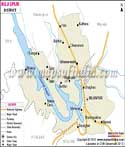
The district covers a territory of some 3,950 square kilometres, and is dotted with dramatic mountain scenery, fertile valleys, forests and rivers. The Beas River and its tributary systems have formed the landscape, providing a scenic natural vision. The eminence of the Mandi district in terms of rugged topography and abundance of river systems could be understood through the Mandi district map.
History & Culture
Excavations have revealed a long human occupation of the district historically, which dates back to ancient times. The region was ruled by several local kingdoms and later it became organized princely state ruled by Chandravanshi rulers. The foundation of the Mandi state is believed to be in the 15th century when the capital of the state, through Raja Ajbar Sen, was moved to present day Mandi.
Over the centuries, Mandi's role grew to become one of trade and administration. Caravans were used to transport wool, salt, grains and other products from the various parts of the Himalayas to northern India. This can be reflected in the routes shown on an old Mandi district map.
Mandi is a culture characterized by its richness, tradition and multidimensional nature. Folk dances, folk songs, temple architecture and community celebrations are the forte of the district. In many settlements today, ancient stone temples with elaborate carvings still reign. Numerous religious places can be identified through a Mandi district map, which have their own legends and significance.
The International Shivratri Fair of Mandi is one of the most famous cultural affairs. This festival is different from a religious assembly, as hundreds of the deities of neighbouring valleys come to town dressed up in colourful processions. There's the traditional drum and folk music that fills the streets with ambience. The clothing is customary. Rituals seamlessly merge with festivity and combine to create an ambiance which is unlike any found in Himachal Pradesh.
Religion is a primary factor that constitutes the local identity. Shiva and Vishnu temples (and others of local deities) permeate the social scene. But Mandi culture is not a religion based one. It's a culture of mountain resilience, community collaboration and a deep appreciation for the environment.
Economy
The development of the economy of Mandi district is interrelated with the geographical strength and the path being taken by its development. The livelihoods of the population are supported by agriculture, horticulture, hydropower, government services and trade & tourism.
The Government Sector is one of the major employment sectors in the district. There are ample opportunities in administrative, educational, health care, security and local governance. There is significant governmental activity in Mandi, which is also an important administrative centre in Himachal Pradesh, and which therefore has a significant economic impact on the local economy. The Mandi district map shows the administrative centres and their distribution, reflecting their significance in providing public services in such rugged terrain.
The Public Sector is an equally important and integral part. The contribution of hydroelectric power generation is at the forefront. The district has multiple major Hydro Electric Projects generating power on the Beas River and its tributaries. The power generation projects supply electricity to Himachal Pradesh and beyond while also providing employment opportunities in the field of engineering, maintenance and allied services.
Agriculture continues to be an important economic base. Maize, wheat, paddy, and pulses are grown by the farmers based on the various altitudes and climatic conditions. The terraced agriculture in the mountainous region continues to have a great impact on the rural livelihoods. The agricultural settlements in Mandi district are better evident in the Mandi district map and are mostly confined to fertile valleys and accessible slopes.
Horticulture is an increasingly important sector. Apples, plums, peaches and apricots play a major role in supporting livelihood. Cultivation of vegetables has also expanded and provides fresh vegetables year round for the area markets.
Over the past decades, significant growth has occurred in the Services Sector. The district's economy now has a significant base of education, banking, healthcare and retail trade as well as transportation and hospitality services. Student enrollment in institutions of higher education leads to people visiting those areas from different parts of the country for accommodation, transport and commercial services.
Tourism (directly and indirectly) advances economic development. There is a regular flow of visitors to the hotels and guest houses, restaurants, travel companies and local traders. There are also markets created for traditional crafts and local products in tourism-related activities.
Small scale industries introduce another facet to the economy. Local businesses include food processing, handicrafts, weaving, and construction related businesses. Enhanced transport (as seen from the modern-day Mandi district map) remains a key infrastructure enabler for economic integration and market linkages.
Economy reflects a yin and yang of co-mingled traditional employment and development within the district. Deeply anchored agriculture and culture, but more and more hydropower, education and services are the drivers for future growth.
Tourism
The tourism in Mandi district is much like a well-choreographed movie scene. Mist rises off the hills as the ancient temples rise along with it. The sky reflects in the lakes. These valleys lead on towards far off peaks. Each place has its own tale to tell.
Mandi town is one of the main attractions of the district. It is also known as “Town of Temples”, as it has many historic temples, among them the renowned Bhootnath Temple and Triloknath Temple. Its narrow lanes, the traditional architecture and the riverside landscape contribute to its charm. Mandi is located at the centre of many of the circuits and is represented in the Mandi district map.
Rewalsar Lake is one of the most important pilgrimage centres in Himachal Pradesh. The lake is sacred to the Hindus, Buddhists and Sikhs, and is a locality of monasteries, temples and gurudwaras. Here, in a delightful combination, there is spiritual and natural beauty.
Prashar Lake is quite another tale. The lake is located in the midst of high mountains, and frequently is described as having crystal clear waters and an ancient pagoda-style Prashar Temple. Winter brings a scenic winter time to the area in a snowy landscape. The destination is rather secluded, with many visitors taking to this district map of Mandi to find the way to reach the destination.
The famous Barot Valley attracts nature lovers, trekkers and anglers. Dense woodlands, peaceful environments and mountain streams provide ideal conditions in which to be active in the outdoors. The valley is also one of the gateways to some trekking routes.
Sundarnagar is famous for its lovely and pleasant environment and its scenic lake. The town offers a stunning view and is a crucial point in the urban landscape of the district. Sundarnagar lies on major transport corridors on the visible paths referred to in a Mandi district map.
Kamrunag Lake is a blend of mythology and natural beauty. Its verdant woods and the beauty of the high terrain it is enveloped by make it an attractive place to visit for travellers and pilgrims alike. The location has attained its share of mysticism in the local legends. A Mandi District Map is useful to facilitate exploration of this area.
Tattapani, harbouring a number of hot water springs near the district boundary, is a famous place. Visitors are attracted both for relaxation and the religious sense.
There is much more to Mandi's touristic offerings than its touristic sites. Rivers, forests and valleys link these roads in the district, making even ordinary travels a memorable experience. The Mandi district map is therefore not just a way to navigate but also a way to explore and discover. As in many other tourist regions, the most interesting events of the tour frequently happen between the points on the Mandi tour map. The Mandi district map can, in many ways, serve as a guide to geography and storytelling.
Demographics
The Census of India 2011 recorded the population of Mandi district as 999,777. The district has a balanced demographic ratio with a slight female outnumbering male ratio. Its population density was about 253 persons per km².
An 81.53 per cent literacy rate was achieved in the district. Out of the total male population, 89.56 per cent were literate as compared to 73.66 per cent of the female population. The extremely high emphasis on education and social development in the district is reflected in the numbers.
Hindi is used all over the district. The local communities speak several varieties of Pahari, mostly Mandyali and related dialects. The region's diverse linguistic landscape has been influenced by Sanskrit traditions and regional languages.
Administration
Mandi district is managed from the headquarters of the district at Mandi town. The district is governed within the administrative structure of the state of Himachal Pradesh with multiple tehsils covering the entire district, so that it would be possible to carry out administration and service to these on an efficient basis.
It consists of 17 tehsils: Mandi, Sundarnagar, Sarkaghat, Karsog, Jogindarnagar, Chachyot, Padhar, Thunag, Dharmpur, Bali Chowki, Aut, Lad Bharol, Baldwara, Bhadrota, Kotli, Nihri, and Sandhol.
It has about 3,300 inhabited villages & village settlements in its mountainous topography in the Mandi district. The very social, cultural and economic organisation of these villages is the core of the district.
Administrative institutions have a mission to achieve solutions for rural development, infrastructure development, education, medical services, handling disaster and environmental preservation. The district map of Mandi is still a crucial document for planning and coordinating these activities on a variety of terrains.
FAQs
Q1: How many villages are there in Mandi district?
Mandi district has approximately 3,300 inhabited villages and village settlements.
Q2: What is the population of Mandi district?
According to the Census of India 2011, Mandi district had a population of 999,777.
Q3: What is Mandi district famous for?
Mandi district is famous for its ancient temples, the International Shivratri Fair, scenic Himalayan landscapes and rich cultural heritage.
Last Updated on : August 18, 2026
