






About
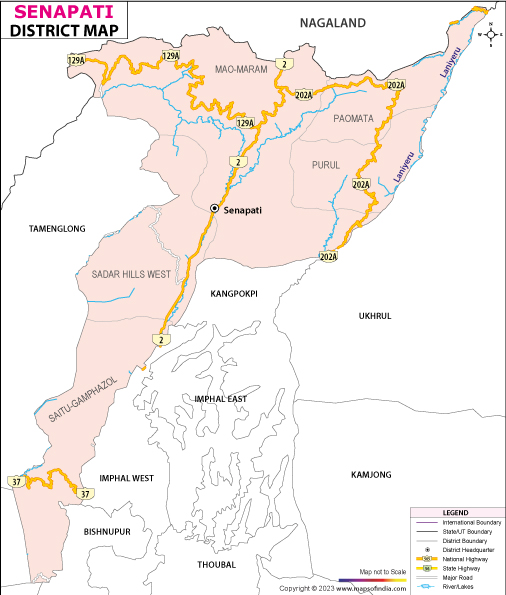
Senapati District is in the part of Manipur. Senapati District is bordered on the east by Ukhrul District on the west by Tamenglong District on the north by Phek District of Nagaland and on the south by Imphal East District and Imphal West District. Senapati District has an altitude that ranges from 1061 m to 1788 m above sea level. The hills of Senapati District run from north to south. Gradually slope down toward the south to meet the Imphal valley. Senapati District was earlier called Manipur North District. Was created on 14 November 1969 with its headquarters at Karong. Later the district headquarters was moved to Senapati on 13 December 1976. Senapati District took its name on 15 July 1983.
Senapati District has a landscape with blue hills, green valleys winding streams and rivers that flow through mountains and deep gorges. Senapati District is home to kinds of plants and animals. Most people in Senapati District work in agriculture. They usually grow crops on terraces. Paddy, maize, cabbage, potato and other cereals are the crops in Senapati District. Forest covers 80 % of Senapati District and the remaining 20 % is used for farming.
History & Culture
Senapati District was earlier called Manipur North District. Was created on 14 November 1969 with its headquarters at Karong. Later the district headquarters was moved to Senapati on 13 December 1976. Senapati District adopted its name on 15 July 1983.
Senapati District began as the Mao Subdivision of Manipur State after Manipur joined India. By 1961 it had grown into the Mao and Sadar Hills subdivision, which combined the hills next to the Imphal region.
In 1969 Manipur was split into five districts. Mao and Sadar Hills was one of them. Was also called Manipur North District with its headquarters at Karong. This district had three subdivisions: Mao West, Mao East and Sadar Hills.
During the 1950s and 1960s Kuki tribes in the northern hills of Manipur were displaced because the Naga National Council wanted to make the population in those areas more uniform. The displaced Kuki tribes moved into the interior of Manipur. Settled in the Sadar Hills subdivision. This gave the Sadar Hills subdivision a character.
In 1970 the Sadar Hills Kuki Chiefs Zonal Council decided to ask for a district for Sadar Hills and sent a memorandum to Union Home Minister K. C. Pant. In 1971 just before Manipur became a state the Indian government passed the Manipur (Hill Areas) District Council Act, 1971 which gave autonomous district councils to hill regions. Two separate ADCs were created in 1972 one for Sadar Hills and one for Manipur North.. Because the Nagas opposed it Sadar Hills did not become its own district and stayed part of Manipur North.
Economy
In Senapati District 42.3 % of workers aged 15 and over work in agriculture, forestry or fishing. In a district in India this figure is 47.7 %. Senapati District has 5,423 registered MSMEs while a typical district in India has 38,876 MSMEs. In Senapati District 64 % of MSMEs are in services and 36 % are in manufacturing; in a district 76 % are in services and 24 % are in manufacturing. Small and medium enterprises provide 1.5 % of MSME employment in Senapati District compared with 3.3 % in a district. EPFO covers 0.2 % of the labour force in Senapati District, versus 2.1 % in a typical district. Bank deposits per person in Senapati District are ₹23,075 while in a district they are ₹59,112. Senapati District has a DPIIT One District One Product designation of Kiwi. Enrolment in classes 9 to 12 in Senapati District is 34 % of the population of that age whereas, in a district it is 66.9 %.
Tourism
Mao Senapati
Brimming in culture and history and blessed with tranquility Mao is a hill town in Senapati district of the state Manipur. Mao is home to the Mao tribe of Nagaland and Mao is one of the busiest commercial towns in Manipur. Apart from the Mao tribe a number of local communities reside here as well. Renowned for its location, lively shopping markets and enthralling attractions Mao is evidently the most talked-about tourist destination in Senapati district. At present this surreal town of Mao has cemented its place in the map of Manipur tourism. With its grandeur, enchanting waterfalls and dreamy landscapes the hill town of Mao has become a must-visit attraction in Manipur for people of all ages. While spending a vacation here you can binge on the gardens of orchids, lilies and more to relish the exquisite beauty of such floral species.
Yangkhullen Senapati
Yangkhullen is a town in Senapati district in Manipur which is famous for its natural beauty, historical past and magnificent traditions. Some 75 km north of Senapati town Yangkhullen is a town and a tourist destination in Senapati district. Lies on a cliff Yangkhullen is surrounded by mesmerizing landscapes that make it one of the popular places of tourist interest in Senapati. Moreover the entire valley that surrounds the place proffers some sights that are definitely a treat to eyes. The serene surrounding and the beautiful attractions of the place truly delineate the historical past of the town.
Dzukou Valley Senapati
Dotted with green forests, gorgeous valleys, crystal clear water and sedating ambiance, Dzukou Valley in Senapati district is often touted as an epitome of eternal beauty. Situated on the border of Nagaland and Manipur Dzukou Valley is a paradise of landscapes that consist of the misty clouds and gorgeous valleys. Throughout the year this place welcomes tourists. Spellbinds them with its enduring grandeur. However what catches the eyes of tourists most are the seasonal flowers that take the exquisiteness of this places to a different level in summer; the views of which is mind-boggling in itself. Besides this gorgeous tourist destination in Senapati district is also engirdled by the two streams. Japfu and Dzukou. Since Dzukou Valley enclosed by the imposing Japfu hill ranges the place is also a destination, for those adventurers who love to break a sweat through hiking and trekking.
Demographics
According to the 2011 Census Senapati district had a population of 479,148. That included 242,212 males and 236,936 females. Women formed 49.42% of the population which saw a sex ratio of about 978 females for every 1,000 males.
The main people in Senapati live in rural areas. In 2011 we saw that the majority of the population lived in rural areas and only a smaller proportion lived in urban areas. Senapati town, Mao, Maram and also other settlements are the main urban centers.
Scheduled Tribes are very large in number in the population. In the 2011 Census it was recorded that we have a large Scheduled Tribe population which forms the majority of the district’s population. Also that of Scheduled Castes which make up a much smaller proportion.
In 2011 the district had a literacy rate of around 63.60%. Male literacy was higher which also shows female literacy at a lower rate. Also at the time of the Census this is the gap between male and female literacy.
In Senapati people speak Mao, Maram, Poumai, Thangal and other tribal and regional languages. Tribal languages which are used by the communities are very much a part of local identity. Mao, Maram, Poumai and others maintain their own cultural practices and forms of speech.
Administration
Senapati district is administered by the Deputy Commissioner which is the head of the district administration. The administration is into revenue, public services, law and order, rural development, welfare programs and other government work.
Today the district administration has administrative subdivisions, development blocks, village authorities and police stations. Senapati and other administrative areas serve as the main units for local governance.
The development blocks which include administrative areas across the district. They run development works and government programs at a local level.
Senapati’s administration has to deal with a large rural and tribal population which is spread out in hilly and forested areas. This puts local government institutions and village level bodies in a key role in reaching out to people that live far from the main towns.
| Official Name | Senapati |
| Location | Manipur |
| Area | 3271 sq. km |
| Population | 479,148 |
| Language | Mao, Maram, Poumai, Thangal, English |
| Religion | Christianity, Hinduism, and other faiths |
FAQs
Q.1: Why is Mao important in Senapati?
Mao is a home to important local markets and serves as a key town in the district. Also the town is an important commercial and cultural center in the district.
Q.2: What is Senapati’s agricultural economy based on?
Senapati’s agricultural economy is based on farming communities which cultivate rice, maize, vegetables and other crops. In Senapati’s rural economy agriculture has become a local source of livelihood.
Q.3: What is Lui-Ngai-Ni festival in Senapati?
In February Senapati celebrates Lui-Ngai-Ni which is a grand cultural festival. It features tribal music, dance, traditional food, handicrafts and other local cultural events.
Q.4: Why are the hills of Senapati famous?
The hills of Senapati are part of the Manipur hill ranges which also feature forests, streams and scenic landscapes. Their natural setting which is home to a variety of flora makes them a popular natural destination.
Q.5: Why is Senapati important in Manipur?
Senapati is home to a large tribal population, we also see here a great array of natural resources, agriculture, culture and tourism. What makes this district stand out in northern Manipur is its mix of hill landscapes, tribal culture, farming and local crafts.
Last Updated on : October 30, 2026
