






About
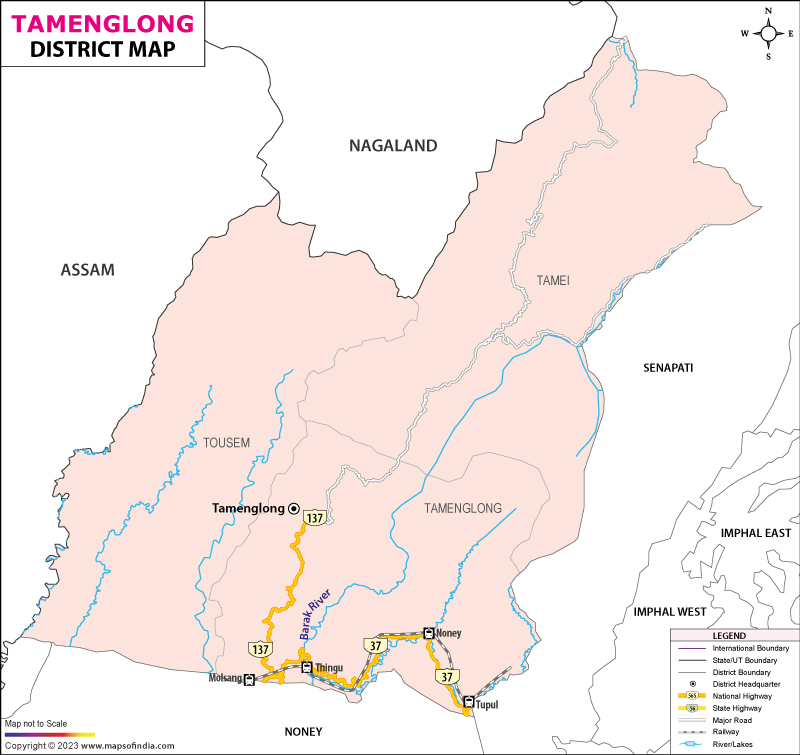
Tamenglong District lies next to Senapati District on the east to the west it touches the North Cachar Hills District of Assam to the north it meets Peren District of Nagaland and to the south it borders Churachandpur of Manipur. Tamenglong District is the district from the state capital Imphal and from the district headquarters. The Tamenglong District headquarters is also the farthest from Imphal at a distance of 147 kilometres.
The main rivers that flow through Tamenglong District are Barak (Ahu) Irang, Makhru (Makhu) Iring, Ijei (Aga) and Apah. The Barak (Ahu) is the river. Far the water of this river has not been used for irrigation or power generation.
The district contains thick forests. Interior villages such as Lemta, Nallong, Kadi, Kuilong, Langpram, Taipram, Inem, Magulong, Phoklong, Zingning, Kakui and Thiulon are surrounded by forests. These forests contain kinds of trees and animals.
Rare animals such as hornbill, hoolock gibbon, slow loris are found in these forests. Bamboo, cane and other plants grow in abundance. Many medicinal herbs grow in the forests. The area is known for its biodiversity.
Most of the land in Tamenglong District is hilly except for a flat areas such as the Barak bank, Khoupum Valley and Kunphung.
History & Culture
When India became independent in 1947 Tamenglong District had no roads. The first motorable road in Tamenglong District linked the capital of Manipur, Imphal to Tamenglong. The road was 75 miles long. Was called the I.T. Road. It passed through Kangpokpi. Touched about seven villages in the district. This road was opened in 1957. Later when NH-53 was built the state built the Khongsang–Tamenglong Road from Khongsang on NH-53 to Tamenglong. This road is 39.5 kilometres long. Touches six villages between the district headquarters and the state capital. The Tousem–New Kaiphundai road was opened in 1979. This road connects eight villages in the Tousem subdivision. Light vehicles travel on this road. There is still no bus service to Tousem. In fact 45.8 percent of villages in Tamenglong District do not have motorable roads.
Tamenglong District, which is mainly inhabited by the Zeliangrong community is famous for its festivals that are celebrated with great joy. The Zeliangrong people are proud of their cultural heritage, which is shown in their beautiful art, especially dance and music performed during the festivals. These festivals are closely linked to the Zeliangrong religion and to their activities, social life and cultural values. The Zeliangrong festivals, which they call Ngai (in Rongmei, Ngi in Zeme and Liangmai meaning rejoicing) are a cultural phenomenon. As N. Saha said, "The Zeliangrong people hold festivals throughout the year.”
According to Brown "In their festivals and dances the men wear a cloth around their waist a wool scarf in grey colour white cloths with spots and long feathers on their heads. A favourite ornament is a pair of butterfly wings attached to each ear." The following features are characteristic of Zeliangrong festivals.
The festivals are an extension of the Zeliangrong beliefs. Festivals are seen as a rite for the whole village community. The worship of the God, other gods and goddesses village deities and ancestors is shown in the festivals.
Because most Zeliangrong people are farmers their festivals are tied to the stages of farming. Festivals are held to mark the farming activities of the village during each season. The festivals show the joy and happiness of the Zeliangrong people. The festivals are a chance for the people to show their talents, strength through martial arts, dance and songs.
The festivals involve social groups, in the Zeliangrong village. The male dormitory (Khangchiu) and the girls’ dormitory (Kailu) play the role in the festivals. Even though the dormitories have declined they still function fully during the festivals. Some people call the dormitory the Ngaikai meaning the house of festivals. Somebody calls the dormitory as the Ngaikai, the house of festivals.
Economy
In Tamenglong 42.3 percent of workers aged fifteen and over are in agriculture, forestry or fishing. In a district in India that figure is 47.7 percent. Tamenglong has 1,793 registered MSMEs whereas a typical district in India has 38,876 MSMEs. In Tamenglong 52 percent of MSMEs are in services. 48 Percent are in manufacturing compared with 76 percent and 24 percent in a typical district. Small and medium enterprises in Tamenglong account for 3.2 percent of MSME employment less than 3.3 percent in a typical district. EPFO covers 0.2 percent of the labour force in Tamenglong while a typical district in India has 2.1 percent. Bank deposits per person in Tamenglong are ₹15,180 below the ₹59,112 average in a typical district. Tamenglong holds the DPIIT One District One Product title of Orange – Tamenglong Mandarin. Enrolment in classes nine to twelve in Tamenglong covers 45.9 percent of the population in that age group whereas a typical district reaches 66.9 percent.
Tourism
Zeilad Lake
Zeilad Lake lies near the village of Zeliadjung (Atenba) on a high hill platform. This lake is one of famous lakes in Tamenglong and is a must‑visit tourist spot. Visitors to Zeilad Lake can enjoy the scenery and relax in a peaceful setting. Zeilad Lake also offers plenty of adventure for thrill‑seekers. The lake is home to pythons, fish, tortoises, water and migratory birds, which visitors can easily see. These wildlife sights are a reason why tourists love Zeilad Lake. Naga stories say Zeilad Lake is where paddy originated. Zeilad Lake was recently declared one of Manipur’s four wildlife sanctuaries. Is also called Zeilad Wildlife Sanctuary.
Barak Waterfall
Barak Waterfall is one of the visited sights in Tamenglong. It is part of a group of seven waterfalls that sit close together and add beauty to the area. The Barak River flowing through the falls supplies irrigation and water to Tamenglong residents. Both locals and tourists can spend a day by picnicking on the riverbank, the best way to enjoy a holiday. Tourism in Tamenglong is still young so the Barak Waterfall and its nearby falls remain mostly untouched which makes the scenery more beautiful. When you visit the Barak Waterfall you will hear the gurgling of green water that feels pleasant to the ears. The sight of cool water rushing from the hills to the plains is indescribable. Must be experienced once. Adventure lovers can try water sports and rafting here.
Tharon Cave
Tharon Cave, called Thaeuluan Cave is about 27 km from Tamenglong. The cave stretches 655.6 meters. Has five exits and 34 joints. When you enter the cave you will find a stone map engraved and painted outside which helps visitors explore the interior. The map shows every nook and turn inside the cave helping visitors find each passage. A trip to Tharon Cave is a must when you plan a visit to Tamenglong. The cave holds archaeological and historical value and is now a tourist attraction, in Manipur.
Demographics
In Tamenglong we see a mix of different groups of people which is very interesting. As it is a large scale rural and horticultural center thousands of people are living here for work and agriculture. This has made the district a melting pot of cultures which includes people from different communities. By 2026 the district’s population is reported at about 156,784 and the total district population is spread across the rural areas.
In Tamenglong’s case we see literacy rates of around 69.83%. Over 69% of the population is literate which is reported in the district profile. This is in great part due to the fact that the district has schools, colleges and educational institutions which in turn train young people for different fields. Also, what we see is that the more educated the youth are the better it is for local business growth which in turn brings more opportunities into the community.
In the district most people speak Rongmei, Liangmai and Zeme in different areas. But we see a great deal of English and Meiteilon in education and administration which is brought in through government institutions and wider communication. Also in terms of demographics there is a good balance between men and women in Tamenglong but in the rural areas we see communities who are engaged in agriculture and horticulture work.
Administration
In Tamenglong it is a team of dedicated officials which run the administration of the district and which see to it that the district is safe and developed. At the top we have the Deputy Commissioner which is the main leader for the entire region. This person is in charge of the land records, revenue work, and also plays a large role in what we see as the development of our district’s rural structure today and into the future. Also they see to which government departments are following suit in terms of development rules and regulations to keep the public services of the area at an optimal level. The district is split into three which we refer to as sub-divisions which in turn makes the administration of Tamenglong more efficient. In each of these areas for instance Tamei or Tousem we have local offices which are headed by a Sub-Divisional Officer. It is these officers which play the role of a point of contact for the local people which includes issues like issue of certificates or small scale problem resolution. What we see is that having these break out into smaller offices also helps the government to reach out to the remote villages which are far from the main urban areas. In the district area the local administrative bodies are the bodies which do the local work. They are in charge of reporting clean drinking water, that public facilities are working, and the roads are in good repair. Also they support local development and see that public services are provided for families. This local team works to also keep up with the needs of rural communities as people depend on agriculture and horticulture for their livelihoods.
FAQs
Q.1: What is Tamenglong district famous for?
Tamenglong is known for its scenic hills, rich tribal culture, and natural beauty. Also it is home to waterfalls, forests and the Barak River which make it a beautiful destination in Manipur.
Q.2: Why do we refer to Tamenglong as an important cultural district of Manipur?
The district is a home to many tribal communities and traditional cultures. In Tamenglong we see Rongmei, Liangmai, Zeme and other Naga communities with their rich traditions.
Q.3: Why is Barak Waterfall so popular?
During the journey through the hilly areas of Tamenglong the Barak Waterfall is seen as one of the best known natural attractions in the district. For visitors it has become a popular place for enjoying the natural beauty of Tamenglong.
Q.4: What industries are important in Tamenglong?
Agriculture and horticulture, handloom, handicrafts, forest-based activities and small businesses are the backbone of the district’s economy.
Q.5: Is Tamenglong a good destination for nature lovers?
Yes, in fact Tamenglong has a natural landscape which includes hills, forests, waterfalls and rivers. It has traditional villages, wildlife and also scenic locations which make it an interesting destination.
Q.6: What role did Tamenglong play in the history of Manipur?
The district has a very rich tribal history which saw different communities living across its hills and valleys. Its location was strategic which in turn made it an important area for traditional communities and cultural heritage.
Q.7: Is Tamenglong suitable for family trips?
Tamenglong is a great place which has scenic hills, waterfalls, forests, rivers, and traditional villages. It is a peaceful destination for families which wish to see into the natural and cultural heritage of Manipur.
