






History
During the early and ancient times Imphal served as the capital region of the Meitei kingdom with the Ningthouja (Mangkhul) dynasty being the main ruler. The ancient histories are maintained in the form of Cheitharol Kumbaba the royal annals of Manipur where accounts have also been given in relation to the kings, religious movement, war and social reforms. This existed not only in Imphal as a political center, but Imphal was also a sacred landscape, with its shrines, spaces of ceremonies, and royal institutions. Imphal was the center of the cultural transformation and the introduction of Vaishnavism in the 18th century under the rule of King Pamheiba (Garib Niwaz) was the greatest turning point as it reorganized religious practices and art forms and transformed the culture of the court.
The 19th century saw a growing contact with the British East India Company which led to huge political disturbances. The Anglo-Manipur War of 1891 marked the end of Manipur’s sovereignty. After the defeat of the Manipuri army the kingdom lost its independence and Imphal was put under the rule of a British colony. The British still maintained the monarchy on a formal basis but the power was actually held by the colonial governors. With this era, there were new administrative structures, development of infrastructure and new modern education, yet it also led to the distortion of the traditional political power.
The historical role of Imphal in the world was established during the Second World War especially by the Battle of Imphal in 1944. The city of Imphal was a strategic base of Allies as Japanese forces retreated to Burma (Myanmar). The heavy combat of the Japanese and the Allied forces made the city and the surrounding places a big battlefield. The Allied forces managed to defend Imphal successfully, which turned into the turning point in the Southeast Asian field of the war and is commonly considered among the biggest failures of the Japanese. The war brought about a great destruction but also solidified Imphal's place in international history.
Manipal was incorporated into the political organization of India after their independent state was received in 1947 with Imphal being its capital. The city grew to be an administrative, educational and commercial hub even in the post independence era. Nevertheless, it had also had moments of political instability and social activism which influenced its modern identity.
Culture
Imphal culture is also a dynamic and rich culture of long-established traditions and religious beliefs, artistic skill and value system which transforms over the centuries. Based on the indigenous roots and being affected by the historical formation, the city can be viewed as the cultural core of Manipur, and its traditions remain applicable to dictate the way of life and the overall sense of belonging.
The close relation to ritual and religious life can be regarded as one of the most peculiar features of the Imphal culture. The traditional faith systems of the indigenous people are also superimposed onto subsequent religious practices to form a stratified spiritual space. Sacral domains, domestic practices, celebrations of seasons and rituals of the community are key aspects of social existence. Festivals are very religiously followed and they are usually associated with agriculture, mythology, and royal customs. They are characterised by the complexity of rituals, music, dance and mass involvement and strengthen the social ties and culture.
In Imphal, there is a significant importance of dance and performance traditions in the cultural scene. Forms in classical and folk dances are closely interwoven in the religious stories and ritual purposes. Such performances are not artistic performances but are regarded as devotion rituals and storytelling. These dances are accompanied by music that is traditionally played using native musical instruments to show a fine aesthetic feeling that had been cultivated through royal patronage. These traditions are still maintained in performance spaces, both sacred and secular and they are practiced on a regular basis and they are also presented to the public.
Another significant part of cultural life is the handicrafts and traditional occupations. Good handwork may be observed in the field of textiles, handloom goods, ceramics, metals, and objects of bamboo. These crafts are also not just economic but symbols of culture with a motif and method that is spoken over generations. The markets of Imphal are culturally active places where these traditions are now being kept and most specifically through community-based commercial activities that constitute a distinctive social structure and division of gender roles.
Another characteristic feature in Food culture in Imphal which links much with the local resources, availability at particular time of the year and the traditional ways of preparing food. Food is usually simple but unique, focusing on natural products and ancient cooking traditions. Food practices go hand in hand with social practices, religious practices and the tradition of a family, and food therefore is a significant indicator of cultural placement.
Language
The linguistic landscape in the city of Imphal contains the depth, cultural diversity, and the tradition of communication and expression during the historic times. The modern Imphal language has developed over the centuries through the native culture, the practices and elements of the court and the religious elements and the contact that they had with the neighbouring countries. It does not only serve as a tool of daily communication, but it also serves as the bearer of collective memory, oral traditions and cultural values.
In the past, language was significant in the kingdom administration, religion and also in the maintenance of historical records. Chronicles of the Royalty and lineages, texts on rituals, and literature works were meticulously preserved which meant that there was a well established and quite advanced tradition of recording and literature. Written documents were supplemented by oral traditions in the form of myths, legends, and folk narratives and provided knowledge that could be passed through generations. Narration, songs and ceremonial chanting are still playing a key role in propagating culture.
Language in Imphal also shows a good social relationship and social stratifications in the social life. The modes of speech, deferential attitude, and the speech patterns are strictly attached to age, social status, and context. Politeness, restraint, and emotional overtones are stressed elements of everyday communication, which contributes to the harmony of society and respect. Rituals, festivals as well as the performances are also highly intertwined with language, as particular terms and recitations bear a symbolic and spiritual meaning.
Imphal has also enriched the linguistic culture by literary and artistic traditions. In the course of time language turned out to be an essential tool of religious expression, artistic development, and cultural reformation movements. Literary traditions have been upheld and creative expression has been promoted by education institutions and cultural organizations.
Geography
The natural environment of the city is determined by the unique valley location, plains, and diverse geographies; the city boasts of these unique settings to define its natural environment, settlement arrangements, and economic practice. Imphal is in the middle of Manipur, and lies within the Imphal Valley, an intermontane valley which is both wide and low-lying and has traditionally been able to support a high population due to its pleasant physical factors. The valley is the very geographical center of the region and has long been regarded as the sweeping-point of human activity.
Imphal has an average altitude of approximately 790 meters above sea level which also adds to moderate climate in contrast to the regions on the hills surrounding Imphal. The valley floor contains a lot of alluvial soil which has been deposited in the previous centuries due to the erosion of the rivers and therefore very fertile and agricultural. This fertility in the past has supported agrarian life forms and has enabled food security which then allows the city to become a stable place for settlement and governance.
The city is surrounded by low hills which form a system of hills that are larger and join the hills of Manipur. These hills serve as natural boundaries and they enclose the valley, as well as form an effect on the climatic condition and drainage. In the past, they have had a significant role in defense but still influence the transportation paths and urban sprawl. These hills were historically known to connect Imphal with the adjacent areas since they served in trade, migration, and in exchange of culture.
Imphal has major geographical characteristics in river systems. The valley has the Imphal River and its tributaries supplying water to the valley which is used in agriculture, domestic and maintaining the ecological balance. These streams help in the development of wetlands and marsh in some sections of the valley. Although they help in supporting biodiversity and traditional methods of fishing, they also expose certain areas to seasonal floods and also during the seasons of excessive rainfall.
The climate of Imphal is also related to the geographical location. The climate experienced in the city is influenced by monsoons; and the rain-season is rather intense and renews the water sources and maintains the agricultural life. Temperatures get moderated by the adjacent hills, thus providing fairly cool winters with warm and not hot summers.
| Particular | Details |
|---|---|
| City | Imphal |
| State | Manipur |
| Country | India |
| Area | 94 km² |
| Population | 390,000 |
| Official Languages | Manipuri (Meitei), English |
FAQs
Q.1:What is the importance of the Battle of Imphal?
The battle of Imphal was a significant war that was fought during the Second World War and was a decisive turning point in the southeast Asian fight. The loss of Japanese troops at the not too distant Imphal stopped their forward thrust into India.
Q.2:Is Imphal safe for tourists?
Imphal is not usually a very dangerous place to a tourist, particularly in central locations and major tourist destinations. Tourists are not only encouraged to obey local regulations but also adhere to traditions and keep up with local conditions.
Tourism of Imphal |
|
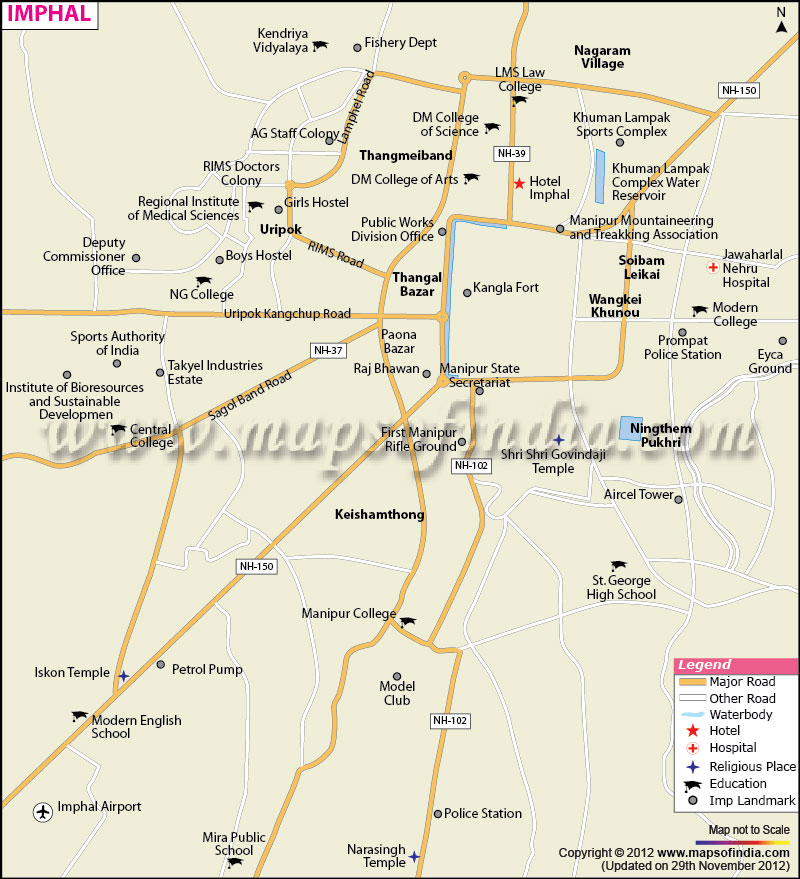
Accomodation (Government) 1. Hotel Imphal 2. State Guest House 3. Youth Hostel Airlines 4. Indian Airlines Office Hospitals 5. Regional Institute of Medical Sciences |
Place of Worship 10. Mahabali Temple 11. Central Church 12. Ramjee Prabhu Temple 13. Mosque (Babupara) 14. Bijay Govindajee Temple 15. Nityai Nanda Temple Restaurant 16. Sangam Restaurant 17. Nikhil Cafe |
Offices 18. Tourism Directorate 19. Government of India Tourist Office 20. Imphal Municipality 21. Public Works Department 22. Directorate of Arts & Culture 23. Session's Court 24. Manipur Development Society/Kangla Emporium 25. Industries Directorate 26. D.C.'s Office, Lamphelpat 27. Lamphel Police Station |
|
Place of Tourist Interest 6. Womens Bazar 7. Lakshmi Bazar 8. Gandhi Memorial Hall 9. Indian War Cemetry 29. Khuman Lampak Stadium |
Imphal Facts
| City Name | Imphal |
| State | Manipur |
| District | Imphal West |
| District Headquarters | Lamphelpat |
| Tehsil/Taluk | Lamphelpat |
| Ward | 27 (MCI), 2 (OG) |
| Lat Long | 24.816045, 93.937869 |
| Population as per 2011 | 264,986 |
| Sexratio | 1,055 |
| Average Literacy (%) | 91.70% |
| Official Languages | Meiteilon (Manipuri) |
| Time zone | IST (UTC+5:30) |
| STD Code | 03852 |
| Transport | Air, Road, Rail |
| Vehicle registration | MN-01 |
| Food and Cuisine | Rice, Fish and Green Leafy Vegetables, |
| Religion | Hinduism, Christianity, Muslim, Animism |
| Festival | Kartik Purnima, Sarada Purnima and Basanta Purnima, Rasa Lila dances are performed at Shri Govindaji Temple, Lui-Ngai-Ni, Ramjan Id( Id ul Fitr), Gaan Ngai, Cheiraoba, Yaoshang (Dol Jatra), Christmas, Lai Haraoba, Kut, Ningol Chakkouba, Mera Houchongba, Ratha Jatra, Kwak Jatra and Heikru Hidongba etc. |
| Monuments | Langthabal, INA Memorial, Leimapokpam Keirungba Temple, Shaheed Minar etc. |
| Places of interest | Kangla Fort, Manipur State Museum, Khwairamband Bazaar, War Cemetery, Manipur Zoological Gardens, Shri Govindjee Temple, Loktak Lake, India Peace Memorial, Khongjom War Memorial, Leimapokpam Keirungba Temple, Loktak Lake, ISKCON Temple, Lord Krishna Temple, Chingkhei Pukhri Pond, Kangla Fort Complex, Kangla Museum etc. |
| Markets | Khwairambad Bazaar, Paona Bazaar, Nagampal Market, Tera Bazaar, GM Hall, Gambhir Shopping Mall, Amos Shopping Plaza, Lamlong Keithel Market, Singjamei Bazar, Mini Market, Kwakeithel Bazar, Paona International Market, Thangal Bazar, Paona Bazar, Kasuba Market etc. |
| Hospital | Shija Hospitals & Research Institute, Jawaharlal Nehru Institute of Medical SciencesHospital, Maipakpi Maternity And Child Hospital, Imphal Hospitals & Reseaech Centres, Ayaokasar District Hospital Imphal, Mothers Care Children Hospital And Research Centre, Surbina Physiotheraphy Clinic etc. |
| Hotel | The Classic Hotel, Nirmala Hotel, Anand Continental Hotel, Imphal Hotel, White Palace Hotel, Hotel Bheigo, Hotel New Airlines, Hotel Prince, Dinesh Delux Hotel, Hotel Krishtina, State Guest House, Hotel Krishtinia, Mass Hotel, Hotel Avenue, Hotel Pintu, Rajasthan Guest House, Hotel Excellency, Tampha Hotel, Thoibi Hotel, Hotel Apollo etc. |
| Industries | Agricultural, Tourism, Information Technology, Manipur Pulp Allied, Manipur Electronics Development Corporation, Manipur Spinning Mills Corporation etc. |
| University/College | Manipur Central University, Central Agricultural University, D.M. College, G.P. Women's College, Imphal College, Manipur Institute of Technology, National Institute of Technology, Manipur, Regional Institute of Medical Sciences, Jawaharlal Nehru Institute of Medical Science etc. |
Last Updated on : June 24, 2026
| Find Distance from Imphal to other Indian Cities | |||
