






About
Ukhrul District is located in the north of the Manipur State. It is a hill district of the state with full of scenic beauty. District is home of Tangkhul people and Tangkhuls are the dominant tribe and other tribe like Kuki are also included in very low number.
Ukhrul District, the land of the Tangkhuls was marked out first as a Sub-Division in 1919 during the British Raj. Then in November 1969 it was upgraded to a fledged district bearing the nomenclature of Manipur East District. The area of the district was 8,200 Sq.Km. According to the CSI Publication 1976.
Later Tengnoupal District, now called Chandel District was carved out from this district on July, 1983 and the area of the then Manipur East District was sliced down to 4,544 Sq.Km.. The title of the district was changed into Ukhrul District in 1983. Again Kamjong District was curved out from the District area on December 2016 making present District.
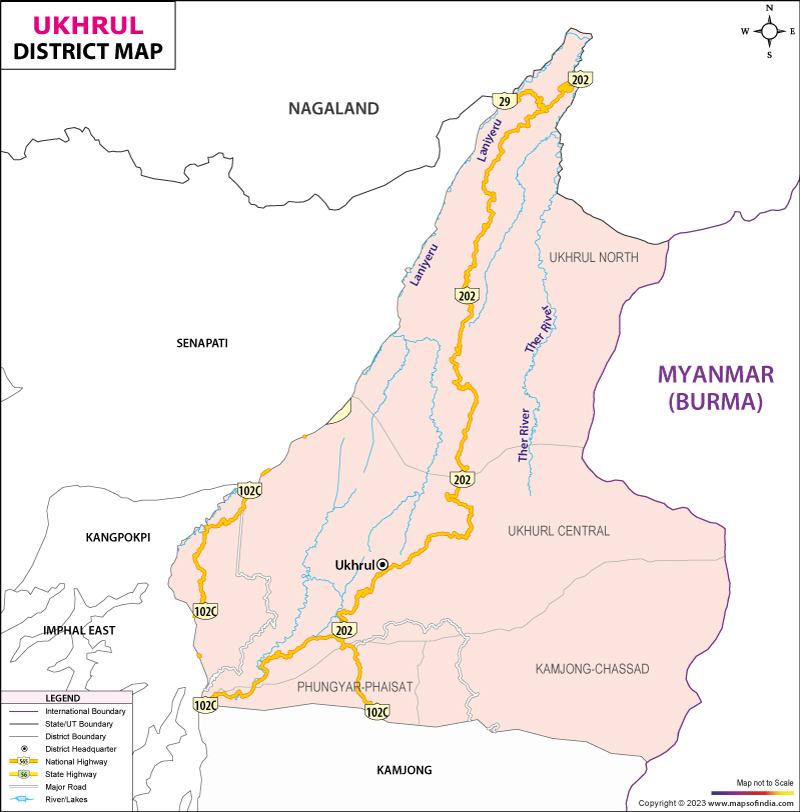
Ukhrul District is bounded by Myanmar in the East Kamjong District in the South, Kangpokpi and Senapati Districts in the West and Nagaland State in the North. The terrain of the district is hilly with a varying heights of 913 m to 3114 m (MSL). Ukhrul district HQ is linked with Imphal, the state capital by a NH 150 with 84 Km
History & Culture
Ukhrul District is the home of the Tangkhul tribes, who are a highly cultured people. The name Tangkhul was given to them by their neighbours, the Meiteis. The northern Tangkhuls were also called the Luhupas. The name Naga was given to them and similar tribes by the Burmese ( Myanmar ) which in Myanmar means people with earlobes. Piercing of the earlobes is spread practice among the Naga people including the Tangkhuls. The Tangkhuls belong to the Mongolian race which is spread all over the World. Linguistically they belong to a language family called Sino-Tibetan within that family to the sub-family Tibeto-Burman.
The earliest home of the Tangkhuls was the reaches of Huang heo and Yangtze Rivers which lies in the Zinjiang province of China. Like the desert areas of the world the people including the Tangkhuls due to hardship of life dispersed from this place to different directions. One group moved towards east and southeast to be become known as Chinese another group moved southward to become the tribes of Tibeto-Burman which includes the Tangkhuls and other Naga sub tribes. That was between 10,000 B.C. To 8,000 B.C. This movement has continued into historic times. S.K. Chatterjee noted that from 2000 B.C. Onwards Tibetan spreads from China pushed south and west and entered India. According to W.I. Singh in his "The History of Manipur" the Tangkhuls settled in Samshok (Thuangdut) area in Myanmar. They belong to Yakkha tribe in China. The Tangkhuls were first noticed in Manipur by Poireiton, one of the kings of a principality in Manipur valley.
The Tangkhuls as other Naga tribes came to Manipur, Nagaland, Assam and Arunachal Pradesh through Myanmar. Some of them also settled down in Myanmar. Did not venture further. However their movement over Myanmar and into India was spread over a period of time. They entered the habitat in waves following one another and in some cases in close succession. The Tangkhuls came together with the Maos, Poumeis, Marams and Thangals because all of them have references to their dispersal from Makhel a Mao village in Senapati district. They had also erected megaliths at Makhel in memory of their having dispersed from there to directions.
The Tangkhuls point out to the association of their forefathers with the seashore. Most of the ornaments of the Tangkhuls such as kongsang, huishon, etc. Were made of sea shells, cowrie and conch shells a feature of the people who live on the shore.
By 2nd century A.D. The Tangkhuls were living in Samshok (Thuangdut) in Myanmar. Ptolemy, an astronomer and geographer of Alexandria in his Geography of Further India c. 140 A.D. Referred to the Tangkhul Nagas (Nangalogue) at Triglypton (Thuangdut). The Tangkhuls began disperse from Samshok after the invasion of Ko-lo-feng and his successor I-mau-shun the king of Nan-chao in the closing part of the 8th century A.D. And beginning of the century A.D. They were further driven towards the north west of Myanmar by the Shan people.
Thus the Tangkhuls as other Naga tribes have travelled from China to Myanmar and from there finally they came into their present land traversing through innumerable snow covered landscapes, mountains and wild forests confronting wild beasts and wild tribes. The exodus of the Tangkhuls from China to Myanmar and finally to India is indeed a story of heroism of courage and endurance.
Economy
42.3% of workers aged 15 and over in Ukhrul work in agriculture, forestry or fishing against 47.7% in the district in India. Ukhrul has 3,184 registered MSMEs, against 38,876 in the district in India; 56% are in services and 44% in manufacturing (typical district: 76% and 24%) and small and medium enterprises account for 0.9% of MSME employment (typical district: 3.3%). EPFO covers 0.5% of the labour force against 2.1% in the district in India.* Bank deposits per person in Ukhrul are ₹28,526 against ₹59,112 in the district in India. Its DPIIT One District One Product designation is Kachai Lemon. Enrolment in classes 9 to 12 in Ukhrul equals 52.5% of the population of that age against 66.9% in the district in India.
Tourism
Mova Cave
The Mova cave is a limestone cave which can be reached after a detour before reaching Ukhrul. It is situated near the defunct cement factory and Lungshang Kong/river in a small hamlet called Hungpung. The main hall of the cave can assemble over 100 people. Some distance from the cave is a solid rock mountain which is believed to be the male partner of the cave according to the local myth.
Kachai Village
Kachai Village is one of the scenic village in Ukhrul District. It has a total of 510 houses with 2107 population of which 1092 male and 1015 female. The average sex ratio of the village is 838 female per 1000 male. The village is home to people of Tangkhul Naga tribe. The inhabitants are 1005 christain. Agriculture is the occupation of the inhabitants. Kachai Village is around 140 Kms from Imphal and 46 km approx. From Ukhrul district headquarters. It is located in the west of Ukhrul district bordering Senapati district, Manipur. Kachai is flanked by by Hoomi village in the east Theiva in the north (Senapati District) Tingshong (Senapati District) in the west and L.Phungthar in the south. Kachai village can be reached via Talui-Hoomi-Kachai which is connected by Talui-Hoomi- road (NH-102/A).
Khangkhui Cave
The Khangkhui Cave, called as Khangkhui Mangsor is essentially a natural limestone cave. Archaeologists have discovered important artefacts dating back to the Palaeolithic culture from this cave. The cave is 15 km away on eastern side from Ukhrul town. The cave was used as a shelter by the people during World War II.
Shirui Hill
The popularly know peak is the Shirui Kashung Peak – 2835 m from the sea level. Most of the rivers originate from the crevices and slopes of this Shirui Peak. Shirui is 18 km from Ukhrul Town and 97 km from Imphal. It is the home of world Shirui (Siroy) Lily (Lilium Mackliniae).The name Shirui Lily originates from a British Botanist named F. Kingdom Ward who in 1948 discovered the uniqueness of this lily flower. The local name of the flower is Kashong Timrawon. According to legends the Kashong Timrawon is also a protective spirit which resides on the Shirui Peak. Every year thousand of Scientists and Tourists over the World come to see this precious flower. The ordinary looking Shirui lily blossoms on the hilltop, during May – June.
Demographics
Ukhrul district is home to a large rural population and a low population density. From the 2011 Census which you can see in government reports the population is of the tune 183,998 in the district report. Also the district has a literacy rate of around 81.35 percent.
A great portion of the population lives in rural areas. In that setting agriculture is very much a main source of income for rural households. Also horticulture, animal husbandry, small scale trade, transport and crafts provide for their income.
Ukhrul district has a large number of villages spread across its hilly terrain. In these villages they put up with issues related to heavy rainfall, landslides and road connectivity. Such conditions affect agriculture, homes, transport and access to public services.
Administration
Ukhrul district has administrative subdivisions and development blocks. The district administration manages local administrative units and village-level institutions across the district. It also coordinates public services and development activities in rural areas.
The district includes Ukhrul town and numerous villages across its mountainous landscape. Local administrative units help deliver government services and support development work in different areas.
The District Administrator is the head of the district administration. At present the district is headed by the Deputy Commissioner.
District administration is in charge of revenue affairs, development programs, disaster response and also the coordination between different government departments. Police forces handle law and order. As for other departments they include agriculture, education, health, irrigation, horticulture, social welfare and rural development.
FAQs
Q.1: What is Ukhrul tourism famous for?
Ukhrul is a destination which puts forth a great range of scenic hills, natural attractions, wildlife and traditional crafts. At Shirui Hills, Khangkhui Cave and the Shirui Lily Festival you can see very important attractions.
Q.2: Which language is spoken in Ukhrul?
Tangkhul is to be found on a large scale in Ukhrul district. In English and Meiteilon you can also see large use, which is a feature of urban areas.
Q.3: Which crops do we have in Ukhrul?
Paddy is the primary crop. In Ukhrul district also you can see important production of maize and other local crops.
Q.4: Which river is important in Ukhrul?
The rivers and streams flowing through Ukhrul are important to the district. Also which are the tributaries and local streams that support agriculture and villages across the hilly terrain.
Q.5: What is Shirui Hills famous for?
Shirui Hills is known for its rare Shirui Lily. In that area local communities celebrate the flower through a festival which they pass on from generation to generation.
Q.6: Why is Ukhrul important in Manipur?
Ukhrul is at a strategic location near the India-Myanmar border and the hill regions of Manipur. Its natural landscapes, agriculture, cultural heritage, traditional crafts and cultural diversity which in turn also play a key role in Ukhrul’s identity in the northeastern part of Manipur.
