

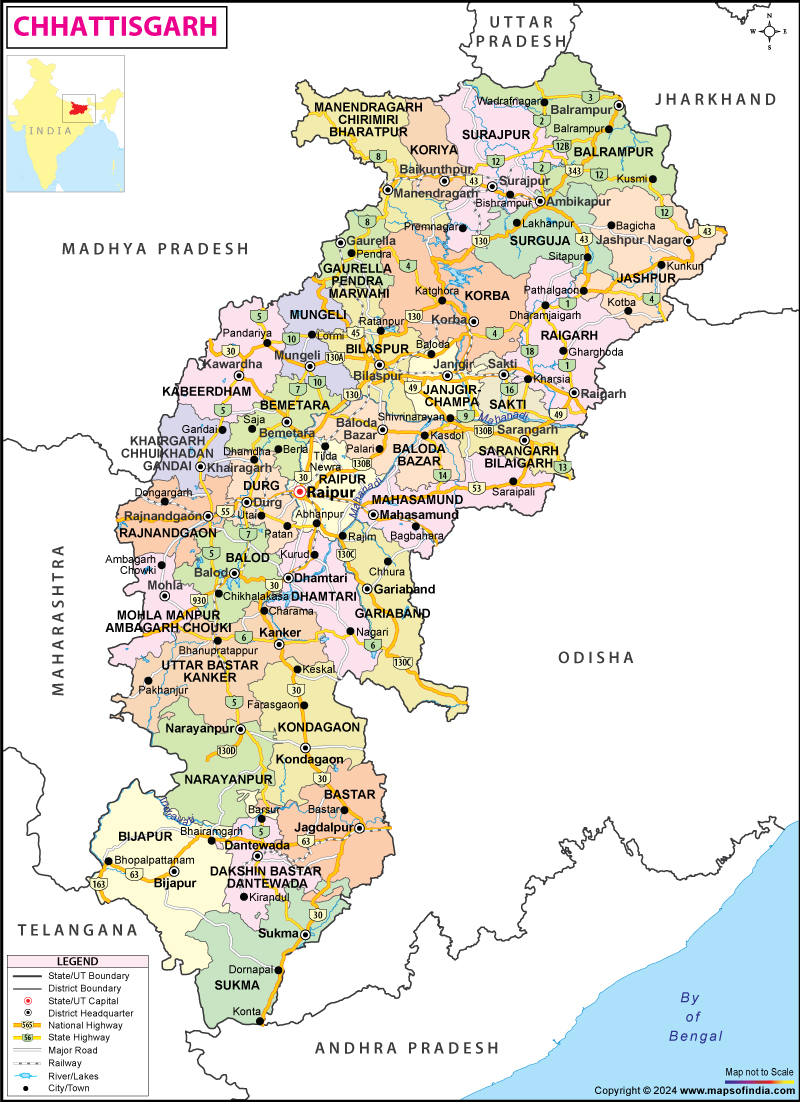



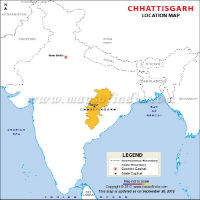

Chhattisgarh Location Map
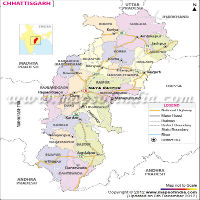
Chhattisgarh Map
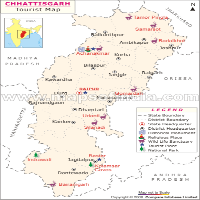
Chhattisgarh Travel Map
About Chhattisgarh
On November 1, 2000, India gave birth to a new state called Chhattisgarh which was carved out of Madhya Pradesh. The area of 135,191 square kilometres acquired by Chhattisgarh accounts for only 30 percent of the total area of Madhya Pradesh.
The demand for the new state can be traced to a meeting of the Raipur district Congress in 1924 when the idea of a separate entity of Chhattisgarh was mooted. The leaders who took part in that meeting were of the view that the region of Chhattisgarh was culturally and historically distinct from the rest of Madhya Pradesh.
The state has its capital at Raipur and the High Court at Bilaspur. There are 27 districts in the state which are as follows:
|
|
The Legislative Assembly of Chhattisgarh comprises 90 members. The state sends 11 members to the Lok Sabha and five members to the Rajya Sabha.
Facts on Chhattisgarh | |
|---|---|
| Official Website | www.chhattisgarh.nic.in |
| Date of Formation | November 1, 2000 |
| Area | 135,191 sq km |
| Density | 189/Km2 |
| Population (2011) | 25,545,198 |
| Males Population (2011) | 12,832,895 |
| Females Population (2011) | 12,712,303 |
| No. of District | 27 |
| Capital | Raipur |
| Rivers | Mahanandi, Indravati, Son, Pairi, Hasdo, Sabr |
| Forests & National Park | Kankerghati NP, Indravati NP, Kanger Valley NP |
| Languages | Hindi, Oriya, Marathi, Chhattisgarhi, Gondi, Korku |
| Neighbours State | Madhya Pradesh, Maharashtra, Jharkhand, Orissa, Uttar Pradesh, Telangana |
| State Animal | Wild Buffalo |
| State Bird | Hill Myna |
| State Tree | Sal |
| Net State Domestic Product (2011) | 41167 |
| Literacy Rate (2011) | 71.04% |
| Females per 1000 males | 991 |
| Assembly constituency | 90 |
| Parliamentary constituency | 11 |
History of Chhattisgarh
The history of Chhattisgarh, which was called as South Kosala goes back to the 4th century AD. The mythological history of the state can be traced back to the days of Mahabharata and the Ramayana. The Haihaya dynasty ruled Chhattisgarh for six centuries during the 14th century. During the middle ages, Chalukya dynasty established its rule in Bastar. Annmdev was the first Chalukya ruler, who founded the dynasty in Bastar in 1320. In 1741, the kingdom was seized by the Marathas from the Haihaya dynasty. After conquering the kingdom during 1745 AD, Raghunathsinghji, the last descendant of the Ratanpur house, was forced to leave the area. So, finally in the year 1758, Chhattisgarh was conquered by Marathas and Bimbaji Bhonsle was appointed as the ruler. After the demise of Bimbaji Bhonsle, suba system was followed by the Marathas. It was an era of unrest and misrule. Maratha army was involved in large-scale loot and ransack. More...
Geography
The state of Chhattisgarh was formed by integrating 16 districts of Madhya Pradesh that held together by a strong linguistic barrier. However, more districts were added to the state and presently it has 33 districts. The state came into being in the new millennium on November 1, 2000. The area of Chhattisgarh is estimated to be 135,194 sq km. Chhattisgarh stretches across the latitudinal expanse of 17°46' North to 24°05'North on one hand to the longitudinal meridian of 80°15' East to 84°20' East on the other. The recorded forest area in Chhattisgarh is 59,772 square kilometers, which constitutes roughly 44.21% of the state's total geographical area. Chhattisgarh claims nearly 12 percent of India's total forest area that accounts for tremendous biodiversity as well as a rich collection of timber and variegated species of wildlife More...
Demographics
The Chhattisgarh projected population constitutes approximately 3.15 crore of 2023. The state is densely populated with one hundred and eighty nine persons per square kilometer. The four important districts of Raipur, Durg, Surguja and Bilaspur support the maximum population of the state. The rural areas of Chhattisgarh are more populated than the urban areas. However, in recent years, most of the population of rural Chhattisgarh migrated to the urban areas in search of better jobs and higher standards of living. Most of the districts of Chhattisgarh depend on agriculture because of low level of industrialisation. More...
Economy of Chhattisgarh
The newly formed state is richly endowed with natural resources. Its forest revenue alone accounts for 23.5 percent of the total state's forest revenue. It has rich deposits of limestone, iron-ore, copper-ore, rock phosphate, manganese ore, bauxite, coal, asbestos and mica. Agriculture is the main activity for the population of this landlocked state enveloped by Maharashtra, Andhra Pradesh, Odisha, Bihar and Uttar Pradesh and of course Madhya Pradesh. 80 percent of its population is engaged in agriculture. Chhattisgarh is known as the Rice Bowl of India and supplies food grains to 600 rice mills. Steel and power are the major industries of the state. Chhattisgarh accounts for 15 per cent of the total steel produced in the country. More...
Government and Politics
Though the bifurcation of the larger state of Madhya Pradesh and the birth of Chhattisgarh was considerably a peaceful process, the demand for a state to preserve the ethnic identities of the people here itself gave birth to certain new chapters in the history of India. This has made the formation of this new state an important issue for the whole nation. The executive head of the Chhattisgarh government is the Governor and the legislative head is the Chief Minister. The present governor is Biswabhusan Harichandan and the present Chief Minister of Chattisgarh is Vishnu Deo Sai. More...
Wildlife Sanctuaries
Chhattisgarh Wildlife Sanctuaries has made it an important destination on the tourism map of India. Chhattisgarh has 3 National Parks and 11 Wildlife Sanctuaries gifted with their unparalleled natural beauty and diverse and rich flora and fauna. Indravati National Park is the most famous wildlife sanctuary of the state of Chhattisgarh. It has several wildlife sanctuaries in secure areas such as Barnawapara Wildlife Sanctuary, Tamor Pingla, Kanger Ghati National Park, Pamed, Sanjay National Park, Semarsot, Sitanadi Wildlife Sanctuary, Udanti Wildlife Sanctuary, Achanakmar Wildlife Sanctuary, Badalkhol, Bhairamgarh, Gomarda wildlife sanctuaries etc. More...
People, Culture and Festivals
The picturesque state of Chhattisgarh abounds in natural splendour and is an idyllic mix of the pastoral and the urban. The state is also a hub of Central India's cultural extravaganzas that is evinced by the friendly and vivacious people, culture and festivals of Chhattisgarh. It is a nascent state that was formed by integrating some districts of Madhya Pradesh that were held together by the fine thread of a common Chhattisgarhi dialect. The people are mainly tribals who speak Hindi and Chhattisgarhi and live harmoniously together. They are diligent and hard working and mainly work in the numerous mines and factories in the state. The tribal people are very talented and creative and their expertise is manifested in the exquisite traditional handicrafts. More...
Language
Hindi is the official language of the state. However, majority of the state's population speak Chhattisgarhi which is a dialect of Hindi language. Chhattisgarhi has linguistic features and draws its vocabulary from languages like Munda and Dravadian. In some parts of the state, Telugu is also spoken by the people. Oriya, Bhojpuri and Kosali are also spoken by some people in some areas.
Education
The literacy rate in the state is approximately 70.28 per cent. Out of which male literacy rate is 80.27 per cent and female literacy rate is 60.24 per cent. The state government has launched many programs to improve the education scenario of the state. There are many government as well as private schools which are affiliated to Chhattisgarh Board of Secondary Education, Central Board of Secondary Education (CBSE) or Council for the Indian School Certificate Examination (CISCE). There are many universities which offer higher education in several fields such as Chhattisgarh Swami Vivekanad Technical University, Guru Ghasidas University, Sarguja University etc.
Tourism in Chhattisgarh
Evolving as an important tourist centre, Chhattisgarh is home to several tourists' attractions. Major tourist centres in the state are Amarkantak, Banjari Baba, Bhoramdev, Champaranya, Chitrakoot, Dudhadharimath, Indrawati National Park, Kangerghati National Park, Jagdalpur, Bastar, Danteswari Temple, and many more.
Tourist Attractions in Chhattisgarh
Chitrakote Falls:
The Chitrakote Falls is one of the prime attractions situated in the district of Bastar in Chhattisgarh. The waterfall has a length of almost 29 metres. The best thing about this waterfall is that the colour of the water changes according to the change in season.
Kanker:
Kanker is a true gem in the crown of Chhattisgarh. Kanker is a quaint little old town that boasts of abundant natural beauty. The town happens to be almost a thousand years old. Travellers come from different parts of the country to see the enchanting forests, cascading waterfalls and unending landscapes of this town. Kanker also has an ancient palace that once belonged to the royal family of the state.
Bhoramdeo:
This is also known as the Khajuraho of Chhattisgarh due to its resemblance to the masterpiece. Bhoramdeo temple is situated in the Kabirdham district of the state. The temple is dedicated to Lord Shiva and has some of the finest carved sculptures on its exteriors.
Hot spring Known as Taat Pani:
Taat Pani is the popular hot spring in Chhattisgarh in the Sarguja district. This hot spring is known to have medicinal properties and it flows continuously throughout the year. More...
Transport
Chhattisgarh is well connected through railways, road and air.
By Train
Travelling to Chhattisgarh by rail is relatively easy. Bilaspur, Durg and Raipur connect Chhattisgarh to almost all major Indian cities and towns. In fact, the railway network of the state centres around Bilaspur which also happens to be the zonal headquarters of the South East Central Railway of the Indian Railways.By Road
The road network of Chhattisgarh has improved a lot in the last few years. There are a number of national and state highways that connect Chhattisgarh to the cities and towns in India. Some of the important National Highways that pass through Chhattisgarh are: National Highway 6, National Highway 43, National and Highway National Highway 78. There are 11 National Highways in the state.By Air
Since Chhattisgarh is relative new it does not have a well-defined air network. Raipur which is the capital of the state is the only city in Chhattisgarh that is connected by air. Raipur shares a strong air network with cities like; Delhi, Bombay, Jaipur, Nagpur, Bhubaneswar, Kolkata, Bhopal, Indore, Ahmedabad Gwalior, Vizag, Hyderabad and Bangalore. More...
Hotels of Chhattisgarh
Chhattisgarh is among the upcoming tourists destinations of the country. Numerous hotels have been dotting the region over the last few years. They are reputed for their hospitality and services and suit the needs of most travellers. More...
Last Updated on: June 16, 2026
