







About
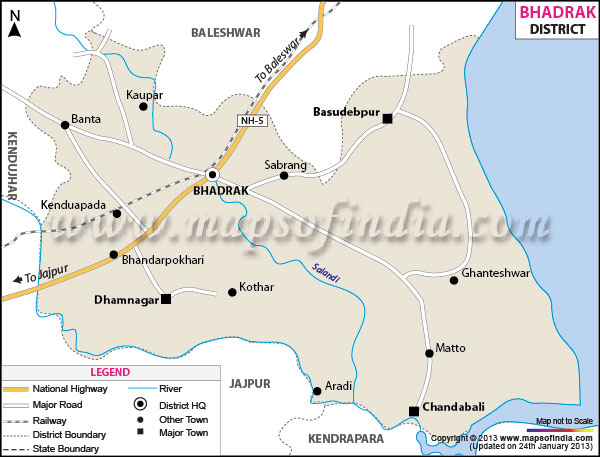
Bhadrak district is located on the northern coastal strip of Odisha, about 140 kilometres from the state capital Bhubaneswar and is named after Bhadrak, which is named after Goddess Bhadrakali whose ancient temple stands on the banks of Salandi river outside the town. It is a district carved out of the old district of Balasore on 1st April 1993 which has been given a new identity around a few significant temples, coastal fishing, agriculture along the river and is emerging as a port, industrial gateway at the north-eastern coast of Odisha.
The District has Balasore district on its North, Keonjhar district on its West, Baitarani river on its South and Bay of Bengal on its East with Kendrapara district. The area of Bhadrak is approximately 2505km², a great portion of which comprises agricultural land formed by the Salandi and Baitarani Rivers entering the Bay of Bengal. The district is also famous for its five great Odia Vaishnava poet-saints for whom Bhadrak is known locally by this name 'Panchasakha Bhumi'.
History & Culture
The religious significance of the ancient Bhadrak is very close to the overall history of the ancient Kalinga and Odra-Desa, as the temples and shrines of the area reveal a centuries-long continuity of religious life. It is believed that the Bhadrakali Temple dates back to about the 9th century CE, but was extensively reconstructed after it was damaged in the 18th century, and the older mountain inscriptions are housed at the Odisha State Museum in Bhubaneswar. The district's geography is also dotted with remains of the Hindu, Buddhist and Islamic religions, alongside old temples, dargahs and graves – a unique and layered faith heritage for such a small district.
Bhadrak is an important region for Odia literature, as several of the poet-saints of the medieval Vaishnava srijans — Balarama Dasa and Achyutananda Dasa in particular — were from there. Culturally, the district today is a land of festivals of the Hindus, one of the most important is the annual fair at Chandaneswar, the annual festival at the Akhandalamani Temple marking the Mahashivaratri day, the festival at the Bhadrakali Temple for Kali Puja and the celebration of Sravana month at the temple. The festivals have continued to shape Bhadrak's identity as a district of a self-sustaining agricultural tradition, as well as a place of long-standing devotion, and continue to serve as a focal point for the community's life, often attracting pilgrims from beyond the district's boundaries.
Economy
The economy of Bhadrak is primarily agricultural, with coastal fishing, a few important industrial projects and a developing trade industry centered around the port.
Government Sector: Bhadrak town being the headquarter of the district is home to the collectorate and various state government departments that are in charge of the district's seven blocks and its administrative machinery. Coastal exposure to cyclones and flood from Salandi and Baitarani rivers makes coordination on disaster and irrigation management of the government an important aspect of local administration in the district.
The district's economy is also provided with an industrial anchor which is absent in many of the agricultural districts in Odisha, in the form of FACOR (Ferro Alloys Corporation), one of the largest manufacturers of quality ferro chrome in the country. Public investment in port infrastructure has also started to change the district's economic landscape, with new rail lines being built to link Bhadrak town with the coast to facilitate this change.
In addition to these big industries, Bhadrak has an extensive network of smaller industries such as rice mills, ice factories, electrical goods manufacturers, etc., which offer good employment in the various towns of Bhadrak district. In coastal regions such as Dhamara, Chudamani and Chandabali, fishing is the main occupation, and a large trade in various fish, prawns and marine products are established at these locations. There has also been some development of a small but useful education and services sector at Bhadrak Autonomous College, founded in 1948, and other education institutions in the district headquarters attracted students from all the rural blocks of the district.
Tourism
Its temples, in addition to its rivers, its coast and its rare ports and nature reserves, are the key pillars of Bhadrak's tourism identity.
The temple bearing the name of the district, Bhadrakali Temple, on the banks of Salandi river near Aharapada village, which is around 9th century old and attracts many pilgrims, especially during Kali Puja.
The principal tourist attraction of the district, Akhandalamani Temple, Aradi is an impressive stone-built Shiva temple that rises 150 ft. above the ground on the banks of Baitarani River and was constructed from stone obtained from the historic hill Lalitgiri.
Chandaneswar Temple, another important Shiva temple, which is famous for the colorful annual festival of Chandaneswar Fair, where visitors come from all over the region.
The scenic site of the confluence of the Baitarani and Brahmani rivers and the Bay of Bengal, where the port facilities are developing as well, is a tribute to Bhadrak's natural beauty and its emerging industrial landscape.
Chandabali is an ancient riverside port town on Baitarani with a more tranquil and traditional seaside ambience than the other more popular temple centres of the district.
Notable Temple of Sri Biranchinarayan Temple, Palia - It is easily accessible to the travellers on the road between Bhadrak town and Chandabali, along the southern part of the district.
These places combine to create Bhadrak's touristic character, which is mostly oriented towards devotion and coastal views rather than towards monumental structures. Pilgrims visiting the Akhandalamani Temple also visit the Bhadrakali Temple in Bhadrak whereas the coastal interest pilgrims often continue their journey to Chandabali and the confluence of Dhamra river. Although not as well developed as the dargahs or Buddhist shrines, the district's dargahs and Buddhist shrine sites provide additional interest for those visitors who wish to delve into Bhadrak's true religious and cultural mix.
Demographics
As per Census 2011, Bhadrak district has 15,06,337 people with 7,60,260 males and 7,46,077 females, with a sex ratio of 981 females per 1,000 males and this is higher than the National average. The literacy percentage of the district was 82.8% male literacy 89.64% and female literacy 75.83% which is well above the state and national average. Though urbanization is also prevalent in Bhadrak, with 12.34% of its population residing in urban areas, the reliance on agriculture and fishing is also strong as 87.66% of the population lived in rural blocks of Bhadrak district. The district's population is highly skewed towards Scheduled Castes which constituted 22.23% and Scheduled Tribes which constituted 2.02% of the total population.
Most of the population speaks Odia language and about 90.56% of the population speaks Odia as their mother tongue, Urdu is spoken by a smaller population estimated at 6.61% population and Bengali and Santali are spoken by a smaller population. Bhadrak is one of the more densely populated coastal districts of Odisha with an approximate population density of 601 per sq km due to its fertile agricultural land especially on river, which is a source of agriculture.
These are an educational profile of an essentially rural district, which is unusually good, and no small part of this may be due to the district's literary and devotional literary traditions of the Panchasakha poets. The district's high literacy rate, and predominantly rural, agriculture- and fishing-based population, suggests a community well-positioned to take advantage of the district's economy, which is slowly diversifying as port and industrial investment grows around the district's town of Dhamra.
Administration
Bhadrak district is divided into 12 tehsil (or blocks) for administrative purposes of the district and currently the local self-governance has been incorporated into many Gram Panchayats to manage the administration of the nearly 1,250 villages in the district. The administration of urban areas is through Bhadrak Municipality and some Notified Area Councils of smaller townships like Chandabali, Dhamnagar in the district.
The district collector's office, located in Bhadrak town, is responsible for revenue administration, coordinating disaster management in the district, given its vulnerability to flooding and cyclones, and general governance over the tehsils with the support of elected panchayat representatives, who are responsible for the development plans of their areas.
Bhadrak's administration has embodied a district with a very restricted geographical area, which has to accommodate riverine farming, coastal occupation, and a new port and industrial sector. The district administration is supplemented by a tahsildar for each of the 12 tehsils, who takes care of land records, revenue collection and certification, and the Panchayati Raj system that connects villages to the district administration through elected representatives of the Gram Panchayat.
Coordinating relief and disaster preparedness is a peculiar line of work in the collector's office, especially in the coastal blocks of Chandabali, Basudevpur and Dhamnagar, considering the district's susceptibility to cyclones and river inundations from the Salandi and Baitarani. With Dhamra Port in the process of becoming a logistics and trade hub, District officials play a new governance role in coordinating with the port and railway agencies.
The more urbanised sections are under civic administration by Bhadrak Municipality while the overwhelming majority of the district's population continues to be under the rural Gram Panchayat administrative system, highlighting the deep-rooted nature of Bhadrak's administrative character despite the modernization of its coastal economy.
| Facts of Bhadrak District | |
|---|---|
| Official Name | Bhadrak |
| Location | Odisha |
| Area (km2) | 12805 |
| Population | 15,06,337 |
| Language | Odia |
FAQs
1. The Bhadrak district has how many villages?
1370.
2. How many people live in Bhadrak district?
The population of the district is 15,06,337.
3. Why is the district famous?
The Bhadrakali Temple is the most famous temple here and it is the birthplace region of several of the five great medieval Vaishnava poet-saints of Odia culture the Panchasakha.
4. What is the literacy rate of the district?
82.8%.
5. Which languages are spoken in Bhadrak district?
Odia, Urdu, Bengali and Santali.
6. How many tehsils are present in Bhadrak district?
There are 12 tehsils in the district.
7. What is the date of establishment of the district Bhadrak?
Bhadrak district was carved out of the erstwhile Balasore district on 1 April 1993.
8. Why is the Akhandalamani Temple important?
The Akhandalamani Temple at Aradi is dedicated to Lord Shiva and is believed to be the main reason for the growth of the tourism industry in Bhadrak and is visited by many during the pilgrim months of Mahashivaratri and Sravana.
9. Which are the leading industries of Bhadrak district?
The industrial base of the district consists of FACOR, India's biggest Ferro chrome manufacturer with rice mills, small scale manufacturing industries and expanding port and trade related industries that have come up in connection with Dhamra port.
10. What is the local administration like in Bhadrak district?
The district functions through various Gram Panchayats in the 12 tehsils of the district under the coordination of the district collector office in Bhadrak town, Bhadrak Municipality and various Notified Area Councils.
11. What is the population density here?
601 sq. km.
