





About
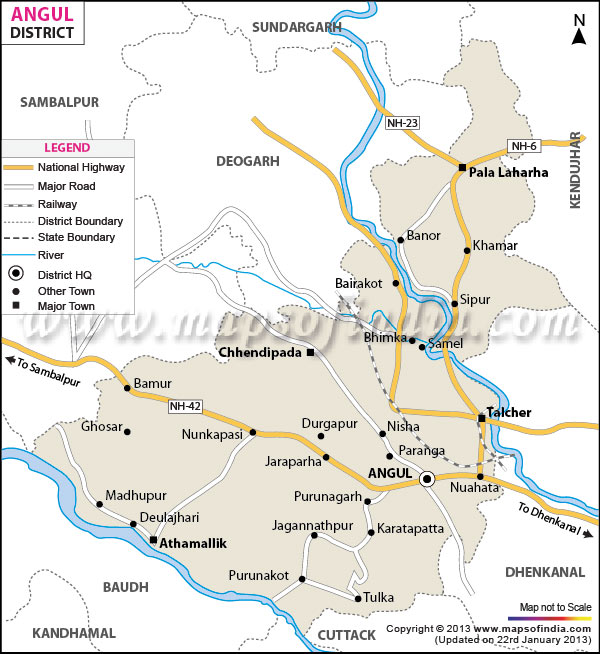
Angul is a district which lies at the center of Odisha and is also one of the best known industrial zones in the state. In 1993 on the 27th of March Angul was separated to become a distinct administrative district. Angul town is the headquarters of the district. In Talcher, Athamallik, Chhendipada, Pallahara and Banarpal we see some other important areas of Angul district.
Angul is of an area of 6,375 square kilometres. In terms of diversity the district has it all from industry to forests, rivers to farm fields and ancient religious sites. In Talcher we see large coal mines and power plants which are a feature, at the same time in Angul town we have developed a very important center for admin, education, trade and business. Also in the district you will find large companies and public sector entities like Mahanadi Coalfields Limited (MCL), National Aluminium Company Limited (NALCO) and National Thermal Power Corporation (NTPC).
Angul also has very good connectivity with the rest of Odisha. We see national and state highways which connect the district to Bhubaneswar, Cuttack and Sambalpur. Also in terms of rail transport Angul and Talcher are key nodes which in turn play a role in easy movement of people, coal, industrial goods and other products. These connections have also been a cause for Angul’s growth into a large economic center.
History & Culture
Angul has a past which is very much tied in with the old princely states and local communities of Odisha. In what was to become a modern district, different parts of what is today’s Angul area were associated with local kingdoms which included Talcher and Athamallik. In those areas’ own separate traditions, temples, fairs and systems of local administration took root.
In 1993 Angul came into being as a separate district. Since then the district has seen great change mainly due to mining, power generation, aluminum and steel industries. Talcher in particular grew when large coal fields were discovered in the area. With industrial growth came workers and families from all over Odisha and other states to Angul.
Even with large scale industrial growth local traditions are still very much alive. In Angul festivals play a key role. Talcher Ganesh Puja is one of the best known celebrations in the district. It goes on for many days and draws in people from all over. Also very popular is Angul Laxmi Puja which has decorated puja pandals, markets, music and cultural programs.
In Angul’s culture you will see reflection in local handicrafts and folk traditions. In that district Dhokra work, terracotta, woodwork and traditional textiles are practiced. These products display the skills of local artisans and are sold in local markets and fairs.
Economy
The economy of Angul is dominated by coal, power, aluminium, steel and other industries. In Talcher we see very large coal production which in turn supports many power plants. Near Angul is located the NALCO aluminum complex which is also a very large element of the district’s industrial base.
We also have private steel and power companies as well as many small businesses that supply large industrial units. Also farming, trade, transport, construction and tourism contribute to the income of people who live outside the main industrial areas.
Government Sector
In Angul the government sector has a large presence as the district is a key administrative and industrial center. The District Collector’s office along with other government agencies run services related to revenue, education, health care, agriculture, rural development and public welfare.
The district administration also operates in areas of mining and industrial activity. We have welfare programs and development projects for rural families, farmers, workers and communities which live near mining areas.
Government is putting money into roads, bridges, public buildings and other infrastructure which in turn creates local jobs. We see that out of these projects come opportunities for contractors, transporters, construction workers and small scale suppliers.
Public Sector
In Angul, the public sector is very much at the fore as several large government run companies operate here.
Mahanadi Coalfields Limited is a major player in the district. In Talcher, which is the site of their mining operations, they support a large network of workers, contractors, transport companies and local businesses. Also from Talcher comes the coal which supplies power plants and other industries.
NALCO has aluminium smelters and power plants in Angul. The company has been a large player in making Angul a preeminent aluminium production center. Also it has grown to become a primary source of employment for engineers, technicians, contractors, transporters and other workers.
NTPC runs a large scale power station at Kaniha, also of note is the fact that Talcher Thermal Power Station has been a key player in the area’s power industry. At Vikrampur we also have the Heavy Water Plant which is a large public sector installation.
These companies have grown beyond industrial production. They have played a role in the development of housing areas, shops, schools, transport services, food businesses and other local activities. In Angul many small businesses depend directly or indirectly on the industrial population.
Services Sector
In Angul the services sector has seen growth along with industry and town development. In Talcher and Angul you will find active markets which have a variety of shops, restaurants, hotels, medical stores, private clinics, coaching centers and other businesses.
Transport is a key service sector. Coal, aluminum, steel and other industrial products use trucks, rail services, repair shops, warehouses and also support from other businesses. This in turn creates work for drivers, mechanics, loaders, transport agents and small traders.
Health care is a very large component of the local economy. In Angul and Talcher government hospitals co function with private ones, clinics, pharmacies and diagnostic centers. Also people from neighboring villages and towns use these health care resources.
Tourism
Angul is known for coal and industry but the district also has a lot to offer to visitors. It has forests, rivers, temples, dams and old religious sites which present a variety of options.
Satkosia Gorge in Tikarpada is a top attraction in Angul. Mahanadi as it runs through the gorge among hills and forests. You may enjoy the river views, boating, the natural environment, which is also the base for gharial conservation programs.
Deulajhari near Athamallik is a special place. It is an old Shiva temple which has hot springs all around. The springs which are still active around the temple draw in pilgrims as well as people interested in the area’s natural beauty.
Rengali is known for the dam it has on the Brahmani River. The reservoir and the surrounding area which is very scenic are what make it a popular spot for a day trip or picnic.
In Talcher there is a large scale worship of the Goddess Hingula at the Hingula Pitha which is a very important religious site. Devotees from great distances come to visit the place during religious festivals.
Saila Srikhetra in Angul which is a temple complex on Sunasagad hill. This site is related to Lord Jagannath and is a draw for local devotees.
Demographics
According to the 2011 Census of India Angul district had a population of 1.273 million. Which also included 655,718 males and 618,103 females. The district had a population density of around 199 per square km.
Angul is a district which has a greater rural population base as compared to urban. In villages many people live which are into farming, daily wage work, small scale business, government jobs and other local professions. Angul town and Talcher are the main urban areas of the district.
In the district we see large numbers of Scheduled Castes and Scheduled Tribes. In 2011 Census it was reported that we have 239,552 Scheduled Castes and 179,603 Scheduled Tribes in Angul district. Also it is the tribal communities which are very much present in the forests and rural areas of the district.
Odia is the primary language in Angul. In schools, offices, business and industrial settings you also find Hindi and English. Also from other states which have migrated to Angul have brought into the town and industrial areas a diverse language mix.
In the 2011 Census our district reported a literacy rate of 78.96%. We have seen growth in education which includes the expansion of schools, colleges and training institutions that serve both urban and rural communities.
Administration
In Angul district the District Collector and District Magistrate are the administrators. The district administration is in charge of public services, tax collection, development projects, law and order and welfare programs.
In terms of district administration Angul has 4 sub divisions, 8 tehsils and also 8 community development blocks. Also the district has 225 Gram Panchayats which play a role in local development and village level issues.
Angul has 2 municipal bodies and 1 Notified Area Council (NAC). These urban local bodies run services which include roads, sanitation, drainage, waste collection and other civic facilities.
The district is home to some 1,930 villages which is an indication of the large rural area we are dealing with. Also we have 23 police stations which play a role in upholding law and order in various parts of the district.
| Facts of Angul District | |
|---|---|
| Official Name | Angul |
| Capital / District Headquarters | Angul |
| Area (km2) | 6232 |
| Population | 1,273,821 |
| Religion | Hinduism, Christianity, Islam, and other faiths |
| Language | Odia, Hindi, English |
FAQs
Q.1: Why is Talcher important in Angul?
Talcher’s importance is due to its coal mines and power plants. That area has played a key role in the supply of coal and electricity which in turn has made Angul a major industrial district.
Q.2: Which rivers flow through Angul?
In Angul which served as a home to the Mahanadi and Brahmani the main rivers. From this water which is a base for farming, irrigation, and reservoirs, many natural attractions have grown.
Q.3: Which festivals are popular in Angul?
Talcher Ganesh and Angul Laxmi are the groups which have the greatest attendance in the district. Nuakhai and Viswakarma are also very important in farming and industrial communities.
Q.4: What languages are spoken in Angul?
Odia is the primary language in Angul district. In towns, at schools, government offices and industrial work places Hindi and English also are very much in use.
Q.5: Why is Angul important to Odisha?
Angul is outstanding in that it is a base for coal, aluminum, steel and power production. Its industries play a large role in Odisha’s economy, also its forests, agriculture and tourism which in turn support the district at large.
Last Updated on :August 27, 2026
