







About
Ganjam district is located on the sprawling golden shores of the Bay of Bengal, amidst splendid emerald green waves of sea and on the emerald, misted peaks of the Eastern Ghats rolling with the smooth rhythm into fertile alluvial plains. Located at the southernmost part of the state, it is an extraordinary land, a monumental and major cultural hub of the state. It is a historical honour for a country that has, throughout thousands of years, continued to be a fountain of agricultural riches, trade and shipping.
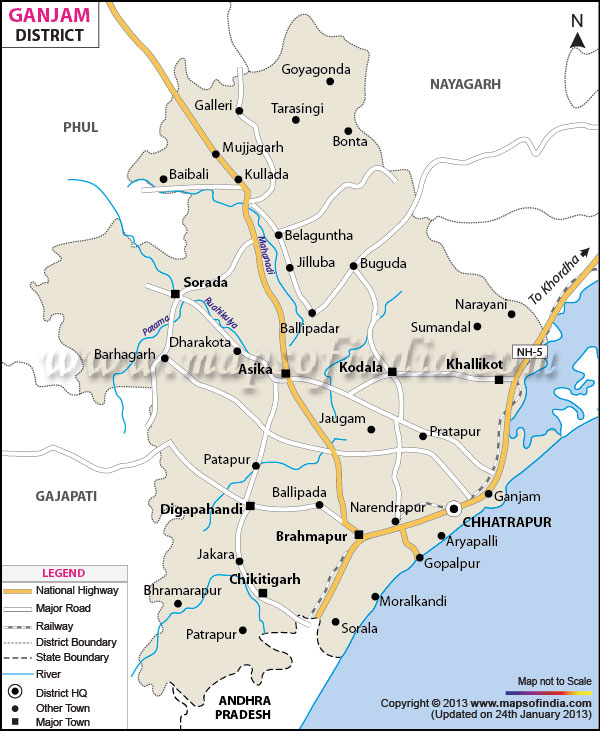
To see the grand geography of the Ganjam district in modern times, on the Ganjam district map, one will find a magnificent geography in an area of around 8,206 sq.km. It is bounded by the northern territories of Khordha and Nayagarh, is flanked by Gajapati in the west, by Kandhamal in the north-west, is anchored in the South by Andhra Pradesh and is embraced by the roaring sea in the East having an enviable geographical placement. Filled with the chaos of vibrant, commercial, offensive pulses of Brahmapur, the ‘acclaimed Silk City' and the serene, protected, bird-filled sanctuary at the southern reaches of Chilika Lake, every single line that is drawn on a Ganjam district map tells a drama of its own on a subliminal level.
History & Culture
You step onto this land is like stepping into history in the flesh: onto the land of ancient empires, risen, fallen, and etched into the land and its people. This great land had thrived under the banner of ancient Kalinga, and later under the crown of a magnificent, independent and wealthy medieval Kingdom of Kongoda. Before the modern administrative divisions were established, this magnificent land was under the banner of ancient Kalinga and then evolved into the independent, strong Kongoda Kingdom. The sounds of great imperial campaigns resonate through the sea breeze along the shores. If one looks closer at an ancient Ganjam district map, close to the ancient settlement of Jaugada, one will see the famous place where the Maurya Emperor Ashoka had pecked out edicts in rock in the 3rd century BCE. Also, the Ganjam district map can help understand history of the region in an effortless manner.
In the wake of the terrible, bloodshedden Kalinga War, here a conquering heart broke, and there, a legendary shift to pacifism, dhamma and spiritual eternity. Waves of centuries inundated the region, allowing the Gajapati Kings of Puri to rule over it; through the period of the Golconda Sultans who quilted over into the Mughal rule and then to the glittering era of British rule, when the region became a very valuable and strategic port on the coast of the Madras Presidency of the British East India Company, till it once more returned to its glory days in the merger with Odisha in 1936.
In culture, it is impossible to get any more dynamic and emotionally charged than this place, with its folk art, rhyming theatrical displays, and fervent community ceremonies. The regional ambience echoes the mighty sound of the renowned Thakurani Yatra, a massive biennial event that sees urban areas become a spectacular living canvas of ecstatic worship, elaborate masked dances and theatrical performances. Ancient Vedic mythological battles are presented skillfully here in crude and unfiltered emotional expression, while the Ghumura and the thrilling Ranapa ( Walking on Stilt dancing frames) demonstrate unparalleled physical agility, balance and “ancestral cadence”. The intellectual and literary legacy is as luminous too, carried forward by indigenous law poets and musicians whose stylistically complex yet melodic Odia poetry still resonates in the ancient halls of the court, the temple precinct and in the peace of any quiet coastal hamlet on any Ganjam district map in Orissa.
Economy
The economy of the area is a multi-faceted engine, never idle, fueled by its fertile agriculture, its abundant coastal resources, its industrial complexes, as well as its ancient and strong trading culture.
Government Sector
Public administration and civic infrastructure are key building blocks for thousands of families and the regional economy development. Governments direct and organise large-scale construction works, agricultural policies and support measures, marine protection programmes and health care systems out of their official headquarters at Chhatrapur. A huge army of civil servants, teachers, engineers and administrative staff members diligently scrambles from one municipality to another or from one rural block to another as it is recorded in a Ganjam district map, uncovering and carrying the governance of the state to the farthest corners of the population.
Public Sector
The coast is dominated by heavy industry and the latest in public facilities. The commercial marine port at Gopalpur is an economic monster moving monstrous volumes of ocean-bound international trade, bringing the industrial minerals of the land of Odisha right through to the sea. Seated next to this coastal wealth is the huge OSCOM (Orissa Sands Complex) mineral processing complex run by another major CSPU, Indian Rare Earths Limited (IREL) which extracts, processes, and refines valuable heavy minerals like ilmenite, rutile, garnet and zircon directly from the mineral rich coastal sands.
Services Sector
Also known as the undisputed commercial hub and financial nerve centre of the Indian state of Odisha in the South, Brahmapur is the home to a fast-paced and booming services economy. Lauded all over the world for its stunning and handmade Phuta Berhampuri silk sarai, this city has developed a vast network of master weavers, through which passed on many generations, wholesale textile merchants and retail outlets. Along with textiles, a thriving hospitality industry, emerging eco-tourism businesses, medical centres, transport logistics and prestigious higher educational institutes all drive a fast modern growth of the service sector in each of the key towns as visible on a Ganjam district map.
Tourism
Each and every ride over the multimoving prominences of the landscape throughout the region reveals a spectacular visual feast, a holy spiritual sanctuary or the untouched coastal wilderness.
The sacred Tara Tarini Temple lies dramatically on the top of the sacred Purnagiri Hills near the Purushottampur town with an awesome panoramic view of the sinuous Rushikulya river at the bottom. It is regarded as one of the Shakti Peethas and holds an enormous significance for pilgrims, either employing the steep and strenuous ancient twin paths or climbing into the temple by the modern cable car, which makes the journey almost seamless, in order to pray to the two Goddesses, Tara and Tarini.
The world famous Rushikulya Rookery, located near Purunabandha, is the place where one can find his true calling if he is a nature lover who follows the route from the Ganjam district map. It is a miracle of nature each winter, when hundreds of thousands of vulnerable olive ridley sea turtles "arrive" onto shores en masse in a stunning spectacle of mass nesting called the Arribada. Facing the coast, the Town of Tampara offers a perfect, unspoiled waterfront property that has been beautifully landscaped, with many water sports enthusiasts, kayakers, and nature lovers along its shores for a spectacular, sparkling, vast body of freshwater.
Demographics
A detailed analysis of human populations in these records reveals a rich and varied demographic past, in which the people were dense enough to make this part of Odisha the most populous district of the state. Official Census data shows that the region is home to a large population—3,529,031 population spread across coastal and inland areas with an incredible population density of around 430 persons per square kilometre. The gender parity shows a healthy social structure in the cross-section of the population, with a recorded proportion of 983 females to 1000 males spread across which can be analysed with the help of the Ganjam district map.
The overall level of literacy has been steadily increasing over recent decades, with a general uplift of standards and literacy rates, rising to 71.88%. However, the analysis of metrics related to gender and education shows that male literacy rates are around 80.99%, as against 61.13% for females, despite the efforts and expenditure of intensive campaigns at the state-level and school construction projects. So much so from the language point of view that the sweeter, melodious sound of the Odia language prevails in daily life, the distinctive, highly colourful accent of Odia being universally called Ganjami. Telugu is spoken, understood and utilised as a language much wider and with a long history in the district as a border area with Andhra Pradesh. Other classes of languages include Hindi, English and regional languages which are used more widely in the academic, administrative and trade sectors.
Administration
Looking in detail at the administrative system of the region, a layered administration is apparent, well organized, and tailored to the geographical scope and high population density of the region. The District Collector and District Magistrate, located in the official power-house at Chhatrapur, are at the pinnacle of local governance. For efficient operations, the whole territory is divided into three main administrative subdivisions: Chhatrapur, Brahmapur and Bhanjanagar. These three subdivisions supervise a wide area network of 23 administrative Tehsils – which are the major administrative centres of the region – such as Chhatrapur, Brahmapur, Bhanjanagar, Asika, Khallikote, Purushottampur, Hinjili, Chikiti, Surada, and Polasara.
On a Ganjam administrative map, further analysis indicates the presence of an administrative structure of 22 Community Development Blocks, where they coordinate in rural transformation, agricultural support, health service delivery and the social safety net service. Urban governance is very skillfully executed, having 20 Urban Local Bodies and smaller municipalities, with the huge municipal corporation of Brahmapur.
At the grassroots, a hundredfold in more than 300 Gram Panchayats across the landscape of rural areas, a total of 3,195 revenue villages are celebrated for their democratic values. This solid, pervasive administrative network ensures that all government services, emergency disaster relief and welfare infrastructures reach even into the most marginalised areas, as illustrated on a detailed Ganjam district map.
FAQs
Q1: What is the district population?
It has 3,529,031 residents.
Q2: How many villages are there?
There are 3,195 revenue villages.
Q3: What is the literacy rate?
The literacy rate is 71.88%.
Q4: What is the headquarters?
The headquarters is at Chhatrapur.
Q5: What is it famous for?
Berhampuri silk, Kewda, and sea turtles.
Q6: How many subdivisions exist?
There are 3 administrative subdivisions.
Q7: What language is spoken?
Odia in the Ganjami dialect.
Last Updated on : August 19, 2026
