







About
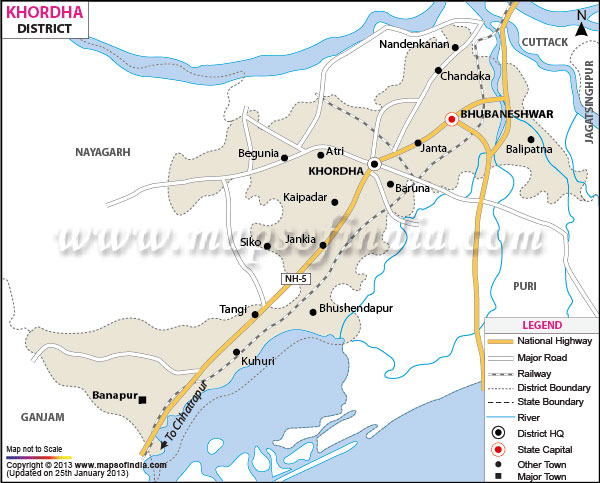
Enter a land where ancient echoes of warrior footsteps echo through an emerald canopy and the gleaming glass towers that are of tomorrow rise to the sky. This is Khordha. This land was carved out of the historic cradle of the greater Puri region in April 1993 and has a unique privileged status on the eastern coast of India. The name itself, which in folk memory is believed to have originated from the word "Khurda", associated with the martial traditions of the region. To the north and east lies Cuttack, to the west Nayagarh and to the south lies Puri, while to the South-West lies Ganjam, with between these borders being abuzz with political life, Bhubaneswar and scattered with striking numbers of birds, Chilika lake.
History & Culture
The three pillars of Khordha's dramatic history are blood, devotion and iron. In the late sixteenth century, when the glorious Gajapati Empire began to suffer from turmoil, Bhoi dynasty ruler Raja Ramachandra Deva I established Khurda as his capital in the early 1570s after the fall of Cuttack. The kingdom was also bordered by an impenetrable fortress of Barunei hill and was the last bastion of native Odia rule. During numerous generations, the kingdom faced repeated attacks from Mughal and later Maratha forces but the golden standard of Khordha held up, and the holy role of Lord Jagannath's divine abode was well guarded.
Then came 1817. Early in the history of the Indian uprising in the year 1857, long before the might of millions had risen on the Lone Stars of the Indian uprising, the brave men of the Paika army, the hereditary land owners and land militia of Khordha, arose in a terrible storm of armed rebellion. A dense jungle became a frightful labyrinth of long swords and long bows, under the leadership of Bakshi Jagabandhu Bidyadhar, a warrior. All the gorges that appeared on a historical Khordha district map were places of ambush and this is where the spirit of freedom secretly blazed through and remained unquenchable. A colonial era Khordha district map shows the strategic redoubts around Barunei Hill, where the British were confronted by the tough resistance of the people of the district.
The art of culture in Khordha is not stagnant and anchored in the museum, but is part of the daily life rhythm. The youth of the village continue to leap and twirl, practising martial dances like Paika Akhada, sword dances which hold ancient military techniques alive in the village akhadas (martial arenas). The art genius of the district is highlighted by the beautiful products of brass works from Khordha and the intricate folk handicrafts of generations. During the days of the cloudy sky of Monsoon, they celebrate the festival of Raja and the countryside becomes a celebration of womanhood and earth's fertility, with swinging wooden seats tied to the mango tree and the smell of smoked Poda Pitha all around. Hundreds of thousands of people climb the ancient stone stairs of the wonderful Lingaraj Temple in Bhubaneswar on Maha Shivaratri night, burning a sea of lamps in the night sky.
Economy
The combination of tradition-based agriculture and service-based high tech frontiers creates a dynamic duality that has guided the economic structure of the district. This duality of tradition-based agriculture with frontiers of service-based high tech has guided the economic structure of the district. Through a detailed economic understanding with the help of a Khordha district map, it was observed that a flourishing industrial belt was developing on key transport routes which serves as the hub for commerce throughout the state.
Government Sector
The government sector is an Institutional dragon, the hub of power for Odisha, hence the economic colossus in the state. Government staff as a group is stable and resilient; that's an enormous number of people who contribute to local consumption and real estate activity. These significant administrative installations on every civic areas, Khordha district map highlights the district as the nerve centre of governance.
Public Sector
There is a very strong foundation of heavy industrial infrastructure and central public institutions. There is an important divisional headquarters of East Coast Railway supported by large Railway Yards and maintenance workshops at Jatni. The overhauling workshops and heavy engineering factories run in Mancheswar Industrial Estate. Close by, key public enterprise facilities like the huge Indian Oil Corporation Limited (IOCL) LPG bottling plant and strategic warehouses help ensure energy security in eastern India. The map of industries in Khordha shows that these key Public Sector establishments are located close to major railway lines, which provide employment opportunities for technical experts and skilled craftsmen.
Services Sector
The district has emerged as an economic powerhouse of Odisha with the skyrocketing growth of the services sector. Foreign listed tech giants such as Infosys, Tata Consultancy Services, Wipro, Tech Mahindra and LTIMindtree have their base in the northern parts of Bhubaneswar in the Infocity and DLF Cybercity. These beautiful campuses welcome hundreds of thousands of tech industry youths each day. This digital revolution is supported by a knowledgeable education and healthcare system. Students from across the nation as well as from other nations, pour in at world-class institutes such as the National Institute of Science Education and Research (NISER), the Indian Institute of Technology (IIT), AIIMS Bhubaneswar, KIIT University and SOA University. The technology corridors on a commercial Khordha district map illustrate how quickly the district has become an international innovation hub. In addition, amid the growing economy, manufacturing producing soft drinks, sachets, cables and accurate electronics make up another nice part of the local business industry.
Tourism
Passing through Khordha is to traverse a magical kaleidoscope of history, divinity and untamed nature. The tourist Khordha district map is a key to unlock the treasures, which have enchanted many travellers from centuries.
The sandstone twin hills (Udayagiri and Khandagiri) beyond the city boundaries have ancient caves from the 2nd century BC which contain the remains of that era. The rock shelters were once occupied by the Jain ascetics and now host the famous Hathigumpha inscription of Emperor Kharavela, documenting military conquest and royal benefactions, from the King in the Brahmi script. The hillocks are part of the tourist track of Khordha district which also includes Dhauli Giri on the tourist Khordha district map. Located on the shores of the Daya River, Dhauli has the gleaming white Peace Pagoda (Shanti Stupa) constructed by the Japan Buddha Sangh and the government of Odisha on top of rock edicts inscribed by Emperor Ashoka on the heels of the traumatic Kalinga War.
The secluded, calm waters of Chilika lake of the Southern part of the district greet the nature enthusiasts in the eyes. Chilika is one of the largest brackish water lake in Asia and during winter months millions of migratory birds visit the lake from Siberia and Central Asia. Glimpses of frisky Irrawaddy dolphins frolicking on the placid waters off Balugaon, Banapur, are captivating for avid enthusiasts. Further inland and lying at the foot of rich hills, there is the Barunei, where several natural perennial springs, a sacred temple, and a strong historic tradition are found. Closer to home, the thermal sulphur springs of Atri attract thousands looking to improve their health through the waters of healing. The Nandankanan Zoological Park is known for its rare white tigers and diverse wildlife along the green woods, making it an experience never to be forgotten among family and dear ones. Once these are plotted on a detailed mapping of the Khordha district, one can imagine a touristic heaven that could almost be called a heaven on earth.
Demographics
Khordha district is the most urbanised, densest and well educated district of Odisha towards demographic parameters. The district is considered a hub of activity, with the official census showing 2,251,673 inhabitants from diverse cultures and traditions, as opposed to other urban centres that are predominantly rural in their hinterland, which only make up 51.84% of the total people in Bhubaneswar and the other municipalities. The growth in the urban centres is rapid. From the Khordha district map, the population is concentrated in the densely populated areas around the capital and major industrial corridors, with a sparse population in the rural tracts.
The population is well known for its intellectual capability. An impressive overall literacy rate of 86.88% is well above the state and national average. Male literacy is outstanding at 91.78%, with female literacy at 81.61%, which is encouraging. The sex ratio stands at 929 females per 1,000 males.
The ancient language of Odia is used as the main language and is sung by the majority of the residents in a melodic tone. The cosmopolitan nature of its capital means that Hindi and English are the widely spoken languages in the commercial, educational and corporate realm. When these areas of linguistic enclaves are laid out on a Khordha district map, it showcases the 'multi-levelled' atmosphere of the area.
Administration
A good administrative system is needed for efficient governance over this heterogeneous country. The Bhubaneswar and Khordha Sadar are the two main subdivisions of the administrative operations which are supervised by the District Collector and Magistrate. The administrative Khordha district map is clear of the boundaries of the various zones and planes of the district, to facilitate uninterrupted provision of public services from urban space to rural hamlets.
The district comprises 21 tehsils and 10 community development blocks. The tehsils are those tehsils which are producing ready money such as Bhubaneswar, Khordha, Jatni, Banapur, Tangi, Balugaon, Begunia, Bolagarh, Balianta and Balipatna. The 1,546 revenue villages were inhabited in the respective tehsils and are considered as part of urban area. The administrative district on the Khordha district map is not linear and is heavily marked and documented; it is a realistic yet functional, even harmonious, span between rural administration at a bottom-up level and urban management, with technology in force.
FAQs
Q1: How many villages are in Khordha?
There are 1,546 villages.
Q2: What is Khordha's population?
It has 2.25 million people.
Q3: What is Khordha famous for?
It is famous for Paika history and brassware.
Q4: What is the district headquarters?
It is the Khordha Town.
Q5: Is Bhubaneswar in Khordha?
Yes, Odisha's capital is in Khordha.
Q6: What is Khordha's area?
It spans 2,813 square kilometers.
Q7: What is the literacy rate?
The literacy rate is 86.88%.
Last Updated on : August 19, 2026
