





About
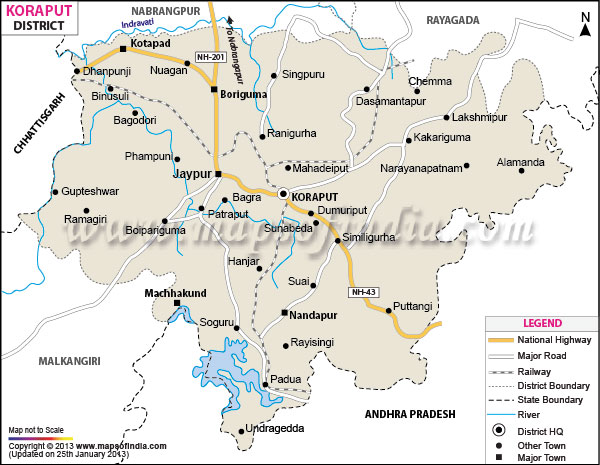
Koraput is a beautiful hill district in South Odisha. In that large part of the district is made up of the Eastern Ghats range, we have green hills, forests, waterfalls and also many tribal villages. Koraput town is the headquarter, also Jeypore, Sunabeda, Semiliguda and Kotpad are some of the known towns in the district.
Koraput is a tribal district. In over 50% of the population you will find Scheduled Tribes which include Paraja, Gadaba and Kandha. Their festivals, dances, weekly markets, food, dress and handicrafts are an integral part of the district’s life.
Koraput’s setting makes it special in Odisha. The district which is near to Andhra Pradesh and Chhattisgarh has good road and rail connections to many main towns. From Bhubaneswar Koraput is at a distance of 500 km and 200 km from Visakhapatnam by road. Also Jeypore has an airport which operates to Bhubaneswar and Visakhapatnam.
Koraput is also a very industrial district. At Panchpatmali we have NALCO’s bauxite mining which is a well known industry in the area and also in Sunabeda we have the HAL establishment. Also in terms of produce the area is known for its Kotpad handlooms, tribal coffee, fruit and vegetable produce.
History & Culture
Koraput’s past is tied to many royal families and kingdoms. At one point the Satavahanas, Nalas and Gangas were present in the region. Also because of its hilly terrain and dense forests large empires did not have a permanent hold over the area for very long. Also the region became a center of Jain culture and was a part of trade routes which went from central India to the east.
The Suryavanshi rulers at one point became very prominent in that area. They shifted their primary base from Nandapur to Narayanpatna and later to Jeypore. For a long time they ruled the area which came to an end only when the British took over greater control of the area.
During the days of British rule, what we see today as the Visakhapatnam District included this area. In 1936 which also saw Odisha become a separate province Koraput district was established. Then the area covered by Koraput was much larger than it is now. In 1992 which also marked the break up of old Odisha into many new provinces, the old Koraput district which included what are present day Koraput, Rayagada, Nabarangpur and Malkangiri was split to form these present districts.
Culture is a very strong defining element in Koraput. In this district we see many tribal communities which have their own sets of practices, songs, dances and festivals. Traditional dance in the area is a sight to see with very colorful clothing, use of feathers, flowers and leaves. Music and dance play a large role in festivals, social assemblies and other community functions.
Handicrafts in Koraput have a very old tradition. We see local artisans work with bamboo, clay, wood, stone, paddy and other materials. In the district terracotta items, bamboo crafts, cloth toys, stone carvings, wood carvings, traditional jewelry and papier-mache products are made. Many artisans work out of their villages which in turn makes handicrafts a very important source of non farm income.
In Koraput’s culture the Kotpad handloom tradition also is a mainstay. Kotpad textiles are known for their age old designs and colours and have received a Geographical Indication mark. These products which are of local weaves connect to the larger market.
Economy
The economy in Koraput is made up of many elements which include agriculture and forestry as well as mining, manufacturing, handlooms, tourism and local trade. The district’s hills and forests are the base for much of its economic activity.
Agriculture is the base of many rural families in this area. We see that people are growing what does best in our soil and climate. Also we have a reputation for our fruit and vegetable production which does well here, at the same time coffee has become our recognized produce. Koraput tribal coffee in particular has put us on the map as a farming community.
Mining and large scale industries play a very important role in our economy. In the case of Panchpatmali bauxite mines which are run by NALCO we have a large scale industrial site, also at HAL’s Sunabeda unit we see production of aircraft engines. Also in Koraput we have large power and irrigation projects which include the Kolab, Muran, Telengiri and Jolaput.
Government Sector
Government is a large player in the economy of Koraput. In that district we see large numbers of government employees in the district offices, schools, hospitals, police force, judiciary and other public services.
The district administration runs programs which include agriculture, education, health care, tribal welfare, rural development and public works. Also because most of the population is rural based the government services have to reach communities which are located in hill and forest areas.
Public outlay on roads, schools, health centers, drinking water and other services which in turn generates work for local contractors, workers and suppliers. Also it helps villages to connect with nearby towns and markets.
Koraput’s tribal population requires that welfare and tribal development programs be a priority. Government agencies work with local communities on education, livelihoods, health care and other social programs.
Public Sector
The public sector is very much a part of Koraput’s industrial and transport economy. In Panchpatmali NALCO has the large scale bauxite mines which are the public sector’s primary activities in the district. Also as a result of the mining operation we have seen growth in the need for transport, housing, shops and other local services.
Railways play a role in the local economy. In Koraput and the nearby towns rail lines connect to Odisha and neighboring states. Rail transport which includes passenger travel between the hill district and larger cities also supports goods movement.
Public and private banks as well as electricity and water supply services also support households and businesses. Also included in this base are government supported institutions. These services form the foundation of the local economy.
Services Sector
The services sector in Koraput is a large component of education, health care, transport, retail, tourism and local market. In Koraput, Jeypore, and Sunabeda there is a high concentration of shops, health facilities, schools, hotels, and other service oriented establishments.
Education has a place for teachers, admin staff, support staff and other professionals. In rural areas students commute to bigger cities for higher education and training.
Hand weavings and hand loomed fabrics are also a part of the service based work. We see that Kothapad textiles, bamboo products and other hand made items are sold in markets which in turn connect rural artisans to buyers. Also it is reported by the district administration that though hand crafts are a feature of rural areas they also have a large presence in urban areas and they are a source of income for many artisans.
Tourism
Tourism in Koraput is a reflection of its hills, waterfalls, temples, forests and tribal culture. That which we see in Koraput is a different ball game from what one sees in the coastal tourist spots of Odisha.
Deomali is a major attraction. At 1,672 meters above sea level it is the highest point in Odisha as reported by the Odisha Tourism. Also the area is known for trekking, hiking, camping and the views of the surrounding hills and valleys.
Duduma also known as Machhkund is a major attraction. From great height water drops into the hills which in turn forms a very popular spot for visitors. The waterfall is a part of the Machhkund river and hydroelectric project area.
Gupteswar is known for its cave temple of Lord Shiva. The temple is in a forested hill area which also draws devotees all through the year. The natural beauty of the setting also has much to do with its appeal.
In Koraput Sabara Srikhetra is known for the Jagannath temple and also for its association with tribal culture. A tribal museum at the site which displays elements of the local tribal heritage also exists.
Nandapur is known for its history and association with the old Suryavanshi rulers. Also which may interest history, nature and hill scenery enthusiasts are Kechela, Maliguda and Gulmi.
Demographics
According to the 2011 Census Koraput had a population of 1,379,647. That included 678,809 males and 700,838 females. Women formed 50.80% of the population which saw a sex ratio of about 1,032 females for every 1,000 males.
The main people in Koraput live in rural areas. In 2011 we saw that 83.61% of the population was rural and only 16.39% which lived in urban areas. Koraput town, Jeypore, Sunabeda, Semiliguda and also other towns are the main urban centers.
Scheduled Tribes are very large in number in the population. In the 2011 Census it was recorded that we have 697,583 Scheduled Tribe members which is about 50.56% of the district’s population. Also that of Scheduled Castes which were 196,540 at 14.25%.
In 2011 the district had a literacy rate of 49.21%. Male literacy was at 60.32% which also shows female literacy at 38.55%. Also at the time of the Census this is the gap between male and female literacy.
In Koraput people speak Odia along with a number of tribal and regional languages. Tribal languages which are used by the communities are very much a part of local identity. Paraja, Gadaba, Kondh and others maintain their own cultural practices and forms of speech.
Administration
Koraput district is administered by the District Collector and District Magistrate which is the head of the district administration. The administration is into revenue, public services, law and order, rural development, welfare programs and other government work.
Today the present district administration reports that it has 2 subdivisions, 14 blocks, 14 tehsils, 240 Gram Panchayats, 3 municipalities, 1 NAC and 17 police stations. Koraput and Jeypore are reported to be the two subdivisions.
The 14 blocks which are Bandhugaon, Boipariguda, Borigumma, Dasmanthpur, Jeypore, Koraput, Kotpad, Kundra, Lamtaput, Laxmipur, Nandapur, Narayanpatna, Pottangi and Semiliguda. They run development works and government programs at a local level.
Koraput’s administration has to deal with a large rural and tribal population which is spread out in hilly and forested areas. This puts local government institutions and village level bodies in a key role in reaching out to people that live far from the main towns.
| Facts of Koraput District | |
|---|---|
| Official Name | Koraput |
| Capital / District Headquarters | Koraput |
| Area (km2) | 8,807 |
| Population | 1,379,647 |
| Religion | Hinduism, Christianity, Islam, and other faiths |
| Language | Odia, Desia, Kui, Telugu |
FAQs
1. Why is Sunabeda important in Koraput?
Sunabeda is a home to the HAL which produces Sukhoi aircraft engines. Also the town is an important urban and industrial center in the district.
2. What is Koraput tribal coffee?
Koraput tribal coffee is from the district’s tribal farming communities which have taken to its cultivation. In Koraput’s agricultural economy coffee has become a local product.
3. What is Parab festival in Koraput?
In November Koraput hosts Parab which is a grand cultural festival. It features tribal music, dance, traditional food, handicrafts and other local cultural events.
4. Why is Duduma Waterfall famous?
Duduma is a large waterfall in the Koraput range which also features the Machhkund river and hydroelectric project. Its height and forest setting which is home to a variety of flora makes it a popular natural destination.
5. Why is Koraput important in Odisha?
Koraput is home to a large tribal population, we also see here a great array of natural resources, agriculture, industry and tourism. What makes this district stand out in South Odisha is its mix of Eastern Ghats’ natural beauty, tribal culture, mining, manufacturing and local crafts.
Last Updated on : August 27, 2026
