





About
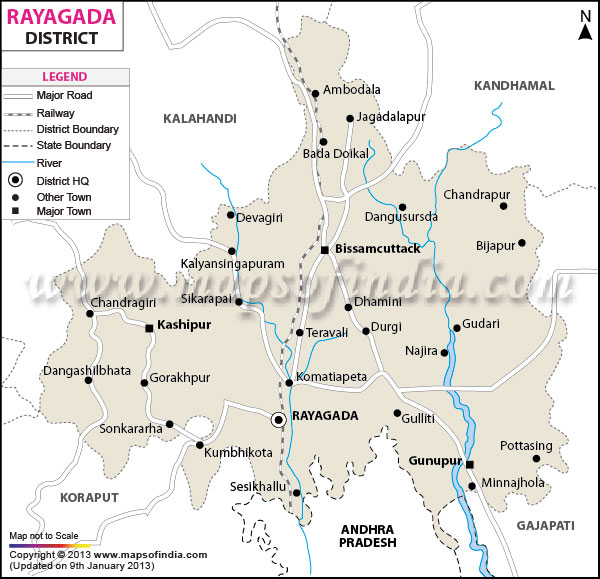
In the south of Odisha, it's nestled among emerald hills draped in a canopy of foliage, whispering out some ancient tales to the mist-cloaked valleys, a landscape created and shaped by nature and the ancient tribal heritage. One has only to look at a map of Rayagada district to see the complex geometry of undulating hills, tumbling rivers and seemingly endless forest peripheries that help to create a land that is quite unique in Eastern India. The land unfolds like a wild beauty, its rough edges and rugged terrain untamed, welcoming the curious traveller to a land in which man's life always plays a deep part in the old earth.
The district came into existence on 2 October 1992 after being carved out of the erstwhile Koraput district, with Rayagada serving as its headquarters and having a long historical association with the Nandapur Kingdom and the Jeypore region. The district occupies an extensive geographic area of 7,073 sq km, which is almost a geographical link between the Eastern Ghats and the fertile land approaching Andhra Pradesh. Upon sketching a Rayagada district map with spatial cross-sections, one feels the dramatic topography brought in by the majestic Niyamgiri and Devagiri hills.
History & Culture
In the heart of Rayagada, the echoes of kingdoms echo and trade bustle, while fierce resistance resonates in the hearts of the people. These rough terrains were once part of the ancient Kalinga, South Kosala and Mahakantara kingdoms, and ancient inscriptions.
In perusing the historical map of an ancient Silavamsi and Suryavamsi district, one could witness from the stones and the highest fort walls in Gunupur and Rayagada the ‘Thamaras of the past. On viewing the old map of an ancient Rayagada and Silavamsi district, one could see stones and the most important buildings of fortification which still remained vivid in the memory of the people of Gunupur and Rayagada to witness the ‘Thamaras of the past' from the fortresses that were once inhabited by the same.
District-wise, it is a living museum of human anthropology preserving a culture unique in providing rare insights into the deep relationship between people and the earth. Once one plots tribal settlements on an elaborated Rayagada district map, the spatial pattern creates a beautiful mosaic with Kondhas (especially the vulnerable Dangaria Kondhas) as the dominating group and the Lanjia Saora. It is remarkable that these communities have a close relationship with nature, breathe in the worship of the deity of the hill Niyam Raja and a way of life that has continued for hundreds of years without any alteration of any kind in or towards nature.
Economy
The economic heart of the district showcases a dynamic shift from agrarian-based livelihoods to modern industrial commerce, with rich mineral reserves and fertile river valleys fueling the growth of the local businesses and industries. The dynamics of historical and old logging systems and current industrialisation provide an intriguing economic story.
Government Sector
Governmental administration is a very important part and part of economic development in the district that helps families to feel secure and stable. The state and central government channels of tribal development through targeted tribal development agencies, employment programmes and the collection of forest produce through federations help to reach remote communities to provide the cornerstone of economic empowerment and developmental assistance to the forgotten and excluded sections of society.
The government identifies agricultural areas on a Rayagada district map and identifies irrigation schemes which are tailored according to the agricultural area, for growing paddy, ragi, pulses, cashew and sugarcane plantations on the basin of Nagavali and Vamsadhara. Additionally, non-timber forest products like sal leaves, mahua flowers, kendu leaves and even lac, etc., are regulated by the state forest departments, which give extra guarantees of income to thousands of indigenous families, relying on forests for their livelihoods.
The government also takes other measures, such as welfare schemes that support sustainable farming practices, organic farming and soil conservation in hilly areas. The state sets up tribal co-operatives to ensure the justification of the price of agricultural & forest produce to the local harvesters and thus safeguard them from exploitation by middlemen.
Public Sector
Mineral exploitation, transport infrastructure and power distribution are undeniably part and parcel of the public sector’s presence in Rayagada. All that has changed in this district has been due to the tremendous quantities of high-grade bauxite buried within the hills, where major state and national industrial alliances have helped to transform the district's industrial landscape and boost its economy.
On an examination of the industrial corridors on the Rayagada district map, it is clear that the East Coast Railway network connecting Rayagada to the key ports, namely, Visakhapatnam and Paradip, is of strategic significance. Highway development, investment in infrastructure for logistics and rural electrification have opened up this once-isolated tribal landscape, turning it into an important industrial transportation hub between the state of Odisha and southern Indian markets.
Large-scale infrastructure projects have also been promoted by the public sector for connectivity in rural areas. The chasm between the tribal belts, mostly rural, and commercial centres, mostly urban, has been filled in by improved road connections, expanded railway networks and improved communications.
Services Sector
There is a swirling services dominated economy, complementing the agriculture and heavy manufacturing, focused on various centres of cities such as Rayagada and Gunupur. The retail and wholesale commerce, tourism, financial, health, and educational sectors are expanding gradually, catering to the growing number of people for industrial and educational activities.
Tourism
Not only is Rayagada a haven for nature lovers and those eager to discover its hidden secrets, but it is also a place of cultural renaissance where visitors can learn the rich local traditions and handicrafts firsthand. The beauty of this terrific district is reflected in the abundance of its scenic locations as listed on the Rayagada map, which, scattered across hills, valleys and riverbanks, offer all kinds of variations in scenic wonders and spiritual enrichments.
Devagiri Hill rises dramatically from Kalyansingpur, reaching almost 120 feet, with a flat summit that is dotted with perennial natural pools of water as well as sacred cave shrines for Lord Shiva. Its unique geological feature and peaceful environment make it a favourite place for pilgrimages, and a natural wonder for enthusiasts.
The grand Jagannath Temple of Rayagada, prominently located in the middle block of the district head office, is a beautiful replica of Puri and also the venue of the annual Rathyatrotha festival in the district, which throws up great processions with great religious fervour throughout the region.
Sculpted into their distinct looks by nature, each of them on any detailed Rayagada district map is a memorable trip through cloud-cloaked summit, roaring stream and spiritual holy site. The tourists escape from the land of enchantment with a permanent appreciation of the ancient cave temples and the peace-filled valley of the setting sun over the mountains.
Demographics
The district is predominantly rural and has an overwhelming indigenous population and a diverse demographic is interesting. Data collected throughout a Rayagada district map is uniquely affected by tribal tradition and forest ecology as part of a social fabric.
The population as per Census 2011 is 967,911, comprising 471,960 males and 495,951 females, with a sex ratio of 1051 females to 1000 males. The overall literacy rate in the district is 49.76 per cent, while the male and female literacy rates are 61.04 per cent and 39.19 per cent, respectively.
It is quite evident when looking at the Rayagada district map, visually based on the demographic scenario in villages such as rural ghanaians Kondha population in Kashipur, Bissam Cuttack and Gunupur, etc. Scheduled Tribes population reflects the largest majority at 55.99 per cent and the Scheduled Castes population at 14.41 per cent.
Distinct tribal dialects like Kui, Kuvi and Sora are heard in the tribal lands, with some of them being officially recognised for administrative and business purposes, as well as the state language of Odia. Sora, Kuvi and Kui are the native tribal languages spoken which are also used amongst tribal people, with Kui and Sora being also followed as government constitutions in business and administration areas, as well as in the homeland inside the state, Odia being the official language. Besides, the neighbouring state of Andhra Pradesh has people who understand and speak Telugu pretty well in all the border towns on the southern side.
Administration
To serve a region defined by mountains and their jagged peaks, wide forests and scanty populations, one must rely on a coordination system for governance. The administrative trace on a Rayagada district map shows that the administration is spread throughout with very little concentration on the administrative town of Rayagada; and furthermore, that authority extends right down to the village level, via block and sub-divisional.
The district administrative subdivisions are two main ones: Rayagada and Gunupur. The region is subdivided into 11 tehsils and 11 Community development blocks which also handle local government and welfare programmes, for revenue administration, developmental tracking and local policing. Rayagada, Gunupur, Bissamcuttack, Kasipur, Kolnara, Ramanaguda, Kalyanasinghpur, Padmapur, Gudari, Muniguda and Chandrapur are the 11 tehsils spread across the region.
The entire administrative Rayagada district map showcases 182 Gram Panchayats with an aggregate of 2,657 revenue villages. The Collector/District Magistrate performs executive functions and supervises the administration of police stations, specialising in law and order maintained by the Superintendent of Police, with whom there are 17 police stations. Legislative representation is ensured through 03 state assembly seats (Rayagada, Gunupur, Bissam Cuttack) reserved for the Scheduled Tribes candidates in order to ensure proper representation of the tribes in the governance.
FAQs
Q.1: How many villages are in the district?
There are 2,657 revenue villages.
Q.2: What is the district's population?
The total population is 9,67,911.
Q.3: What is the literacy rate?
The overall literacy rate is 49.76%.
Q.4: What is the district famous for?
It is known for its tribal heritage and bauxite.
Q.5: How many tehsils are on a Rayagada district map?
There are 11 official tehsils.
Q.6: Which major rivers are on a Rayagada district map?
The Nagavali and Vamsadhara rivers flow through.
Q.7: When was the district created?
It was formed on 2 October 1992.
Last Updated on : August 27, 2026
