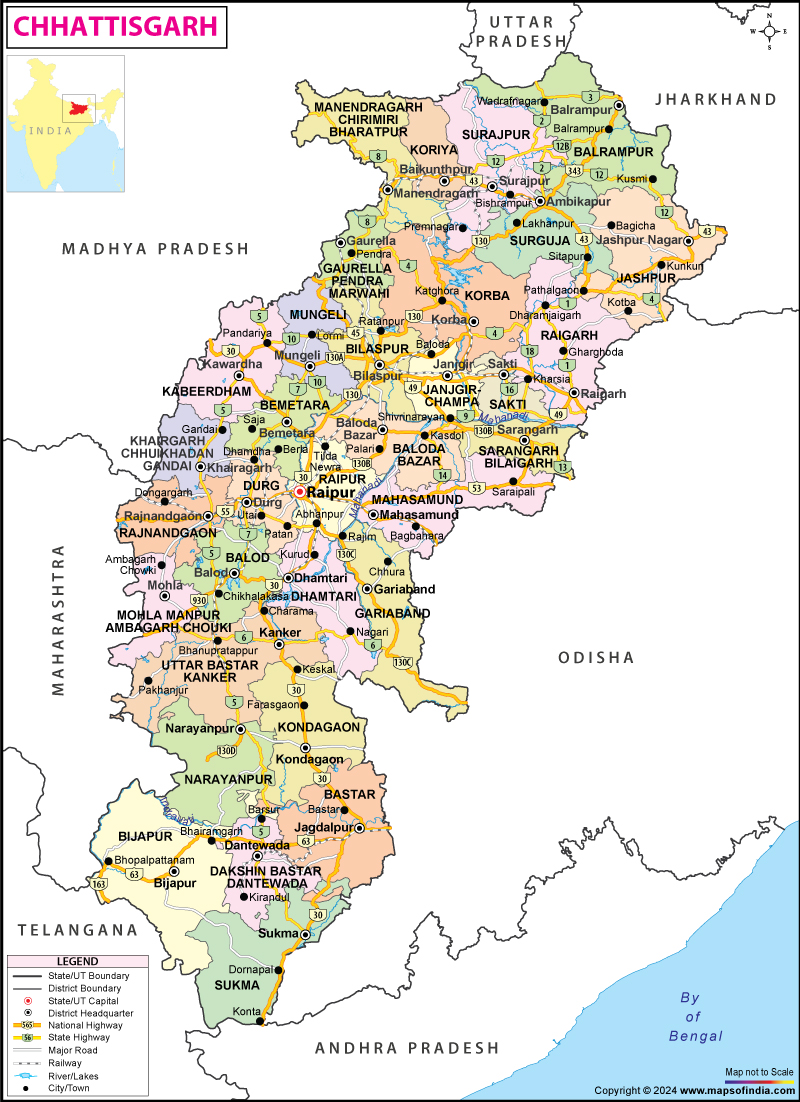





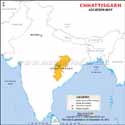
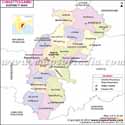
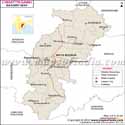
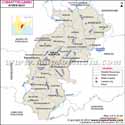
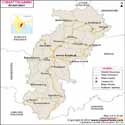
The Chhattisgarh map is helpful for knowing where Chhattisgarh's 33 districts, bigger cities, rivers, highways, and neighbouring states are located. Different maps of Chhattisgarh, including the district, physical, river, road and railway maps, help in understanding the state's administrative and geographical features.
Where Is Chhattisgarh Located?
Chhattisgarh is in the heart of the East Central region of India. It is bordered by Madhya Pradesh to the northwest, Uttar Pradesh to the north, Jharkhand to the northeast, Odisha to the east, Telangana to the south, Andhra Pradesh to the southeast, and Maharashtra to the southwest.
The state is situated between the northern plains and the Deccan region, and is endowed with diverse terrain ranging from plains, plateaus, hills and forests. The Chhattisgarh Plain dominates the central region, whereas the northern and southern regions are dominated by large patches of forest and elevated regions.
Mahanadi River and its tributaries are the significant drainage system of the state. The geographical position of Chhattisgarh also provides it with road and railway links with various states of central, eastern and southern India.
About Chhattisgarh
Chhattisgarh was formed on 1 November 2000 after being separated from Madhya Pradesh. It has an area of around 135,192 square kilometres, and is further broken down into 33 districts and 5 administrative divisions. Raipur is the capital and one of the important commercial and administrative centres of the State. Bilaspur is home to the Chhattisgarh High Court.
Chhattisgarh is also a large forest area with rich mineral resources, agricultural plains and rich tribal cultural heritage. Rice is the main crop, especially in the central plains, and coal, iron ore, limestone and bauxite help to support the state's mineral economy.
History
The region of present-day Chhattisgarh has a long history associated with ancient settlements, kingdoms, temples and cultural centres. It later became part of Madhya Pradesh after India's independence. The demand for a separate state developed around the region's distinct cultural and regional identity. Chhattisgarh was officially created as a separate state on 1 November 2000.
Economy
Chhattisgarh's economy is based on agriculture, mining, power generation, steel, and other mineral industries. The state is a significant producer of coal and iron ore and is home to significant industrial centres around Raipur, Bhilai, Korba and Raigarh. The Chhattisgarh Plain has extensive rice fields, and forest produce is also important for the livelihoods of the rural and tribal communities.
Chhattisgarh District Map
Chhattisgarh district map depicts the district boundaries and the location of each district in Chhattisgarh. These districts are divided into five divisions: Bastar, Bilaspur, Durg, Raipur, and Surguja.
The five divisions are used for administrative purposes for the state's districts. Chhattisgarh has undergone several administrative changes in the last few years, resulting in the division of the state into a new map with new districts, which is especially helpful for students and researchers.
The 33 districts of Chhattisgarh are: Balod, Baloda Bazar-Bhatapara, Balrampur-Ramanujganj, Bastar, Bemetara, Bijapur, Bilaspur, Dakshin Bastar Dantewada, Dhamtari, Durg, Gariyaband, Gaurela-Pendra-Marwahi, Janjgir-Champa, Jashpur, Kabirdham, Kanker, Khairagarh-Chhuikhadan-Gandai, Kondagaon, Korba, Koriya, Mahasamund, Manendragarh-Chirmiri-Bharatpur, Mohla-Manpur-Chowki, Mungeli, Narayanpur, Raigarh, Raipur, Rajnandgaon, Sakti, Sarangarh-Bilaigarh, Sukma, Surajpur and Surguja.
The district map makes it easier to identify the location of each district and understand its relationship with neighbouring districts and states.
Physical Map of Chhattisgarh
Chhattisgarh has plains, plateau, hills, forests, and river valleys as its physical geography. The Chhattisgarh Plain is one of the important agricultural areas in Chhattisgarh state and covers a significant portion of the central region of the state.
It is further divided into two parts: the northern one with high and wooded topography of the Surguja region, and the southern one, which is mainly linked to the Bastar Plateau. The Maikal Range is a significant highland area in the northwest of the state.
Forest is one of the important geographical features, especially in the northern and southern parts of Chhattisgarh. The state's varied terrain can be seen clearly on the physical map, which helps identify its plains, plateaus, hills and other natural features.
Rivers of Chhattisgarh
Rivers are an important part of Chhattisgarh's physical geography and support agriculture, settlements and other activities. Mahanadi is the main river of the state and passes through the central area of the State.
Some of the important tributaries and rivers are the Shivnath, the Hasdeo, the Arpa, the Kharun, and the Pairi. The Indravati River is an important river of Southern Chhattisgarh which passes through the Bastar region. Chhattisgarh Rivers Map displays the important rivers, their drainage pattern of Chhattisgarh State, and explains the relation of rivers, plains, and settlements of the state of Chhattisgarh.
Cities of Chhattisgarh
The Chhattisgarh city map shows the location of major urban centres and their relationship with districts, roads and railways.
The state's capital and the main administrative and commercial centre is Raipur. Bhilai is an important industrial city, especially for steel production. Bilaspur is an important administrative, educational and railway centre, and Korba is an important coal mining and power generation centre.
Other significant cities are Durg, Raigarh, Jagdalpur and Ambikapur. Jagdalpur is an important urban centre of the Bastar region, while Ambikapur is an important urban centre of the northern part of Chhattisgarh.
Roads and Highways in Chhattisgarh
The state of Chhattisgarh is linked to major cities, district headquarters, industrial centres and other states by the road network. Significant road links connect Raipur with the following towns: Bilaspur, Durg, Bhilai, Korba, Raigarh, Jagdalpur and Ambikapur.
The country's and state's roads are linked to Madhya Pradesh, Maharashtra, Odisha, Jharkhand, Uttar Pradesh, Telangana and Andhra Pradesh. The Chhattisgarh Road Map provides the location of major roads and an understanding of the connectivity of roads in the state.
Forests and Wildlife
Forests constitute a large component of the geographical features of Chhattisgarh. A significant proportion of forests are found in the northern and southern areas, with forests being prominent in Surguja and Bastar.
The state has a number of protected areas of significance such as Indravati National Park, Kanger Valley National Park and Guru Ghasidas National Park. These also indicate the ecological diversity shown on the physical map and the geographical map of Chhattisgarh and are also important for wildlife conservation.
Important Geographical Places in Chhattisgarh
Chhattisgarh has several places of geographical and cultural importance. Chitrakote Falls and Tirathgarh Falls are notable natural features of the Bastar region. Kanger Valley National Park is known for its forests, caves and biodiversity.
Other important places include Sirpur, Bhoramdeo and Barnawapara, which add historical, cultural and geographical significance to the state. These locations can be identified in relation to major cities, districts and transport routes on maps of Chhattisgarh.
Chhattisgarh State Information | |
|---|---|
| Capital | Raipur |
| Date of formation | 01/11/2000 |
| Governor | Shri Ramen Deka |
| Chief Minister | Vishnu Deo Sai |
| Tourist attractions | Bastar, Chitrakote Falls, Kailash and Kotumsar Caves, Bhoramdeo Temple, Sirpur |
| Festivals | Bastar Dussehra, Pola, Hareli, Nawakhai, Holi and Diwali |
| Major dance and music forms | Panthi, Raut Nacha, Soowa and Pandavani |
| Arts and crafts | Bell-metal and lost-wax metal craft, wrought-iron craft and traditional murals |
| Languages | Hindi, Chhattisgarhi and various regional and tribal languages |
| Size | 135,192 sq km (52,198 sq mi) |
| Population (Census 2011) | 25,545,198 |
| Rivers | Mahanadi, Indravati, Shivnath, Hasdeo, Arpa, Kharun, Pairi |
| Forests and wildlife sanctuaries | Indravati National Park, Kanger Valley National Park and other protected forest areas |
| State animal | Wild water buffalo |
| State bird | Hill myna |
| State tree | Sal |
| Major crops | Rice, wheat, maize, pulses, oilseeds and millets |
| No. of District | 33 |
| No. of Divisions | 5 |
Maps in Other Regional Languages
MOI.AB.17.01.17
FAQs
Where is Chhattisgarh located?
Chhattisgarh is located in east-central India. It shares boundaries with Madhya Pradesh, Uttar Pradesh, Jharkhand, Odisha, Telangana, Andhra Pradesh and Maharashtra.
How many districts are there in Chhattisgarh?
Chhattisgarh has 33 districts, which are grouped into five administrative divisions.
What is the capital of Chhattisgarh?
Raipur is the capital of Chhattisgarh and one of the state's major administrative and commercial centres.
What is the area of Chhattisgarh?
Chhattisgarh covers an area of approximately 135,192 square kilometres.
Which states border Chhattisgarh?
Chhattisgarh shares boundaries with seven states: Madhya Pradesh, Uttar Pradesh, Jharkhand, Odisha, Telangana, Andhra Pradesh and Maharashtra.
Which is the major river of Chhattisgarh?
The Mahanadi is the principal river of Chhattisgarh. Other important rivers include the Shivnath, Hasdeo, Indravati, Arpa, Kharun and Pairi.
When was Chhattisgarh formed?
Chhattisgarh was formed as a separate state on 1 November 2000, after being separated from Madhya Pradesh.
What are the major physical features of Chhattisgarh?
The major physical features include the Chhattisgarh Plain, Bastar Plateau, Maikal Range, Surguja highlands, forests and river valleys.
Last Updated on : October 22, 2026
