


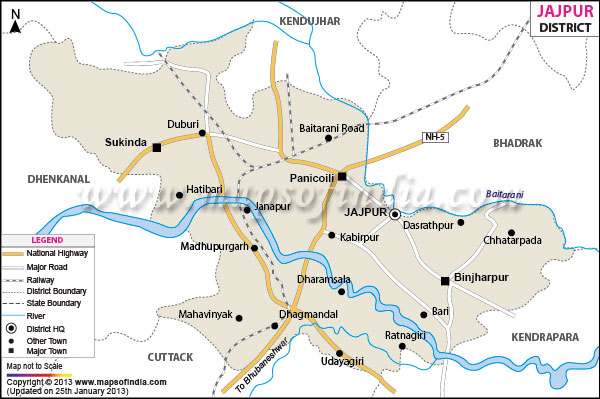





About
Located along the coastline of eastern Odisha, about 125km north of Bhubaneswar, the district's name, Jajpur, has a royal history — Jajati Keshari was a king who made Jajpur the capital of the Kalinga Empire. Jajpur was carved out from Cuttack district in 1993 and is now one of the most economically and archaeologically important districts of Odisha with the presence of old temples and huge investment in the State by industries.
Jajpur is in a unique position in the geography of Odisha, very much in the centre of its coastal plain and its mineral-rich interior highlands, beyond being a pilgrimage centre and an industrial city. The district's topography has formed the basis of the growth of its main raw material suppliers, the steel plants at Kalinganagar, and the primary raw materials exporters, who funnel raw material out to the ports and markets in eastern India, using some of the busiest freight corridors in the state.
Although the town itself is surrounded by satellite industrial townships in the last 30 years, the district headquarters town is still popularly referred to by its old name of Biraja Kshetra and remains compact and temple-centred. This overlaying of eras is perhaps the hallmark of Jajpur; walk through the older parts of Jajpur town and the ambiance is close to a centuries-old pilgrimage centre rather than a district headquarters and another short drive towards Danagadi or Sukinda sees a scene of blast furnaces, rolling mills and steel townships which could belong to a completely different Odisha.
History & Culture
The area known as Jajpur is a part of the historic kingdom of Kalinga which existed for more than 2000 years and whose territory varied from dynasty to dynasty, including the Mauryas, the Cheti kings and finally the Kushanas, who are thought to have ruled by a series of kings called the Murunda kings.
Jajpur gained great prominence under the Somavamsi dynasty, when the town became a center of religion, culture and governance, and under Harshavardhan in the early 7th century CE when it was a part of a larger region referred to as Odra-Visaya or Viraja Mandala. It was here that all three major ancient religions of India – Hinduism, Buddhism and Jainism – thrived at the same time with the district's amazing concentration of Buddhist monastic centres and Hindu shrines being testament to this and all of these continue to exist as history marvels.
The Buddhist heritage of the district focuses on three ancient monastic complexes, Ratnagiri, Udayagiri and Lalitgiri collectively known as the "Diamond Triangle" of Odisha and it is believed to be the site of the Puspagiri University which was a famous Buddhist university established around the 7th century CE. The discovery of a statue and inscriptions of the Ashoka period, at nearby Langudi hill, further highlights the significance of the area as an early Buddhist education centre and pilgrimage site.
Culturally, Jajpur is still highly devotional; the annual Vijaya Rath Yatra of Goddess Biraja is one of the most important festivals in the district, being the only chariot festival in Odisha dedicated to a goddess, as opposed to Lord Jagannath. Durga Puja, Kali Puja, and Raja festival celebrations are also popular in the district annually, making it one of the major places of Shakti worship in eastern India.
Economy
Today, Jajpur's economy is based on a remarkable mix of old and new: traditional farming, mineral resources and extensive industrial-scale steel production.
Government Sector: Jajpur town is the district headquarters which has a collectorate and other government departments of the district that supervise the district's ten tehsils and blocks. Government coordination with respect to industrial policy, resettlement, and infrastructure functions in the Kalinganagar areas in a special way when compared to more agrarian districts in Odisha.
Public Sector – The district is endowed with rich mineral deposits including chromite, iron ore, nickel etc with Jajpur being one of the top producers of chromite ore in the country which is directly utilized in the production of steel in the country. The public sector mining and allied infrastructure along with the road and rail connectivity of the district with the rest of Odisha's industrial corridor plays a vital role in the local economy.
Services Sector: The Kalinganagar Integrated Industrial Complex, which is mostly spread across Danagadi and Sukinda blocks, has turned Jajpur into one of the most important steel belts in eastern India, with large companies such as Tata Steel, Jindal Steel and VISA Steel operating major units, with a group of smaller ones in the area. The complex has since been accorded a national status as a National Investment and Manufacturing Zone. In addition to this modern industrial base, traditional industries like tussar silk weaving are still practiced, and the district's Buddhist heritage sites and temple towns are attracting pilgrimage and heritage tourism, which in turn is nourishing local hospitality and transportation.
Tourism
This is because of the exceptional mix of Hindu, Buddhist and archaeological heritage that is found in Jajpur, the majority of these sites being concentrated in a relatively small region.
The Biraja Temple is one of the 51 Shakti Peethas of the Indian subcontinent and it is believed that Goddess Sati's navel fell in Jajpur during the 11th century and the temple is still considered to be the spiritual heart of Jajpur town, attracting devotees especially during Durga Puja and Kali Puja.
The ‘Diamond Triangle' of Lalitgiri, Ratnagiri and Udayagiri (around the 1st century CE), believed to have been once a part of the historic Puspagiri Buddhist university, which also has an Archaeological Survey of India site museum displaying recovered artefacts in Ratnagiri.
Langudi Hill, where another Ashokan-era statue and inscriptions were found, is another piece of evidence of the district's rich Buddhist heritage and its position in the larger story of the Mauryan Kalinga.
Chhatia Bata is about 25 kilometres away from Cuttack and is a key place of pilgrimage visited by the devotees of the district, where there is a famous temple dedicated to Jagannath.
Baruneswar Pitha and Vyas Sarobar, a temple and religious water body close to Jajpur town, are connected with the district's pilgrimage circuit of the Baitarani river.
Kalinganagar itself, for those interested in modern industry, has become somewhat of an oddball, with a sharp contrast to the ancient Shaktipitha and Buddhist heritage of Odisha and the fast-paced industrial growth of the present day. Located near the Diamond Triangle, many pilgrims also visit the Diamond Triangle sites, making Jajpur a brilliant combo for those interested in exploring the religious history of India from the golden era of Buddhism till today.
Demographics
The 2011 census states that the population of the district is 18,27,192 and out of this 9,26,034 (50.05%) were male and 9,01,158 (49.95%) were female which makes the sex ratio 973 females per 1000 males and the literacy rate in the district was around 80.13 % with the male literacy rate being 86.53 % and female literacy rate being 72.68 %. The difference in the literacy rate is even steeper in the rural area where the numbers are quite bad. The district's industry is growing but the population is predominantly rural (92.61%) with only 7.39% urban and the district was socially diversified and comprised approximately 23.7% of the population from Scheduled Castes and approximately 8.3% of the population from the Scheduled Tribes.
The mother tongues of the district are Odia and Hindi and English is also used to varying extents, especially in the industrial and administrative centres of the district. Jajpur has a population density of approximately 630 persons per sq km which is one of the highest density districts in Odisha due to fertile and river-fed agricultural land and the employment pull of its growing industrial belt.
These indicate a district in the throes of major change – a predominantly rural, temple-oriented population whose character is rapidly being defined by the growth of large-scale industry. Overall, the relatively high rate of literacy, compared to many of the more remote districts of Odisha, is indicative of a population reasonably well equipped to capitalise on this industrial expansion, whilst the relative proportion of agricultural livelihoods and mining or steel industry employment is continually evolving.
Administration
In the revenue administration, Jajpur district is divided into 10 tehsils and in local development administration it is divided into 10 community development blocks of which, two blocks Sukinda and Danagadi have the Kalinganagar industrial complex. The District has 242 Gram Panchayats which coordinate the administration at the village level and are known as the means of local self-governance. There are 1,904 villages in the district, which are irregularly spread across the tehsils, and a few municipalities and notified area councils in more urbanised areas comprising Jajpur town itself.
The district collector's office is based at Jajpur town and it is responsible for revenue administration, coordination of the large-scale mining and industrial activity and administration of the district as a whole, in addition to overseeing the operations of the elected panchayat representatives, who take care of local development priorities.
| Facts of Jajpur District | |
|---|---|
| Official Name | Jajpur |
| Location | Orissa |
| Area | 2887.67 sq. km |
| Population | 18,26,275 |
FAQs
Q1: How many villages are there in Jajpur district?
1781 villages.
Q2: What is the district's population?
18,27,192.
Q3: What is the district famous for?
Biraja Temple, the ancient Buddhist "Diamond Triangle" sanctuaries of Lalitgiri, Ratnagiri and Udayagiri and the Kalinganagar steel and industrial complex.
Q4: What is the literacy percentage?
80.13%.
Q5: What are the native languages in Jajpur district?
Odia, Hindi and English.
Q6: How many tehsils are there?
The district has been divided into 10 tehsils for revenue.
Q7: When was the district formed?
It was carved out of the erstwhile Cuttack district in 1993.
Q8: What is the religious importance of the district?
It is one of the 51 Shakti Peethas of the Indian subcontinent and is one of the most important centres of Shakti worship in the East of India.
Q9: Which is the primary industry in Jajpur district?
Traditional agriculture and tussar silk weaving, supplemented by the chromite, iron ore and nickel mines and modern industries based on steel and minerals.
Q10: What is the local governance system of Jajpur?
The district is organised into 242 Gram Panchayats in each of its blocks and tehsils, with the district collector's office at Jajpur town.
Q11: Which is the main kharif crop that grows here?
Rice.
Last Updated on : August 19, 2026
