







About
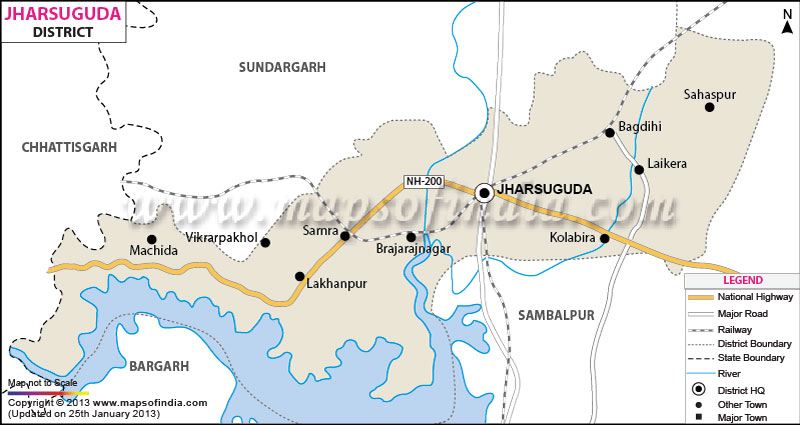
By combining two local words, ‘Jhar', denoting forest, and ‘Guda', denoting area, the very title of the land tells of its ecological heritage. The map of Jharsuguda district reveals its strategic location bounded by Sundargarh on the north, Sambalpur on the east, Bargarh on the south-west and the west bordering the State of Chhattisgarh's Raigarh. During monsoon times, the valley and stream beds here become full when it rains, and the rural avenues become green thoroughfares. In spite of the quick pace of industrial development, large areas of green forests still hold on stubbornly to the outskirts of the new city.
Each inch of ground here echoes tales of a strong agricultural spirit and a strong resolve on the side of industry. A cityscape dotted with industrial structures and development, railway routes on a Jharsuguda district map, clearly signals the revival of settlements into thriving industrial hubs.
History & Culture
Prehistoric artists inscribed enigmatic hieroglyphics and vibrant depictions of diverse scenes on red sandstone rock shelves, creating a script too faint to be deciphered but all the same uniquely left behind. During medieval periods, the soil was acquired by the golden hands of the Chauhan dynasty of Sambalpur and became a significant feudal possession such as Rampur, Kolabira and Padampur.
These dense hills bore the gallantry of stalwart freedom fighters like Veer Surendra Sai, who led tribal warriors and local Zamindars to wage a serious guerrilla war for decades against British colonial powers during the turbulent Indian War of Independence. The ruins of the forts of Kolabira Fort and Ulapgarh, old military outposts, are in possession of silence; if one follows the old military outposts on a map of Jharsuguda district, one will find them. The remains of old military outposts – Kolabira Fort and Ulapgarh still hold great significance.
Here, the cultural tapestry is a rich mixture of tribal custom and classical Odia refinement. The people of the rural hamlets are swaying to the rhythm of Sambalpuri folk music, vibrating with dignified gaits, and dressed in clothes in vibrant colours and sarees. The instruments that accompany them are the Dhol, Nishan and Tasa. As the holiday season comes around, happiness breaks free in every neighbourhood. Passionate enthusiasm marks the beginning of Nuakhai, which celebrates the fresh agricultural harvest with great reverence; the colourful Durga Puja and Rath Yatra adorn the streets.
Handlooms produced by the artistic skill of local weavers produce mesmerising Sambalpuri handlooms that communicate with geometric motifs and traditional symbols that have come down through generations of uninterrupted mastery from the craftsmen. In every village festival, people from different communities come together, rub the differences of caste and background amongst them and traditional songs blare out over the rural vales. When one scans the history of the various cultural locations drawn on a map of Jharsuguda district, one realises that the history here is not limited to textbooks - it lives, breathes, and sings in every village square.
Economy
An economic Jharsuguda district map is enough to show a roaring industrial colossus that is sustained by large hidden coal reserves. This was once a tranquil forest area that became an affluent manufacturing belt in eastern India in the last few decades.
Government Sector
The region is built around the government's infrastructure, which is of great significance. Administrative, law enforcement, educational and healthcare facility structures are strategically designed throughout the land. State government means the city roads and other Municipal facilities and social welfare schemes which uplift the rural population, will be maintained continuously by their developmental capital supply. Large-scale welfare works, agricultural credit schemes and regional infrastructure development programmes are coordinated by the public administrative offices at the district level, making sure to involve rural communities in the development process in a manner proportionate to industrial development.
Public Sector
The main industrialising force is mighty public sector undertakings. The Ib Valley Coalfield is operated by a flagship subsidiary of Coal India Ltd, an open-cast coal mining company that operates huge open-cast mines throughout the Valley. In the meantime, colossal-scale power generators, such as Odisha Power Generation Corporation at Banharpali, use mined coal to generate thousands of megawatts that power millions of houses throughout India. Large aluminium factories and electricity generation units have also been established by private industrial complexes; thus, it has emerged as a major metallurgical hub of the region. Jharsuguda district map shows that Jharsuguda has a vast industrial area, revealing decades of intensive capital investment in rural farmland to make it a hub of an active manufacturing industry.
Services Sector
The service sector is proliferating along with industrial production, running smoothly as the economy is booming. Commerce, banking, logistics, supply-chain management, hotel companies and retail organisations flourish in urban areas. The Veer Surendra Sai Airport has been commissioned, which heralds the arrival of high-flying businessmen and traders who bring a lot of capital into the environment of hospitality, transit and real estate. The demand for specialised engineering maintenance services, transportation, commercial trade and vocational training centres has greatly increased to serve the needs of the developing industrial complexes.
The complex web of primary industries, public utilities and service businesses directly and indirectly sustains hundreds of thousands of livelihoods throughout the area, attracting not only skilled workers, but workers too. Whether it is the movement of semi-trailer trucks on roads or small grocery stores along the town, markets, everything is moving forward towards growth and a Jharsuguda district map is useful to understand the growth.
Tourism
Exploring the tourist map of Jharsuguda, one can appreciate the unique spiritual vibrancy, antiquity, and tranquil natural resorts.
History lovers are astounded at Bikramkhol, where they see the prehistoric cave inscriptions on the cliffs of dense forests. Nature-recreationists are drawn to the awe-inspiring Koilighughar Waterfall, a roaring mountain stream falling over dark and dramatic rocks into a crystal-clear pool. Sitting deep inside a natural cavern below the falling waters is a naturally created Shiva Lingam which is regarded as a sacred place of worship and is an attraction for the really faithful year-round.
The pilgrims venture into spiritual tourism and visit the old, mysterious and sacred place called Jhadeswar Temple, which is encircled by serene green foliage, to seek God's blessings from the Shiva Temple. The Ramchandi temple, situated at Brajarajnagar and the old Padmasini temple, at Padampur, both giving a panoramic view of the verdant countryside, are located nearby. The ancient stone ruins at Ulapgarh hill fort and historic Kolabira Fort give interesting insights into feudal military planning. This travel adventure in the destination coordinates across a Jharsuguda district map is bound to be an unforgettable experience of time and Nature.
Thanks to picturesque reservoirs along the Ib River which draw migratory birds (and picture takers) and picnickers during the winter, eco-tourism potential is slowly gaining ground. Forest paths around Belpahar allow for a quiet time away from industrial areas. A Jharsuguda district map is a perfect tool to find unsuspecting waterfalls, peaceful untouched river banks, and ancient holy temples from the hills of Jharsuguda.
Demographics
However, anyone wishing to understand the human aspect behind the field has to study the statistical picture of the region. The total population as per the official census is 5,79,505. The average literacy rate is impressive (78.86 per cent) and students are making good progress in education. As far as languages are concerned, the main cultural and official language is Odia, while the native tribal languages of the region, like Kisan, Kurukh and Munda, are spoken melodiously in indigenous villages, with standard Sambalpuri as the primary language. Using this demographic Jharsuguda district map is useful to visualise these population mixes and provides a very pretty picture of where indigenous tribal populations mix in perfect harmony with the workforce migrants from all over the country.
Universities, technical institutes and colleges have been added value, as educational growth has seen a steady rise since then in order to train the local youth for modern day industries. Over the last few decades, the gap in gender numeracy has narrowed substantially, and government efforts have been taken to strengthen enrollments for young women (both in rural and urban schools). As a natural consequence of urbanisation, not far from such industrial centres such as Brajarajnagar or Belpahar, one finds cosmopolitan centres which offer a high degree of density side by side with the old tribal communities. An analysis of the demographic dynamics along the Jharsuguda district map shows that economic development is still changing its settlement pattern in the urban township and rural outlying areas in exchange for rapid growth.
Administration
There is a need for an organised administrative structure that enables governance of this dynamic land. The district map of Jharsuguda drafted by the official administration might provide a clearer understanding of the administration taking place in a relatively simple way through various levels of sub-division networks, revenue circles and local municipal bodies.
The district has five tehsils—Jharsuguda, Lakhanpur, Laikera, Kolabira-N and Kirmira-N—and five community development blocks: Jharsuguda, Lakhanpur, Kolabira, Laikera and Kirmira for the revenue office and also for land administration. The tehsil offices have a significant function in the organisation of land records, implementation of development projects and administrative activities of public welfare programs.
These administrative blocks are laid out across about 352 revenue villages in all, with each village having its own active rural tradition, but still connected with the modernising centres of the towns. There is close coordination between Gram panchayats and District headquarters for the implementation of various sanitation, water supply, electricity supply and primary education programmes at the rural level.
When one marks every administrative boundary on a map of Jharsuguda district, one can analyse the effectiveness of the local administration: from sprawling urban industrial complexes to the quietest agricultural farming village, everything is connected effectively. Urban areas are governed by municipal corporations or town councils and civic amenities are provided in urban areas, including the provision of public health services, street lights, waste management and road connectivity across residential areas, etc.
FAQs
Q1: What is the population of Jharsuguda?
Jharsuguda has 5,79,505 people as per the 2011 Census.
Q2: How many villages are in Jharsuguda?
The district has 352 villages.
Q3: What is Jharsuguda famous for?
It is known for coal, power generation and industries.
Q4: What is the literacy rate?
The literacy rate is 78.86 per cent.
Q5: What is the district headquarters?
Jharsuguda is the district headquarters.
Q6: How many tehsils are there?
There are five tehsils in the district.
Q7: What are its major attractions?
Bikramkhol and Jhadeswar Temple.
Last Updated on : May 11, 2026
