







About
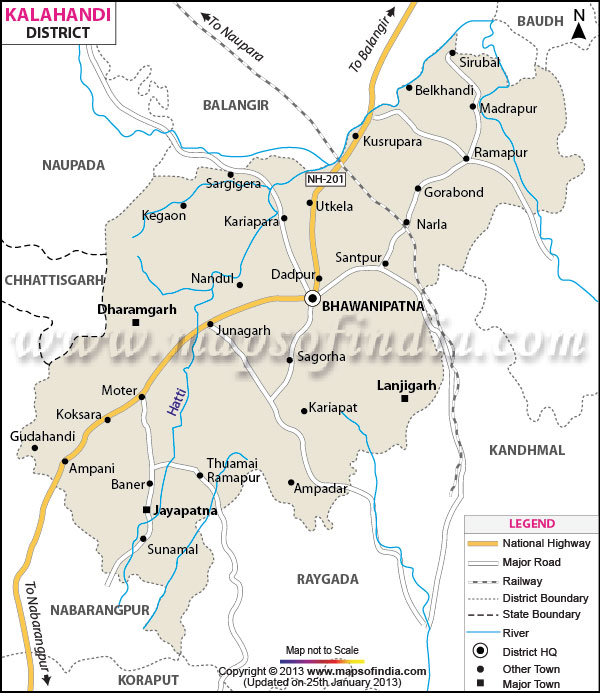
The Kalahandi district, set against the green backdrop of the Eastern Ghats in south-western Odisha, is a dramatic canvas of contrasts, resilience and significant ancient grandeur. Its name evokes a rich association, multifaceted and complex. The geographical layout featured on a Kalahandi district map reflects its origin as a cultural "pot of arts" that transitioned into a fertile regional granary. Alternative suggestions for the etymology of the name is suggested to come from the combination of Kala (black) and Handi (earthen vessel), a reflection on the black, fertile and nutrient-rich soils found over much of its rolling terra-topia.
Geographically, the Kalahandi district map shows that there are various geographical variations in the district; it is bordered by Balangir and Nuapada to the north; Nabarangpur, Koraput and Rayagada to the south; Rayagada, Kandhamal and Boudh to the east; and Nabarangpur and Raipur district of Chhattisgarh to the west. When the Kalahandi district map is analysed, one can enjoy the beauty of how the great river 'Tel ', with its riverside running ‘Indravati' and ‘Hati ', snags life away in the thick woods of Sal trees, rocky mountain faces and fertile plains. In the 21st century, the landscapes and architecture of Kalahandi are a triumph of human endurance and its ancient art, majestic waterfalls, rich tribal heritage and dynamic agriculture.
History & Culture
Bordered by the fogs of prehistory, Kalahandi becomes an important cradle of Indian culture. The rock paintings at the archaeological sites of Gudahandi and Yogimath are all part of the human arts of the prehistoric periods. These borders constitute what was once known as an ancient kingdom, which is alluded to in the classical texts. This area was ruled by Nala kings during the fifth century CE, after which South Kosalas came into power. Cross-referencing archaeological sites like Gudahandi and Asurgarh on a historical Kalahandi district map reveals ancient trade routes and early urban settlements.
The Nagavanshi dynasty consolidated its rule in the princely state of Kalahandi in the early eleventh century, ruling the area for almost nine centuries till it merged with the Indian Union in 1948. The kings ruled a bloodline that fostered an extraordinary fusion of culture. Indian culture and classical Hinduism have meshed offbeat here. The Kondh, Bhunjia, and Paraja tribes bring to life the region's wilderness and its ancient forest wisdom, with their unique dialects and vibrant social customs, the soul of the region. Tribal territories traditionally outlined across a Kalahandi district map show how Kondh and Paraja heritage flourished alongside Nagavanshi royal rule.
The region's famous folk art – the songs and dances – is the ultimate expression of cultural expression. Ghumura is the martial dance amongst this artistic show. This martial dance, Ghumura, is the fiercest of all to lead this ensemble. Through the use of traditional costumes, dancers tie circular clay thud drums around their shoulders and play them soundly to rally warriors when they are to go out to war. During the harvest seasons, the valleys reverberate with the soulful songs of the Banabadi, deep steps of the Dalkhai and the theatrics of the Rasarkeli, in addition to Ghumura. Tracing the origins of the martial Ghumura dance on a cultural Kalahandi district map highlights the deep performing traditions scattered across the river valleys.
The festivals are celebrated with great feeling. The massive assemblage of devotees celebrates Goddess Manikeswari, presiding deity of the royal clan, at the Chhatar yatra that takes place in Bhawanipatna. The Chhatar (divine umbrella) is carried in a majestic procession back to the palace from the temple at Lanjaia, with hypnotising drum beats and chants of the tribes. Festival routes plotted on a Kalahandi district map illustrate how massive processions for Chhatar Yatra and Nuakhai connect local shrines to the kingdom's headquarters.
Economy
The economic development in this area has experienced an incredible transformation in the last few decades. Although agriculture continues to be the lifeblood of the local economy, the structure of local economies has been radically changed by industrialisation and service sector expansion. An economic overview overlaid on a Kalahandi district map depicts a region balancing traditional agriculture with modern industrial growth.
Government Sector
Government plays a big role in the economy, which is able to drive social and economic development and infrastructure. Public investments have been made in rural connectivity, irrigation infrastructure and educational facilities through multi-faceted rural development schemes such as the Biju KBK Plan and various national rural development policies. The building of large-scale irrigation schemes has been one of the key elements that have revitalised this section of the economy. The setting up of the Upper Indravati Hydroelectric and Irrigation Project drastically changed the agrarian topography, converting the dry, rain-fed lands of the wet land to double-crop fertile lands of the irrigated land. In harvest seasons, the involvement of government procurement agencies is a highlight of fair market access to thousands of paddy farmers for their revenue supply and paddy is a major revenue provider.
Public Sector
The growth of the public sector infrastructure has been most pronounced with improvements to power distribution, railway logistics, and social services (providing water, sanitation, and hand washing facilities near schools, hospitals, and workplaces). The appropriate creation of special institutions of education and healthcare like Government Medical College and Hospital, Bhawanipatna and Kalahandi University has significantly increased public opportunities and jobs. These institutions create jobs within the economy that involve direct public services, as well as secondary services in the housing, retail, and transportation sectors.
Services Sector
Services are an expanding sector at a fast pace, due to urbanisation, in important cities such as Bhawanipatna and Junagarh. At the heart of this development are such areas as banking, digital telecommunications, retail trade, logistics and education. The agricultural economy has been improving, leading to increases in consumer spending that have enhanced consumer markets in the area. Transport facilities have been thriving for want of them, opening up the villages of the hills to urban centres where raw materials are bought and sold. Moreover, eco-tourism and cultural tourism are becoming a new phenomenon as possible service niches and thus promoting local hospitality enterprises, homestays and artisanal craft markets.
Agro-processing, cotton ginning and mineral processing are the main industrial operations that dominate. The region is also industrially significant, with significant alumina processing plants in Lanjigarh and abundant bauxite resources found in the hills in the area. The economic dynamism continues to spread widely, ranging from traditional pottery and handloom weaving to the modern level of rice mills and the mining industry.
Tourism
Travelling through this environment is like experiencing a land outside our world in which raging rivers, ancient cliffs and regal history are writ large over granite walls. Tourist itineraries over a Kalahandi district map connect the location of key attractions such as Phurlijharan Waterfall, Karlapat Wildlife Sanctuary and ancient Gudahandi caves.
Ancient Asurgarh Fort, near Narla, gives the history lover a first-hand experience of town-building of the Iron Age, with enormous earthen walls and a water trough around it guarding the ancient trade routes. Nature's Caves of Gudahandi Hills are a treat for the rock art aficionados and adventurers, where the pictographs on the rocks are created in natural caves surrounded by the lush vegetation. It's a 15 km drive from Bhawanipatna. The Phurlijharan waterfall, a sheer 30 feet, is alive with a dazzling play of rainbow lights created as the sun's rays hit the mist it creates. Located within the more rugged topography of the forest, Rabandarh Waterfall boasts rapids in the water rolling over natural rocks and deep canyons, creating a tranquil vista surrounded by natural beauty.
The Karlapat Wildlife Sanctuary consists of a large, undisturbed green area that's rich with biodiversity and home to leopards, elephants, gaur, sambar deer and a wide variety of bird species, with the unpolluted Jhakam Valley being an ideal destination for eco-tourists. Ampani Hills has ghat streets that pass through winding paths showing the valley below while ending up at the revered shrine Budharaja on the valley floor.
Demographics
The study of demographic evidence shows that there is a society that is diverse and has a strong, resolving sense rooted in a deep connection to the ancestral heritage, as it is undergoing the influence and perception of modern literacies and social trends in a soft manner. Demographic density studies plotted on a Kalahandi district map show a rural population distribution where Odia, Kui, and Kuvi linguistic communities coexist.
As per Census 2011, it is estimated that their population is about 1,576,869, which is mostly dispersed among the rural villages, agricultural settlements and the tribal hamlets/villages. A general improvement is observed in the overall literacy rate which currently stands around 59.22 per cent; and of late, emphasis has been laid on education, leading to an appreciable commensuration of the difference in literacy rates at tribal and rural level, especially over the past five years with a significant thrust on school infrastructure; Odia (Kalahandia Odia/ Desia) has a rich regional flavour, and tribal communities passionately speak tribal languages, Kui and Kuvi, among the Kondh population.
Administration
The administration is organised for efficient service, infrastructure and law enforcement in a city and in harsh rural conditions.
The district is divided for administrative convenience and for the collection of revenue into 13 Tehsils: Bhawanipatna; Junagarh; Jaipatna; Dharmagarh; Lanjigarh; Narla; Karlamunda; Madanpur Rampur; Thuamul Rampur; Golamunda; Koksara; Kalampur, and Kesinga.
The rural landscape is characterised as a huge system of settlements, which consists of about 2,249 revenue villages, structured under different Gram Panchayats. Such villages constitute the basic social unit in which traditional community life, agricultural activity and folk treasure develop side by side. Rural settlement boundaries charted on a detailed Kalahandi district map organise thousands of individual villages under local Gram Panchayats.
FAQs
1. What is the district's population?
The total population is approximately 1,576,869.
2. How many villages are there?
There are approximately 2,253 census villages.
3. What is Kalahandi famous for?
It is famous for Ghumura dance, Chhatar Yatra, bauxite deposits, and rice production.
4. What is the literacy rate?
The literacy rate is approximately 59.22 percent.
5. Which languages are spoken?
Odia is primarily spoken, along with tribal languages like Kui and Kuvi.
6. Which river irrigates Kalahandi?
The Tel River and Indravati system provide necessary irrigation.
7. How many Tehsils exist?
There are 13 administrative Tehsils.
Last Updated on : August 24, 2026
