







About
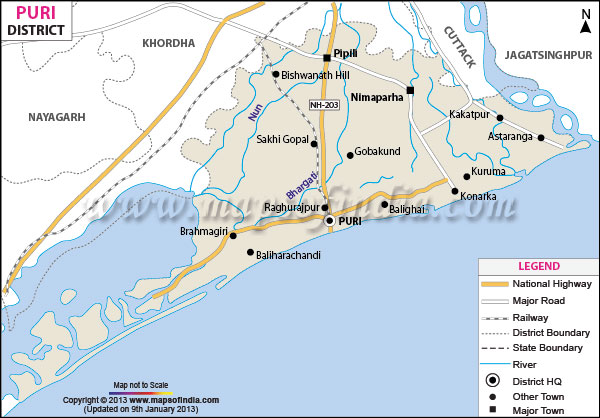
The district is located on the eastern coast of Odisha and is named after its headquarters, Puri, one of the four sacred Char Dham pilgrimage centres and spiritual headquarters of Lord Jagannath. Few districts in India have the instant name recognition like Puri does, not only with the towering Jagannath Temple at its heart but also with the annual Rath Yatra chariot festival that attracts devotees from all over the world every year.
The district borders the Khordha district in the north, Ganjam district in the west and Jagatsinghpur district in the north and its 150 km-long coastline is on the Bay of Bengal to the east. Puri has a geographical area of about 3,479 Sq.Km. which can be conveniently divided into two regions: the sandy littoral tract along the sea coast and fertile level alluvial tract having the tributaries of the Mahanadi river. In addition to its religious importance the district is also the seat of the UNESCO-recognised Konark Sun Temple and it also abuts the largest brackish water lake in Asia, the Chilika Lake, making Puri a rare district with devotional, architectural as well as ecological importance.
History & Culture
The recorded history of Puri started from the 3rd century B.C. and extended up to the present and it is one of the oldest important regions in the east part of India. The city grew around the worship of Vishnu's avatar named Lord Jagannath but whose present temple was constructed in the 12th century AD by the Eastern Ganga dynasty. The nearby Konark Sun Temple was built by the King Narasimhadeva I in the 13th century and it is one of the biggest architectural projects of the Kalinga school with a massive stone chariot on which the sun god Surya rides, being pulled by seven horses and twenty-four ornately-carved wheels.
In terms of culture, the city of Puri cannot be divorced from its association with the Vaishnavite devotional centre. Backed by the deities of Jagannath, Balabhadra, and Subhadra, and pulled by large wooden chariots through the streets of the city, Rath Yatra is one of the biggest and most identifiable religious festivals in the world, attracting pilgrims from all over India, and now a growing number from abroad. In addition to this signature event, the district's craft traditions such as Pattachitra scroll painting, centred in the village of Raghurajpur, applique work, stone carving and traditional woodwork continue to be living art forms which have been handed down from generation to generation by the artisan families, who were historically closely associated with the temple economy of both Puri and Konark.
Economy
The unique blend of religious tourism, traditional handicrafts, agriculture and fishing along Puri's long coastline influences the region's economy.
Puri City has the district headquarters with collectorate and other state government departments functioning in the 11 tehsils and 11 blocks of the district. Co-ordination between the government and the movement of large crowds, the administration of the temples and the conservation of heritage is of unusual importance here given the size of the Rath Yatra festival and the importance of the district as a centre for pilgrimages and tourism.
Coastal Geography: A significant public sector interest in fisheries development and port-adjacent infrastructure, as well as government bodies for tourism and heritage management to preserve monuments such as the Konark Sun Temple and the wider Jagannath Temple complex. The cost of public investment in coastal protection infrastructure and disaster management also cannot be ignored, particularly for the coastal district exposed to cyclone attack from the Bay of Bengal.
Tourism is the largest modern economic activity sector of Puri, the city is a year-round destination for tourists and offers a large network of hotels, guest houses, restaurants, and transport services. The district's handicraft industry, especially the Pattachitra painting, appliqué work and stone carving, which are based on the tradition and motifs of temples, still supports thousands of families of artisans, particularly in and around Raghurajpur. The inland alluvial part of the district is very significant for agricultural development with paddy being the major crop, while the fishermen population around the Chilika lake and coastal areas have a significant livelihood based on prawn, crab and fish catching activities.
Tourism
It is one of the best-preserved and most complete travel destinations along the eastern coast of India, being built around a unique mix of world-class religious architecture, natural landscape and living craft traditions of Puri district.
The most important feature of all is the holy Jagannath Temple in Puri city, which serves as the spiritual hub of the district, and is one of the four sacred Char Dham pilgrimage sites of Hinduism. The temple, in the form it is found today built in the 12th century by the rulers of the Eastern Ganga dynasty, is dedicated to the deities of Jagannath, Balabhadra and Subhadra and is the starting point for the annual Rath Yatra, where these deities are pulled through the city streets on towering handmade wooden chariots, with crowds that can reach the millions. The timing of the festival (usually in June or July) is the only reason for many to make the trip to Puri.
The Konark Sun Temple, one of India's best known monuments and a UNESCO World Heritage Site is a few minutes drive up the coast. The temple was constructed in the 13th century by King Narasimhadeva I, and is a gigantic stone chariot in the name of the sun god, Surya, which has 24 stone wheels and 7 stone horses. Some of the best stone carvings in the entire Kalinga architectural tradition are on its surfaces and even today, after much of it has been destroyed, it is still stunning.
There are two other major sites to note: the Chilika lake is the largest brackish water lake in Asia, running along the south of Puri and attracting a rather different type of tourist. Boat safaris from Satapada take visitors out to see the lagoon's resident Irrawaddy dolphins and the surrounding wetlands are a popular spot for migrating birds from as far away as Siberia and Central Asia each year, as well as being a favourite among nature photographers and birdwatchers.
The majority of the visitors take these places in a familiar tour starting from Bhubaneswar, moving on to Puri and then Konark, popularly known as the "Golden Triangle" of Odisha, and then go on to Chilika and experience wildlife and open water.
Demographics
As per the 2011 Census Puri district has a population of 16,98,730 and out of this there are 8,65,380 males and 8,33,350 females with the population density being 488 per sq. km. The district's literacy rate is 76.05% which is much higher than the state and national averages and this was due to the long-standing educational and cultural institutions. About 15.60% of the population was settled in the urban areas mainly in the city of Puri and 84.40% in the rural blocks of the district, where the major occupation was involved in agriculture, fishing and handicraft production.
Despite the presence of various other tribal languages, Odia is the most widely used language throughout the district with Hindi and English also being understood widely such as in Puri city, due to the large population of pilgrims and tourists from throughout India and the world. Puri is moderately dense, with a population density of approximately 488 persons per square kilometre, as per Odisha standards, due to its fertile interior with agriculture and population density on the temple towns and coastal villages.
Combined, these statistics represent a district with a complex and strong demographic profile because of its status as a pilgrimage and tourism centre. The relatively high literacy rate and the gradual urbanisation around Puri city suggest that, while the bulk of the population is still engaged in agriculture and fishing along its coast and inland regions, they are more exposed to education and other cultural and social aspects than many of these areas.
Administration
The district of Puri is divided into one sub-division, 11 tehsils and 11 blocks for administrative and revenue purposes respectively. Local self-governance is implemented through 268 Gram Panchayats that co-ordinate village-level administration in the approximately 1,722 revenue villages in the district. Urban administration is done by the Puri Municipality, which is the sole Complete Municipality in the district, and three Notified Area Councils at the smaller urban centres in the district (Konark, Pipili and Nimapara).
The district collector in charge of the district in Puri city handles the administration of revenue, coordinating the movement of Rath Yatra, and the overall governance of the district, which are a blend of civic and religious duties, along with the panchayat representatives and bodies of temple administration.
| Facts of Puri District | |
|---|---|
| Official Name | Puri |
| Location | Odisha |
| Area | 3479 sq. km |
| Population | 1698730 |
| Language | Hindi, English |
FAQs
Q1: In which village are there in Puri?
268.
Q2: What is the district population?
16,98,730.
Q3: Which is the most famous place in Puri district?
The Puri Jagannath Temple, the annual Rath Yatra, the UNESCO-listed Konark Sun Temple and Chilika Lake.
Q4: What is the literacy percentage in Puri district?
76.05%.
Q5: Which languages are spoken here?
Hindi, Odia, English.
Q6: How many tehsils are there?
There is one sub-division with 11 tehsils.
Q7: Why is the Jagannath Temple important?
Jagannath Temple is one of the four Char Dham pilgrimages of Hinduism and is the venue of the annual Rath Yatra, one of the world's most popular and famous Chariot Festivals.
Q8: Why is Konark Sun Temple famous?
The Konark Sun Temple (in the 13th century) is a UNESCO World Heritage Site and a masterpiece of Kalinga architecture and it resembles a giant stone chariot dedicated to the sun god Surya.
Q9: What's Chilika lake famous for?
Chilika Lake is the largest brackish water lagoon in Asia and it is famous for its rich biodiversity while being a major stopover for migratory birds and home to a resident population of Irrawaddy dolphins in Satapada.
Last Updated on : August 19, 2026
