







About
Sambalpur is a very known district of western Odisha. In that district you will find great association with the Mahanadi River, handloom industry, temples, agriculture and the history of western Odisha. Also the home to the district headquarters which is Sambalpur city which in turn is a key center for trade, education, administration and transport.
Sambalpur is known all over India for its Sambalpuri handloom sarees and traditional Ikat designs. In that region local weavers produce sarees, dress materials and other fabric items which they design with great care and use bright colours. Also from the Sambalpuri music and dance the district has gained a unique identity. These traditions play out in our festivals, family functions and cultural programs.
Sambalpur is a city which has excellent rail and road connections with the rest of Odisha and neighboring states. Also due to its position along major transport routes the city has grown into a business center. Also the district has large scale industrial and educational areas around Sambalpur and Burla.
History & Culture
Sambalpur has a rich past which stretches back many centuries. As per the district administration the name Sambalpur is a legacy of Goddess Samalai which has a traditional association with Balaram Dev the first king of Sambalpur. Over the years the area passed through the hands of many rulers and at the same time played a key role in the west part of Odisha.
In past ages that region was home to many ruling dynasties. Samudragupta defeated King Mahendra of Koshala in the 4th century. Also which followed were the Sarhapuriya and Panduvasi dynasties which ruled parts of the area. At a later date the Somvansi rulers also had control in that area.
Sambalpur played a vital role in the Indian freedom struggle. In the West of Odisha from which came some of the best known freedom fighters we have the example of Veer Surendra Sai who led the resistance against the British. To this day his name is associated with Sambalpur and its history.
British rule in Sambalpur brought in large scale administrative changes. In 1849 the area came under British control which came about at the time of the death of Raja Narayan Singh. Also it was put into different administrative units before in 1912 it became a part of Odisha.
In time the district saw changes in terms of size. Bargarh in 1993 broke off from Sambalpur, also that year Jharsuguda and Deogarh became separate districts.
Culture is still the top feature of Sambalpur. In Sambalpuri handlooms you see Ikat patterns, traditional designs and detailed weaving which are famous. The craft which also puts food on many tables has put Sambalpur’s name out there in Indian markets.
Sambalpuri music is also very popular. In the folk songs village life, love, farming, festivals and local traditions are put forward. Sambalpuri dance is a part of our culture which we see in cultural events and celebrations. In the west of Odisha we find that songs and dances like Dalkhai and Rasarkeli are very much a part of the cultural life.
Economy
The economy of Sambalpur is a mix of many which are agriculture, trade, handloom, industry, government services, education and transport. Also the district’s location in western Odisha which puts it at a strategic position for business and movement of goods.
Agriculture is still a primary sector which in particular supports rural areas of the district. We see which crops, mainly rice and what do well in the local soil and weather are grown by farmers. Also it is forest produce which for many is a source of income.
Handloom is a very large component of our economy. In local markets and also in other parts of Odisha, one can see the marketing of Sambalpuri sarees, fabric and other handwoven items also. What the weavers do is that they support families and at the same time they preserve their traditional crafts.
Government Sector
Sambalpur is a major administrative center in the western part of Odisha which in turn means that government work is very much a part of the local economy. In the district headquarters we find offices related to revenue, education, health, agriculture, rural development and other public services. These offices besides running government staff also support many small businesses in the area.
In Sambalpur city and the nearby rural areas government schools, colleges and hospitals serve the people. Also under the administration are roads, drainage, water supply and other public amenities. That work in those fields of administration creates local employment which in turn supports shops, transport operators and construction workers.
In Sambalpur and Burla which have key public institutions we see a steady flow of students, employees, patients and visitors which in turn supports food shops, rental accommodation, transport services and small scale retail. Thus the government action plays a role in the local economy.
Public Sector
Sambalpur’s public sector has a heavy dependence on the Mahanadi River, the Hirakud Dam, and the development of Burla. The Hirakud Dam which is a key feature also has a big role in irrigation, water management and power generation. It is a primary element in the development of the area which it surrounds.
Burla has also grown around what we may call main public institutions which include schools, universities and hospitals. These institutions in turn draw in students, staff, and people from out of the district which in turn causes a demand for hotels, transportation, food and other services.
Railways play a very large role in Sambalpur’s public sector economy. In Sambalpur we find the headquarters of a railway division and also it serves the area which has a number of main cities. The rail network in that district also supports passenger transport as well as the movement of goods which in turn helps traders and industries to access larger markets.
Services Sector
Sambalpur’s commercial sector has grown to include a large number of shops, restaurants, hotels, banks, coaching centers and other businesses that serve the local population as well as those which have come in from nearby districts. The city has become a point of attraction for its growth as an educational, health care, trade and transport center in Western Odisha.
Tourism is a large component of the service sector. In the case of Hirakud Dam, Maa Samaleswari Temple and the Leaning Temple of Huma these are what draw in the tourists. Also it is the hotels, restaurants, transport companies, local stores, and hand woven fabric sellers which profit from the foot traffic.
Sambalpur’s role as a transport and commercial hub is also true. From nearby towns and villages people travel to the city for shopping, education, health care, banking and government related work. That which is seen is a constant flow of people which in turn keeps a large variety of service based businesses active throughout the year.
Tourism
Sambalpur is a home to many sites which attract visitors to temples, history, handloom, rivers and nature. In Sambalpur tourism is very much related to the Mahanadi River and the cultural heritage of western Odisha.
Gandhi Minar and Jawahar Minar present views of the dam and reservoir. Also to see is Jawahar Udyan and other area attractions. The district tourism department reports that they also have boat rides and other visitor amenities around Hirakud.
In Sambalpur Maama Samaleswari is a primary religious site. The temple which is dedicated to Goddess Samaleswari is very much a part of the local culture. The temple is a tourist destination all year round. During festivals and religious events we see large crowds which in turn enlivens the area.
In the outskirts of Sambalpur you will find great opportunities to explore the forests, rivers and wildlife. At Hirakud reservoir and in the nearby forest areas guests will note that they can get away from urban bustle.
Tourism in Sambalpur which is a great contributor to the local hotels, restaurants, transport operators, shopkeepers, guides and handloom sellers. As more people are attracted to the district we see an increase in their customer base.
Demographics
According to the report of the 2011 Census which was put out by the Sambalpur district administration the district had a population of 1,041,099. Which broke down to 526,877 males and 514,222 females. Also reported that 733,006 lived in rural areas and 308,093 in urban areas.
In that district the population density was of 157 people per square km. Also from the same data we see literacy rate of 67.59%. In terms of Scheduled Castes they made up for about 18.43% of the population and Scheduled Tribes for 34.12%.
Sambalpur has a mix of urban and rural communities. In the city of Sambalput which is the main urban center and also many villages which rely on agriculture, forest resources and local trade.
Odia is a very common language in the districts. Also Sambalpuri is very much tied to local identity which it does in through folk music, day to day communication and cultural activities.
Administration
Sambalpur district is administered by the district administration which is headed by the District Collector and District Magistrate. The administration is into public services, development work, law and order, revenue and welfare programs.
According to the district administration Sambalpur has 3 subdivisions, 9 tehsils and 9 blocks. Also it has 138 Gram Panchayats which run the local economy and social structure, one municipal corporation and two NACs. Also it reports to have 26 police stations.
The district is home to over 1,300 villages. Local bodies and Gram Panchayats run out many village level development initiatives.
Sambalpur has become a key urban center in the west of Odisha. The municipal body is into roads, sanitation, waste management, drainage and other civic amenities.
| Facts of Sambalpur District | |
|---|---|
| Official Name | Sambalpur |
| Capital / District Headquarters | Sambalpur |
| Area | 6,702 km² |
| Population | 1,041,099 |
| Religion | Hinduism, Christianity, Islam, and other faiths |
| Language | Odia, Sambalpuri, Hindi |
FAQs
Q1: Where is Sambalpur located?
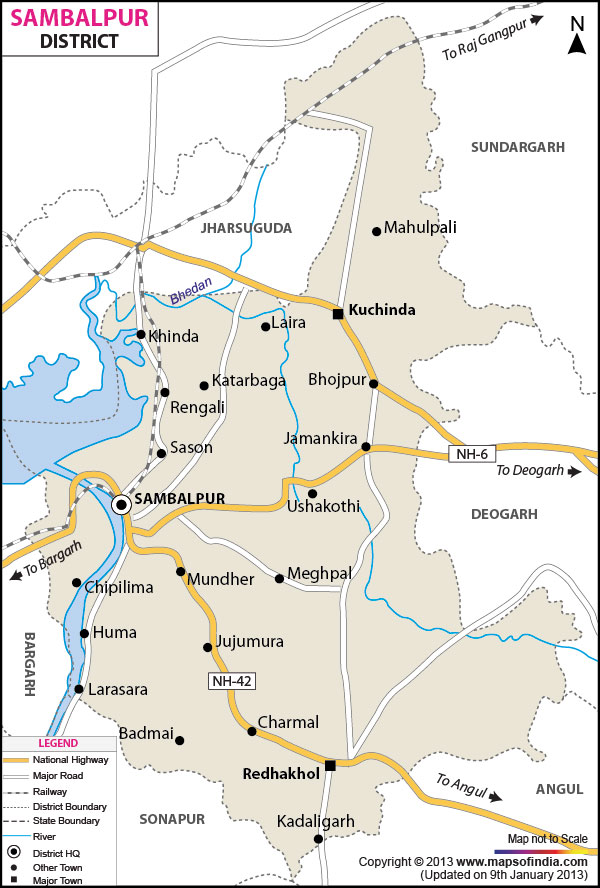
Sambalpur is in the west of Odisha. It is bordered by Deogarh, Bargarh, Jharsuguda, Sonepur and Angul districts. Also its location makes Sambalpur a key transport and business center in western Odisha.
Q2: Why is Maa Samaleswari Temple important?
In Sambalpur Maama Samaleswari Temple is very much a respected religious site. The Goddess Samaleswari is a part of the city and region’s history. Devotees visit the temple all through the year which sees great increase in attendance during major festivals.
Q3: Why should people visit Sambalpur?
Sambalpur has a little bit of everything from history and temples to handloom, rivers, forests and local culture. It is home to the Hirakud Dam, Maa Samaleswari Temple and Sambalpuri markets which are very much known to the public. Also a great base to explore the culture of western Odisha.
Q4: Why do Sambalpur’s handlooms stand out?
Sambalpur is known for its age old Ikat handloom industry. Weavers in the area produce detailed patterns on sarees and other fabrics which they do by hand using traditional methods. Sambalpuri sarees have become the flagship products of western Odisha.
Last Updated on : August 19, 2026
