







About
Coimbatore district's history is like the opening scenes of a big movie. At one time, the land looks peaceful, surrounded by the majestic Western Ghats; at another time, it speaks of one of the most vibrant and impactful parts of Tamil Nadu. Coimbatore district in the western part of the state has historical importance in textiles and is one of the rapidly developing areas in the state, hence known as “Manchester of South India”.
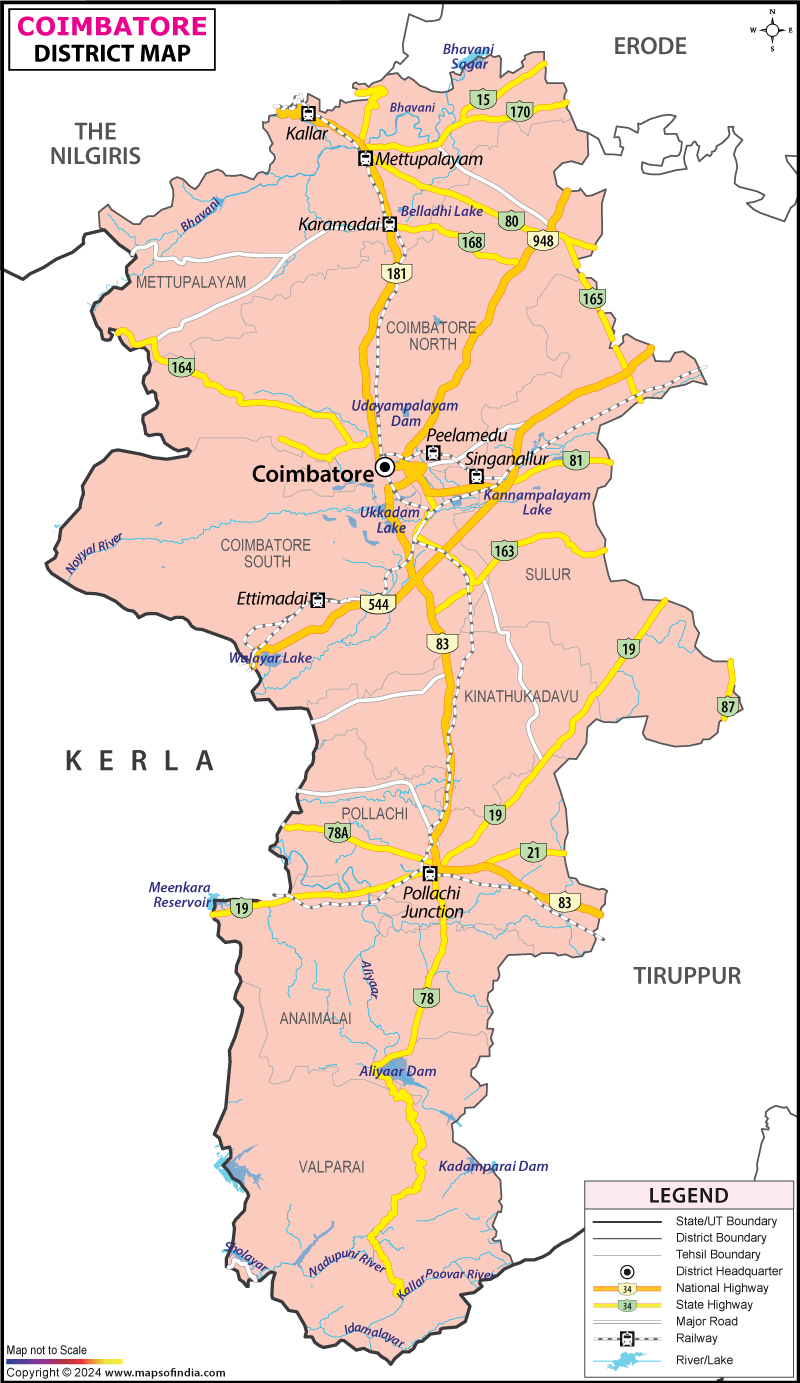
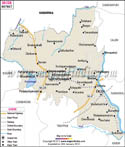
When one looks at the Coimbatore district map, it reminds one of a district at a strategic location sandwiched between the neighbouring districts Nilgiris in the North, Tiruppur and Erode in the east and Kerala at the western edge of the Coimbatore district. This is an enviable situation, which has made the district a viable industrial centre. The Coimbatore district map stands in contrast to itself, depicting industrial pockets, fields and patches of forest lands within an administrative land. Coimbatore district is a unique combination of urban and rural, covering an area of 4732 sq.km. It is one of the largest urban agglomerations in Tamil Nadu, with the headquarters of the city of Coimbatore.
History & Culture
Coimbatore district and its history have crossed over several centuries and the remnants of different eras, kingdoms, trade routes and cultural exchanges can be seen even today. The area was historically part of Kongu Nadu, an area noted for its agricultural wealth as well as its flourishing local traditions. The Coimbatore district map could be referred to better grasp an idea about the following tracts for generations that have lived under Cheras, Cholas and Pandyas — rulers who made an indelible mark.
The medieval period saw the rise and fall of several ruling powers in the area. Temples were built, and irrigation and trade were developed. South Indians were engaged in trade and exchange and merchants had brought the products and thoughts to the local society which enhanced it. This earlier map of Coimbatore would have shown an important crossroads between various cultural & commercial areas.
Administrative and architectural reforms were introduced with the Vijayanagara Empire and then the Madurai Nayaks. Later, the area was ruled by the Mysore rulers such as Tipu Sultan and Hyder Ali. This was marked by violent political battles until, eventually, British rule was established.
Tamil culture is still prevalent in the Coimbatore district. Pongal is a time for the community to celebrate and rejoice in the successful cultivation and a time to feel grateful. Pongal is celebrated with great joy and is a reason for all to unite as a community. There are festivals that enrich the life locally, such as Deepavali, Tamil New Year and temple functions.
The district is also known for its Kongu Tamil heritage. Traditional cuisine, traditional folk music and rural tradition also flourish along with modernity. Rapid urbanisation is evident in the continuity provided by ancient temples, colourful markets and cultural institutions.
Weavers and craftsmen, artisans have been part of the district's identity for a long time. They have been generationally skilled and formed a cultural web of abilities as complex as the textiles for which the district is known. So the Coimbatore district map isn't just a geographic representation but a testament to centuries of cultural evolution and human endeavour.
Economy
Coimbatore district is like a strong locomotive engine that is running at its peak speed due to industry, entrepreneurship and innovation. It is one of the most powerful district economies and has a major impact on the industrial production in Tamil Nadu.
Government Sector
The district's development is significant due to the contribution of government institutions. Admin offices, education institutions, health care facilities and public welfare programmes are the sources of employment and provide necessary services. Government establishments are identified on the Coimbatore District map, which assists in various governance, infrastructure development and rural welfare activities.
The government's educational institutions have successfully boosted the human capital of the district. The services provided by public hospitals and health care networks complement this positive effect on social development and also create jobs.
Public Sector
The public sector enterprises have also played their role in industrial development. Engineering, manufacturing and infrastructure development organisations provide support to the overall economy. The institutions offer a stable job and promote technological development.
The district has an above average level of investment in transport, energy and public infrastructure. An increasing number of businesses are coming to the industrial estates, and development projects are providing employment opportunities for skilled workers. These industrial areas and transport networks are typically marked on a detailed Coimbatore district map, which shows the economic activities of the area.
Services Sector
In the district, the services are becoming one of the strongest sectors in the economy. IT, Education, Healthcare, Banking, and Retail and Hospitality are a few sectors that generate thousands of jobs.
The city of Coimbatore is now known as an IT hub and also a potential location for IT companies as well as start-ups. Students are seen coming from across India, and hence there is a demand for houses, modes of transportation and various other support services. As shown in the Coimbatore District Map, the district has significant strategic connectivity, allowing it to serve as a regional service hub.
The main course of the sector continues to be the textile sector. The district has achieved international fame in the field of spinning mills, garment manufacturing industries and textile machinery industries. The economy is further diversified by engineering industries, the making of pumps, and precision components.
Agriculture is also still very important. Significant cultivation of coconut, sugarcane, banana, vegetables and other crops is done on a large scale. Geographically fertile lands shown on the Coimbatore district map support thousands of families of farmers.
Tourism
Coimbatore district tourism can be easily said to be one breathtaking cinematic experience with completely diverse scenes, each of which is offering and symbolising a different shade of beauty, spirituality and adventure all in all. To begin with, there is a temple known as the Marudhamalai temple, which stands proudly atop the hill and overlooks breathtaking views. It is devoted to Lord Murugan and has emerged as one of the major and visited places of worship.
Perur Pateeswarar Temple is one of the most significant and historic structures. It has intricate carvings and has long historical background that gives hints into the art excellence of previous centuries. The scene of Siruvani waterfalls and forest is an enchanting experience in nature. The region is the source of highly clean water and a picturesque view. A Coimbatore district map is consulted before people tour this pretty area.
Among the most enticing places of the district, Valparai is situated in the land of the picturesque Anaimalai Hills. The picturesque rolling tea estates, mist shrouding hills and the splendour of wildlife make this a cinematic locale. Tourists have the opportunity to not only see the animals but also take part in eco-tourism at Topslip situated inside a Tiger Reserve of Anamalai. The forests hold some birds, elephants and deer which make it a preferred destination for nature lovers.
Visitors come to Monkey Falls for its invigorating water and plentiful flora. There are also several viewpoints around for a breathtaking view of the Western Ghats. Vellingiri Hills, otherwise known as “Kailash of the South”, are a draw to the trekkers as well as the pilgrims. Near the foothills of the Vellingiri Mountains is the Adiyogi statue, which has become iconic. Its size and unmatched design find their way into the tourists' eyes from afar.
This Coimbatore district map is a valuable tool that guides tourists through the area, allowing them to discover the district's numerous natural and cultural landmarks.
Demographics
As per the Census of India 2011, Coimbatore district had a population of about 3458045. The district is one of the most densely populated and urbanised parts of the state of Tamil Nadu. Industrial development, education and migration from other areas have helped with population increases.
The literacy rate of the district was around 83.98%, which was much higher than that of the country. This has been supported through good school and college facilities and the extensive provision of education.
Tamil is the main language of the district. Besides that, Telugu, Malayalam, Kannada, Urdu and English are also spoken in certain communities and professions owing to migration and historical reasons. Local culture takes on further richness owing to the diversity of languages.
Administration
Coimbatore district is administered into 6 taluks (tehsils) of Coimbatore North, Coimbatore South, Mettupalayam, Pollachi, Sulur and Valparai. These administrative districts help in governing the district, collecting revenue and providing public services in the district.
In the district, there are around 237 villages, which are distributed among the various taluks of the district. These villages are the base of the rural economy and many traditional aspects of Kongu Nadu culture are preserved here.
In an era of modern administration, planning and infrastructure/policy development and digital governance are key. The Coimbatore district map helps the authorities with the allocation of resources in the area, disaster handling and planning. It also relates to the identification of transportation corridors, agricultural areas and areas of urban spread.
With the growth of the district, all administrative systems are geared to cope with a fast-changing population and responsive governance without compromising efficiency.
FAQs
Q1: What is the total number of villages in Coimbatore district?
Coimbatore district has approximately 237 villages according to the Census 2011 administrative records.
Q2: What is the population of Coimbatore district?
According to the Census 2011, the population of the Coimbatore district was 3,458,045.
Q3: What is Coimbatore district famous for?
Coimbatore district is famous for its textile industry, engineering sector, educational institutions, scenic hill destinations, agricultural prosperity and its reputation as the “Manchester of South India”.
Last Updated on : July 16, 2026
