







About
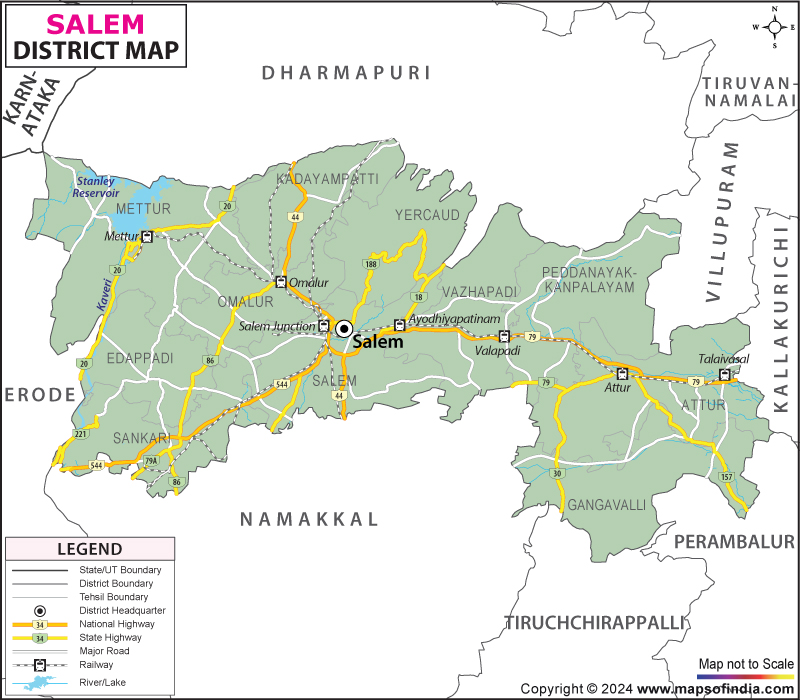
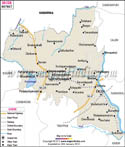
Rising prominently within Tamil Nadu's interior lies Salem, a region marked by both industrial strength and distinct terrain. Nestled in the state’s north-central zone, it forms a key transit hub shaped by natural boundaries - Shevaroy Hills bordering the north, Kalrayan ranges to the northeast, while Nagaramalai and Kanjamalai add subtle elevation near central flatlands. Though distant from coastal centers, its placement about 340 kilometers from Chennai supports wider regional movement. Positioned some 160 kilometers west of Coimbatore, connectivity defines much of its function, linking disparate parts across northern, southern, and western sectors. Its role emerges not through size alone but through location - a crossroads framed by geography.
Hidden within the label "Salem" lies a trail of spoken shifts across time. Coming from the old Tamil term "Sailam," it meant land ringed by hills - a snapshot matching its real-world bowl-shaped terrain among the Eastern Ghats. Spoken habits softened that form over the ages: Sailam became Selam through common use. Later still, colonial paperwork under the British East India Company stamped yet another shape onto the name - Salem - as written records fixed what tongues had already changed.
History & Culture
Long before modern times, people lived here - evidence shows Stone Age tools scattered through the Shevaroy hills. Early settlements thrived under the name Mazhanadu during the Sangam era, governed by regional leaders including King Adhiyaman, remembered in poems about Avvaiyar. Power changed hands often afterward, as the Chola, Pallava, and Pandya dynasties competed for dominance in this land full of valuable minerals.
After the medieval period and into early modern times, Salem emerged as a region frequently fought over. Control shifted to the Madurai Nayaks before giving way to Hyder Ali and then his son, Tipu Sultan, whose governance carried a reputation for intensity. When the Third Anglo-Mysore War ended in 1792, the area passed from Tipu Sultan to the British East India Company through terms set at Seringapatam. One notable fact stands out - Salem was carved out as the initial district within the Madras Presidency during that same year, under British oversight. Alexander Read took on the role of leading administration there as its first collector. Though originally vast, stretching across land now belonging to others, it gradually fragmented over many years, shaping what are today separate regions like Dharmapuri, Krishnagiri, and Namakkal.
Deeply rooted in custom, Salem carries forward age-old practices with quiet strength. Known not just for faith coexisting peacefully but for living expressions of music, dance, and ritual passed down through families. Each year, when the Tamil month of Aadi arrives - between July and August - the town pulses with energy as the Salem Mariamman Temple Festival unfolds. For two weeks, streets glow under strings of light, drumbeats echo at night, performers balance pots on their heads in swirling motions, and crowds gather around moments of shared spiritual intensity. Woven threads run parallel here - not only in fabric but in identity - where weavers still craft fine silk sarees by hand using methods unchanged over decades. These textiles, known locally as Salem Pattu, carry more than elegance; they mark place, history, and skill recognized officially through a Geographical Indication tag.
Economy
Farming brings value here, yet machines shape much of what happens across factories spread through the region. Ore extraction plays a big role, too - deep operations pull materials on an extensive scale. Industry does not rely only on one path; instead, production lines link closely with land yields and raw resource flows.
Government Sector
In the economy, government activity drives growth while offering stable job opportunities. Located in Salem, the Salem Steel Plant - part of SAIL - produces top-quality cold-rolled stainless steel found in markets worldwide.
Public Sector
State-led enterprises stand out across the landscape, especially in agriculture and finance. One such body, Aavin - officially the Salem District Co-operative Milk Producers’ Union - runs a top-tier automated dairy facility, handling vast quantities of milk every day while serving many village-based households. Instead of private backing, these operations lean on collective models managed publicly. For instance, weaving communities rely on institutions like Co-op Tex, which step in with supplies, loans, and paths to market. Such support keeps traditional fabric-making alive despite broader economic shifts.
Services Sector
Fueled by its role in regional distribution networks, Salem's service economy shows marked expansion. Healthcare access draws populations here, contributing to commercial shifts seen across town. Educational institutions anchor demand - daily activity reshapes local business patterns steadily.
Connected by National Highway 44 - part of the North-South Corridor - Salem sits at a key crossroads for movement across India. Because it hosts an important Southern Railway hub, freight services thrive here alongside road-based logistics. Warehouses have grown widely around these links, forming a core part of local commerce. The city's position enables a consistent flow of goods by rail and highway alike.
Among South India’s key hubs for textile commerce stands the Leigh Bazaar, where trade flows through a web of nearby wholesale zones. Yarn moves steadily here, alongside unprocessed cloth and finished clothing items. Activity pulses through these market lanes daily, linking suppliers across the region. Commerce thrives without fanfare - quietly shaping supply chains far beyond the local streets.
Tourism
Salem presents a mix of fog-draped highland towns, vast feats of construction, and places steeped in religious history. Though often overlooked, its terrain shifts sharply - from elevated retreats wrapped in cloud cover to sites echoing centuries of devotion. Where infrastructure spans wide valleys, ancient temples stand rooted in quiet reverence. Elevated zones cool under persistent mist, while human-made structures stretch across rugged landscapes. Each element exists apart, yet fits within a broader pattern shaped by elevation, belief, and time.
Heading toward Salem, one encounters changing scenery - urban zones give way to highland terrain fast. Atop the Shevaroy Hills sits Yercaud, elevated 1,515 meters, known widely by a nickname: "Jewel of the South." This destination draws those seeking cooler air, simple stays, and green views. Its reputation rests on wide stretches of coffee farms that carry strong scents through the morning air. Orange orchards appear across slopes, adding contrast to deep-green hillsides. A central feature, Emerald Lake reflects the surrounding trees with still clarity. Roads curve gently here, forming a 32-km ring absent heavy traffic. Colonial-era buildings remain standing quietly beside forest edges.
From the flatlands, the view centers on the immense form of the Mettur Dam. Erected in 1934 over the Kaveri River, its thick concrete frame stands as an old feat of design. This barrier forms the wide Stanley Reservoir behind it. With rains arriving, gate openings send torrents through - drawing crowds simply by force of motion. On nearby grassy edges, people sit, drawn less by spectacle than quiet space.
Should history or sacred design draw attention, Salem holds notable examples. At its core stands the aged Kottai Mariamman Temple, long respected, shaping much of the area’s customary life. Beyond urban edges, visitors often arrive at the 1008 Lingam Temple, distinct in form. Against hillside terrain rests this sanctuary, where one thousand eight finely shaped stone lingams circle a grand central figure of Shiva. Each element is placed with care, forming stillness suitable for inward thought. Though distant in layout, both sites share quiet influence across the region.
Demographics
Among those living in Salem, city-based factory workers stand alongside long-established farming families in the countryside. While one group shapes industry, the other maintains traditions tied to land and seasons.
Among those counted in the latest government survey, the Salem district holds close to 3.5 million people. Not quite half dwell outside city limits, scattered across village homes surrounded by farmland and open spaces. Slightly more than half settle within developed zones - Salem City leads here, alongside nearby factory-centered settlements that draw daily commuters. Settlement patterns show no extreme tilt toward countryside or pavement; balance leans subtly, almost equal. Urban energy pulses through concrete clusters where jobs and services gather tightly.
Among districts, Salem shows a literacy average of 72.86%. Though city zones report strong numbers - often above 84% - efforts now shift toward remote hillside villages where schooling access lags. Gender imbalance remains noticeable; men reach 80.24%, yet women sit at 65.15%. Because disparities persist, local authorities prioritize learning programs in isolated tribal areas.
Most people speak Tamil first - over 91 percent call it their native language. Because of long-standing movement and commerce across nearby regions, Telugu appears to be used by roughly one in twenty. Next comes Kannada, present among about two out of every hundred. In cities, especially in some neighborhoods, people hear Urdu regularly.
Under the surface, Salem operates through a layered system designed to handle dense communities alongside sprawling factory zones. Leading it all sits the District Collector, while city-level services fall under the care of the Salem Municipal Corporation. Despite its scale, daily governance follows clear lines shaped by function rather than hierarchy.
Split into four parts for tax collection - Salem, Mettur, Attur, Sankari - the area then breaks down once more. Thirteen smaller zones handle daily governance tasks under those larger sections: one of them carries the name Salem. Other tehsils are: Salem South, Salem West, Omalur, Kadayampatti, Mettur, Edappadi, Sankari, Magudanchavadi, Attur, Pethanaickenpalayam, Gangavalli, and Thalaivasal.
Because each block hosts multiple villages, delivery of services relies heavily on localized planning. Where population clusters are sparse, the panchayat network ensures representation stays accessible. Since responsibilities shift between tiers, clarity often depends on proximity to decision-making nodes.
| Facts of Salem District | |
|---|---|
| Official Name | Salem |
| Location | Tamil Nadu |
| Area | 5245 sq. km |
| Population | 3842056 |
| Language | Tamil |
FAQs
Q1: How many villages are located within the Salem district altogether?
There are 385 gram panchayats in the district.
Q2: What is the population of the district?
The population of the district is 3842056.
Q3: What is the district of Salem most famous for?
Salem earns its nickname "Mango City" thanks to top-grade mango harvests found across the region. Not just fruit, the area stands out for making durable stainless steel under SAIL's operations. Water flows through Mettur Dam, shaping farming patterns downstream in quiet but powerful ways. Up above, Yercaud offers green slopes and misty views that draw visitors without loud announcements. Woven threads come alive here too - local looms spin silk by hand while machines hum steadily nearby, producing rich fabric at scale.
Last Updated on : July 16, 2026
