







About
Karur is a district in the Indian state of Tamil Nadu, at the confluence of two great rivers, the holy Amaravathi and Cauvery. The word Karur means “the land of the sacred cow” in Hindi. According to Hindu mythology, Karur is the place where Lord Brahma began his work of creation (Karu means "embryo").
Karur’s fertile lands are largely fed with river water from the Kaveri and Amaravathi rivers. They contribute to Karur being one of the most agriculturally productive districts in the state. Nevertheless, the district is also famous for being industrialized. Karur is referred to as the Textile Capital of Tamil Nadu due to a significant number of home textile units located there. The products from these units are supplied to major international retailers such as IKEA and Walmart. Also, most of the private bus bodies in South India are manufactured in Karur. Moreover, TNPL, the largest paper mill in the world made from bagasse, is located in Pugalur, and the Karur Vysya Bank has its corporate office.
History & Culture
Karur is one of the oldest inhabited places in Tamil Nadu, the capital of the ancient Chera Kingdom. It was ruled by the early Chera dynasty kings. Trade has been carried on in this region for a long time. Excavations reveal that Roman trade flourished in the region. Pots, old gold ornaments, gold coins, and the Roman amphora are among the items found. The diversity of the items found indicate a rich trade that flourished a long time ago but the remnants of which are still found today.
The cultural heritage of the Karur district is closely related to its ancient history and traditions. It has its own set of ancient beliefs, distinctive arts, and traditional music and dance. The locals used to speak the western Tamil language, Karur Kongu Tamil, which is quite different from the one used in modern times. Moreover, it seems that the most notable contribution to the region’s cultural legacy was made by none other than the 10th-century saint poet Karuvoor Thevar, who composed the divine songs known as Thiruvichaippa. They were performed to the accompaniment of the rhythmical music played on the mridangam and were dedicated to the Senguttuvan, the early Chera king, which made him a beloved figure by the people of Karur.
When it comes to the traditions of Karur, they are largely reflected in the local religious practices. In particular, the Therthiruvizha – the great chariot festival in memory of the saint Pasupatheesvarar – is attended by the whole town with its millions of devotees. What is more, there is an annual Mariamman Temple Festival in summer known for its traditional dance and music performances, which create a vibrant atmosphere throughout the region, bringing together the locals and serving as the ultimate celebration of Karur’s ancient culture and social unity.
Economy
Karur has a developed economic structure comprising the public sector, government undertakings, and businesses. The region has vast agricultural lands that yield good harvests. It also has great industrial potential. The public sector occupies an important place in the district. The state government owns enterprises such as the Tamil Nadu Newsprint and Papers Limited (TNPL), which was set up with the support of the World Bank. This enterprise is the world’s largest producer of bagasse paper (paper made from sugar cane juice).
Another Public Limited Company, Bharat Petroleum Corporation Limited (BPCL), owns the receiving terminal and retail petrol pumps at Attur in Karur district. Other public sector undertakings also contribute to the economy, as well as private companies like Chettinad Cement Works Ltd.
The service sector is well-developed in the Karur district and constitutes its mainstay. The district is famous for its home textile industry and earns millions of rupees through exports to countries like the USA, UK, Germany, etc. It is the only Bus Body Building Centre in South India with more than 200 Bus body building units. This industry alone meets almost 95 percent of the private bus body-building needs in the southern states. The district hosts several multinational companies like IKEA, Walmart, and Target associated with textile manufacturing.
Tourism
Tourism in the Karur district provides an opportunity to discover ancient temples, enjoy nature, and have a good picnic. Being an active center of trade and commerce for more than two millennia, the monuments and nature are infused with cultural importance. The area’s cultural heritage reflects the lives of people who inhabited the region during the early Chera kingdom, the ages of Chola rulers, and the period of local Nayak kings.
Kalyana Venkattaramasami temple (Thanthonimalai): This ancient temple, located on the outskirts of the Karur district on a high hill, has been popularly called “Then Tirupati” of South India (The Tirupati of Then).
Arulmigu Kalyana Venkataramana Swamy Temple (Thanthonimalai) is situated 5 km from the center of Karur. The hilltop sanctuary is known as “Then Thirupathi” or the Southern Tirupati in Tamil Nadu because of its resemblance to the famous pilgrimage site in Andhra Pradesh. The ancient Vishnu temple is unique because Lord Venkataramana Swamy, the main deity, was carved out of the rock. Notably, the rock formation itself is part of the temple’s architecture.
Mayanur barrage, constructed across the Kaveri river runs through the Karur district and is an added attraction. The dam regulates the flow of water to different basins in the delta, and has been developed into a major tourist spot by the state government.
Ponnaniyar Dam is the most popular picnic spot located 60 km from the city, near the Pooncholai village. On the banks of this dam, there are great opportunities for nature lovers who want to admire the mountain peaks of the Semmalai hills in the region of Kadavur. Notably, the Semmalai and Kadavur forests are among the most prominent landmarks in the Karur district. The area is well-signposted and well-maintained since Ponnaniyar is operated by the Public Works Department.
Kadavur Slender Loris Sanctuary: The Kadavur ranges sprawl at the southern extremity of the district, and host a diverse flora and fauna in the hilly tracts. The forest has been notified as the premier sanctuary for the endangered species of slender lorises. This is one of the most coveted natural habitats for hundreds of wildlife enthusiasts.
Demographics
The population of the district is progressive and literate. It is spread across the district evenly between different genders. According to the latest census, the total population is 1,076,588. It has a fairly healthy sex ratio of 538,895 males and 537,693 females. The sex ratio in urbanized municipal areas is even more impressive, registering at 1,032 females to every 1,000 males compared to the national sex ratio in India. The overall literacy rate is an impressive 81.74%, with male literacy at 89.20% and female literacy clocking in at 74.3%. This has been attributed to the high number of educational institutions, industrial technical training schools, and corporate CSR initiatives that have made significant contributions to the literacy levels.
Tamil is spoken by over 92% of the people of Karur district. They use the traditional Kongu dialect. English is widely spoken and is used in media, education, commercial banking, and international business dealings. There are also several Telugu and Kannada-speaking communities scattered throughout the region. Karur has a largely working-age population with a significant proportion of the population working in the textile and industry belts, and another large segment working in the rural farming and agricultural sectors.
Administration
Karur district has an efficient administrative setup that ensures ease of governance and control. The district is broadly divided into revenue and local administration wings.
Revenue administration:
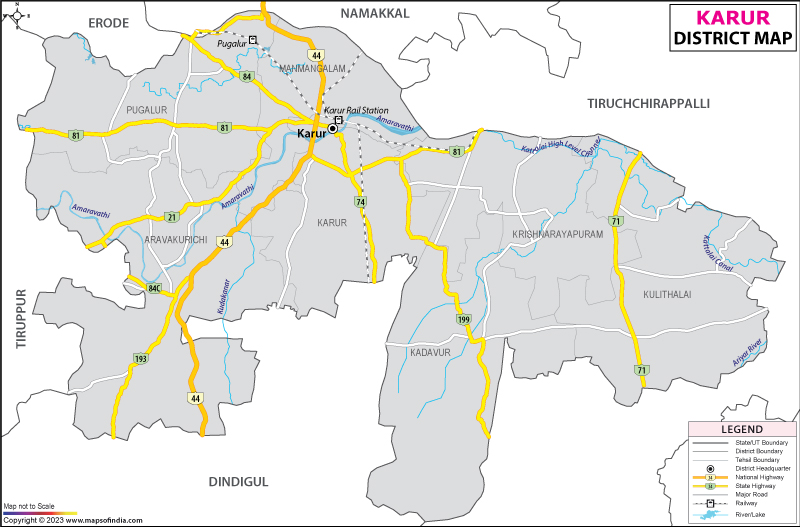
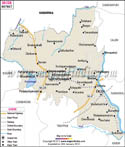
Karur district is under the administrative control of the District Collector who is responsible to the State Government. The District Collectorate is located in Karur. The administrative authority is spread across the district in the form of Revenue Divisions and Taluks. For the ease of governance and management, the district has been divided into 2 Revenue Divisions, namely: Karur Division and the Kulithalai Division.
The Revenue Divisions have further been split into 7 Revenue Taluks (Tehsils) with a Tahsildar (revenue officer) in charge of each: Karur Taluk, Aravakurichi Taluk, Manmangalam Taluk, Pugalur Taluk, Kulithalai Taluk, Krishnarayapuram Taluk and Kadavur Taluk. The 7 Taluks have been split into 203 Revenue Villages that form the lowest administrative unit for the management of land and crop statistics.
Karur falls under 8 Development Blocks, namely: Karur, Thanthoni, Aravakurichi, K.Paramathi, Kulithalai, Krishnarayapuram, Kadavur, and Thogamalai, that oversee the local administrative functions. The blocks supervise 157 Village Panchayats (local government bodies) for the rural population. Karur has 2 Municipalities – Karur and Kulitalai, and 11 Town Panchayats – Pallapatti, Pullur, TNPL Pugalur that have greater administrative powers to look after the civic needs of the growing urban population in Karur district.
| Official Name | Karur |
| Location | Tamil Nadu |
| Area | 2904 sq. km |
| Population | 1064493 |
| Language | Tamil |
FAQs
Q1: How many villages are there in the Karur district?
There are 157 panchayat villages in this district.
Q2: What is the population of the district?
The population of the district is 1064493.
Q3: What is the district most famous for?
Karur is famous all over the world as the "Textile Capital of Tamil Nadu". It supplies premium home textiles to famous international retailers such as IKEA and Walmart. It is also known as South India's leading bus body building center, which produces 95% of private buses in the region, apart from being the headquarters of Karur Vysya Bank.
Last Updated on : July 10, 2026
