







About
Down south in Tamil Nadu, India, lies Tiruchendur - a small coastal town within what was once called Tuticorin, now Thoothukudi district. Most of this region draws attention for factories, busy salt fields, and old oyster beds rich with history. But along the southeast rim near the Gulf of Mannar, something quieter takes hold - something steeped in devotion. Perched right at the Bay of Bengal’s edge, Tiruchendur breaks patterns without announcing it. Among six holy sites tied to Lord Murugan - the Arupadai Veedu - it stands apart. Where others climb rocky peaks shaped by ancient Tamil terrain, this one rests flat against shore waves. Rising from a bluff made of reddish stone long named Kanda-Madana-Parvata, the temple here faces seawater head-on. Architecture meets horizon in a way few places allow. Right along this shore, stories from long ago shape how people live today - Tamil roots run deep here, tied tight to legends older than memory. It was near these waves that warriors followed Murugan, gathering strength before facing Surapadman in a clash told through generations. Time folded into place as homes and markets grew slowly around the very ground where the god struck down evil with his spear. Kings once sent gold and stone to honor the site; Pandya and Chera rulers saw holiness in its soil. Yet ships from distant lands came too - not just pilgrims, but conquerors drawn by sea routes passing close. The past stays present, not locked away, still shaping what happens when tides roll in. Back then, in 1646, Dutch soldiers took hold of the walled temple amid clashes with the Portuguese, walking off with holy figures. A believer had a vision sent from above - saying where to find them - and sure enough, those relics turned up years later from undersea depths. People still speak of it as they saw it themselves, a moment stitched into the town’s everyday story.
History & Culture
Waves shaped Tuticorin long before maps did. Once, Korkai stood where fishermen now cast nets - that old harbor lit up Roman scrolls with tales of flawless pearls. Power shifted like tides through the ages. Chola hands held it; then Vijayanagar’s reach pulled it closer. A different rhythm arrived with Portuguese sails, leaving churches behind them. The Dutch followed, quiet but firm. Last came the British, stepping into control after others had worn down the path. Back then, when India fought to break free, Tuticorin stood tall. Not just any town - this place breathed rebellion. From its soil rose voices that refused silence. Fighters born here didn’t whisper - they roared. History remembers them loudly. Their names still echo through streets and stories alike. A man stood against empire tides - V.O. Chidambaram Pillai, quiet yet unshaken. Ships once ruled only by Britain began bearing Indian names because of him. His move? Founding the Swadeshi Steam Navigation Company, a bold thread in the fabric. Not talk, but sails carried his message across saltwater paths. The colonial grip on sea routes cracked when local engines fired up under VOC's direction. One venture sparked wider defiance, wave after wave. Here stood Veerapandiya Kattabomman, standing firm while the East India Company demanded heavy payments. Surrounded by greater power, he held his ground - fear didn’t slip into his bones. Rather than bow to faraway masters, he fought back; even now, voices whisper his deeds where lanes narrow and time slows. Nearby flows the life of Subramania Bharati, from Ettayapuram, a writer whose words sparked heat, setting minds alight long before dawn broke. Here, traditions blend like streaks of paint on a vast canvas. Brightness rises with each gathering - when fall arrives, the Golden Car Festival near Our Lady of Snows lights up darkness, while groups gather thick for Kattabomman memorials, alive with rhythm and fire. Along the coast, tales move through bodies at Skanda Sashti in Tiruchendur, guided by flames dancing over quiet chants.
Economy
Out here, Tuticorin runs strong on many kinds of income, balancing growth across sectors. Its people rank near the top in quality of life for Tamil Nadu, standing out by clear measures.
Government Sector
Hidden beneath daily life, the work of government resembles hidden supports holding up a building. Built not for earnings, its core role emerges in offering balance and fairness through support of major projects that are too costly or essential for open competition. Shared effort shows here - through people such as emergency responders, legal officers, and public scientists. Taxes fuel this system, allowing funds to return when downturns strike and personal outlays shrink. Stability grows where risk runs high.
Public Sector
Most days, you’ll find this part of the system working quietly behind what people actually rely on. Though national leaders set broad policies, real contact happens where workers show up every morning in classrooms, on buses, and in clinics. Often, these roles keep running things nobody wants left broken - water lines fixed before dawn, kids guided through lessons, patients seen without balance checks. Profit doesn’t drive their hours; need does. Tight budgets stretch thin under constant demand, yet still cover ground no private hand rushes to fill. Each decision here weighs cost not just in dollars but in faces missed if support slips.
Services Sector
Out here among shifting priorities, the service industry hums along where people trade know-how instead of building things. Not tied to factories or metal and wood, its strength comes from thinking fast, listening well, touching lives directly. Picture someone fixing code at dawn while another pours espresso with care - both paid for time, not stuff.
Tourism
Here, gentle waves lap against undisturbed beaches, where the briny breeze fades into a tranquil skyline. Ancient stone temples stand tall, their grand columns bearing the intricate designs of centuries of deep devotion. Old ruins whisper stories under cracked sunlit walls, each fragment holding breath from long ago. Stone walls rise slowly under a sky often heavy with clouds - this church began its life in the 1500s, built by Portuguese hands. Its shape cuts clean against the landscape, neither shouting nor fading. Beauty here feels quiet, earned through time rather than declared. People come Pancalankuricchi breathes history beyond sight, a place where silence speaks louder than noise. Among crumbling stones sits the Sri Devi Jakkammal Temple, hushed yet watchful. This land once cradled defiance, rooted deep in struggle against empire. Where walls split apart, voices of revolt linger between cracks. Not far off, the memory of Veerapandiya Kattabomman lingers like a shadow at dusk. Resistance did not only happen here - it grew. Monuments rise now because courage stood long before. Down by the Tamirabarani River, Adichanallur rests out of sight - famous in archaeological circles across the globe. This place tells stories through its old remains, pointing to skilled lives long ago. Tools, pottery, bodies - each piece speaks of a community rooted deep in South India's past. Not just a local find, it draws researchers from across continents. Life here thrived during what scholars call the Iron Age. People worked metal, buried their dead with care, built homes, kept order. Time covered everything until digging brought fragments back into light.
Demographics
Thanks to hard numbers collected by government counters, we see how well people here support one another daily. About 1,750,176 people lived in Tuticorin District according to the 2011 census. Split across city and countryside, nearly half call villages home. Rural residents numbered 873,374 back then. Cities held slightly more - 876,802 souls. Each square kilometer carried roughly 369 lives packed within it. According to the official Census of India, the actual overall literacy rate for the district is 77.12% (with male literacy at 81.28% and female literacy at 73.05%). While it is higher than the national average, the flat 86% claim is inflated. Tamil is the main language; English is also spoken.
Administration
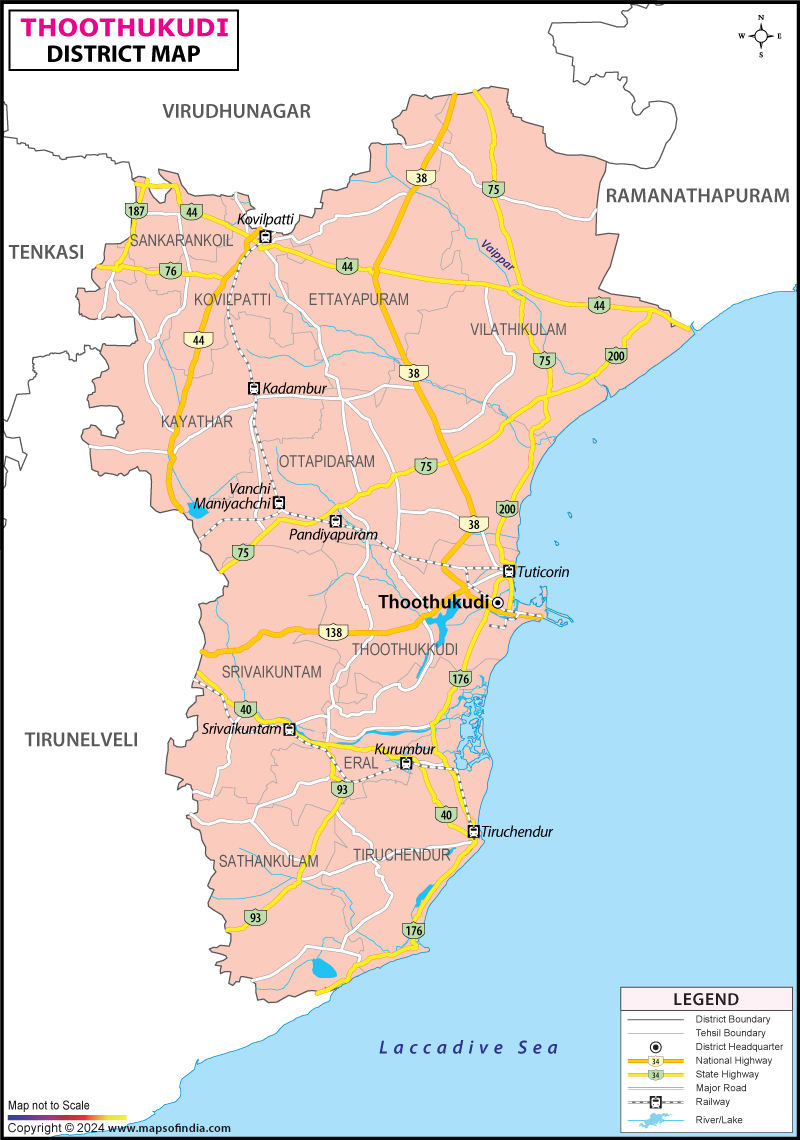
Down at the bottom, things move fast because each level passes updates straight up without delay. Order comes from tight links between local teams and shore-area planners. Eight parts make up the district's setup - Thoothukudi leads off, followed by Kovilpatti tucked nearby. One step west brings Tiruchendur into view, while Srivaikundam sits just behind it. Ottapidaram stretches southward, connected loosely through shared borders. Vilathikulam appears further inland, marked by quiet roads and older homes. Then comes Sathankulam, holding ground near the edge. Last stands Kayathar, completing the ring of divisions. Out here, spread across the land, lie 432 villages that fall within Tuticorin's reach. Each one answers to a block office, shaping how things run day to day. These clusters of homes and fields form quiet hubs beneath the wider sweep of district oversight. Life moves village by village, tied loosely through shared systems not always seen.
| Facts of Tuticorn District | |
|---|---|
| Official Name | Tuticorn |
| Location | Tamil Nadu |
| Area | 4745 sq. km |
| Population | 1,75,0176 |
| Language | Tamil |
FAQs
Q1: How many villages are there in Tuticorn ?
Across the Tuticorin district, a count shows 403 villages sitting within its borders. 403 villages dot the map within the district’s many local divisions. Not one sits outside an official block or named tehsil boundary. Their count adds up exactly - no more, no less. Each answers to a specific governance patch marked on paper and known by name.
Q2: What is the Total Population of Tuticorin District?
One out of every two people is female - that’s how even the numbers are across the district. Official counts list exactly 1,750,176 living there now.
Q3: What is Tuticorin District Known For?
Nowhere else quite matches Tuticorin when it comes to pearls - its nickname isn’t just for show. Salt pans stretch wide across the region, supplying most of what Tamil Nadu uses today. A massive harbor named after V.O.C. handles heavy maritime traffic without much fanfare. Bakers, there turn out crisp macaroons made rich with local cashews. High on a temple gopuram at Tiruchendur, Lord Murugan watches over centuries-old prayers.
Last Updated on : July 16, 2026
