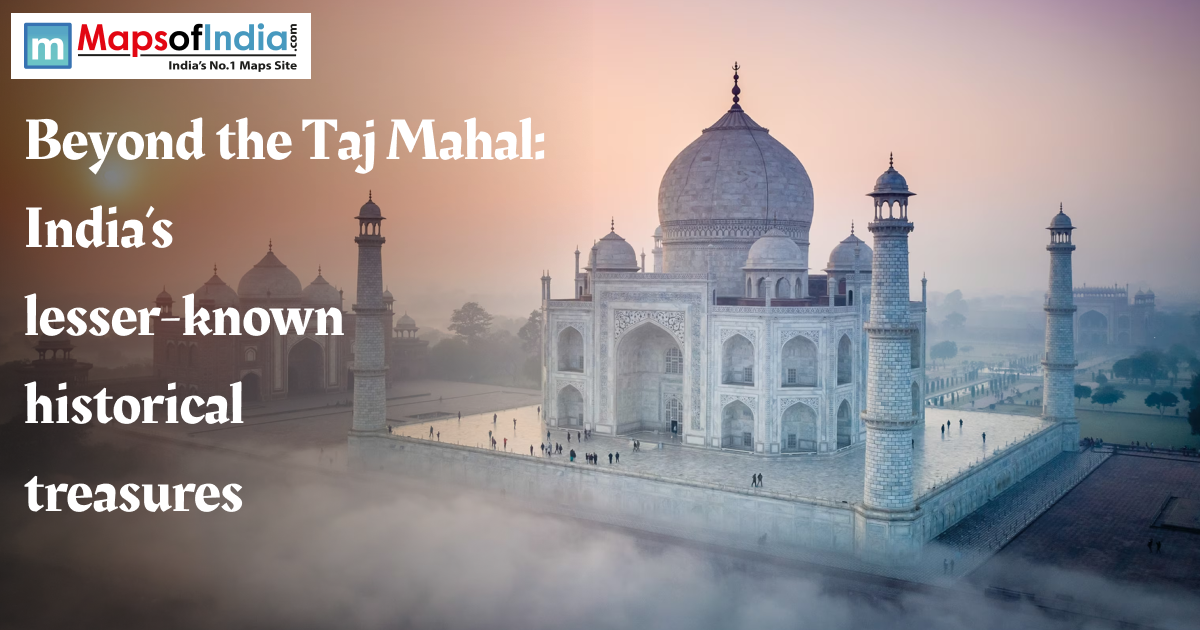
Beyond the Taj Mahal: India’s Lesser-Known Historical Treasures
Abhishree Sharma December 15, 2025
When we look at the famous historical monuments of India, we think about the Taj Mahal only. But we need to know that in India, there are many more great monuments that are not that well known, but are really great to experience. These structures have their own historical and cultural significance that makes them unique in various aspects. The places can be nearby and maybe declining now, but the glory they hold in the past is the thing that makes them great.
The Vijayanagara Empire's pride, Hampi, once shone as a mighty hub of strength. Yet today, its pieces scatter across rocky hills and lush banana groves. Each rock seems eager to speak - sharing echoes of ancient parades and rituals long vanished rather than staying mute. Locals claim the Virupaksha Temple isn't just history; worship still hums through it, quiet but alive. Meanwhile, folks don’t mention the Vittala Temple just because it’s famous, more so for its craftsmanship, particularly those pillars that make music when struck. Moving along the marketplace lanes isn't quite walking; instead, it feels like drifting into a different era.
A hidden gem lies beneath India’s surface - Rani ki Vav, a stepwell built in the 1000s by Queen Udayamati to honour her late husband, King Bhimdev. Though underground, this isn’t just old infrastructure; it doubles as a sculpted wonderland. Instead of plain walls, every level - one of seven - holds hundreds of carved figures showing deities from Hindu belief. While beauty grabs attention first, the layout proves smart too, since balance and precision serve function along with form.
Orchha, once the hub of Bundela rulers, sits quietly but is packed with history. Its strongholds, royal homes, and holy sites still show off medieval craftsmanship in their own way. Standing tall, Jahangir Mahal mixes Mughal curves with fine carvings that catch your eye. Alongside the massive Chaturbhuj shrine, the Betwa glides slowly, mirroring stone shapes on its surface. Life here feels frozen - no crowds rushing by, no noise, just old-world grace playing out like centuries didn’t pass.
Chittorgarh Fort is a symbol and a memory for its people, when there was a time when people from Rajputana were known for showing unmatched courage. This fort is located high on a ridge. This massive structure is a historical witness to the many battles and heavy losses that happened here. The Vijay Stambh, which is also famous for the Tower of Victory, marks the Rajput strength born from those fierce struggles. The famous and well-known Padmini Palace carries the quiet grief of a queen who chose honour over life. Within these, there are different structures that are filled with tales of warrior pride and raw determination.
Ajanta and Ellora Caves, Maharashtra: The Rock-Cut Wonders
Carved long ago by expert local craftsmen right into the Sahyadri hills, both Ajanta and though older, feature bright murals beside delicate statues - each sharing ancient Buddhist stories with new energy. Unlike those, Ellora hosts faith spaces for Hindus, plus Buddhists, even Jains, showing how varied traditions once shared ground peacefully. There are various things that set Kailasa Temple apart. It’s hewn entirely from a single stone block, shaped by removing everything extra.
Rani Mahal in Jhansi is tied closely to Rani Lakshmibai, a well-known rebel figure from India’s past. This royal building came up during the 1700s, showing design blends from both Mughal and Maratha traditions. Arches line the walls, art covers surfaces, while the layout hints at how a bold queen once ruled. Inside sits a collection of old items that speak quietly about her journey through struggle and courage.
Sanchi Stupa, Madhya Pradesh: The Legacy of Buddha
Definitely, the Sanchi Stupa is one of India’s earliest stone buildings, constructed under Emperor Ashoka roughly in the 3rd century BCE. This is done to express Buddha’s ideas about enlightenment and inner peace. Every one of the four entrances around the dome carries detailed artwork depicting scenes from his journey. Even if its shape looks basic, the place holds strong symbolic weight thanks to ancient Buddhist architecture, giving visitors from nearby areas or faraway countries a window into India’s enduring spiritual traditions.
Golconda ruled the region long before Hyderabad rose to fame. What stands out about this fortress? Its clever layout lets noise move across distances - like a single handclap reaching every corner, even climbing up the tallest peak inside. Since diamonds once flowed through here, folks say rare stones such as the Kohinoor got their start within these walls. Massive barriers surround royal rooms and high vantage points, making it full of old secrets and stories - one reason you shouldn’t skip seeing it.
Kumbhalgarh Fort, Rajasthan, The Great Wall of India
Amber Fort in Jaipur attracts lots of people; however, Kumbhalgarh is the one that really stands out with its massive wall extending for over 36 kilometres. The king, Rana Kumbha, created it in the 1400s, and the fortress was a shield for Mewar against the enemy. Because of its smart location and stunning building, it was included in the UNESCO list. The view from the top, looking out at the wilderness, is really something - sunsets here seem to be from another world.
Pattadakal, Karnataka: The Blend of Styles
The architectural styles of the north and the south could be clearly seen fused together in the temples of Pattadakal. It was the Chalukyan kings' ceremonial centre where coronations took place. The temples here are perfect examples of balance and accurate measures. This place shows the different stages of Indian temple architecture culminating in cultural exchange and experimentation.
Why These Hidden Gems Matter
These less-frequently visited monuments are not merely about the huge stones or the crafted works of art. They are gateways into India’s past in terms of society, politics, and art. The whole bunch is a single book of a culture that puts its money on arts, piety, and inventiveness. By seeing and learning about them, visitors are, in fact, the characters who keep the narratives going.
Rediscovering India Beyond the Taj
Indian history cannot be seen in only the major monuments, but it is also visible in the less-remembered forts, silent temples, and old stepwells, which are spread all over the country. Each and every place is endowed with a part of India’s heart, which is waiting for a person with a questioning mind to find out. Hence, whenever you are getting ready for a trip, don't forget to look beyond the Taj Mahal. Truth be told, the history may be trying to speak to you barely audibly through those stones that have been there for quite a while.