

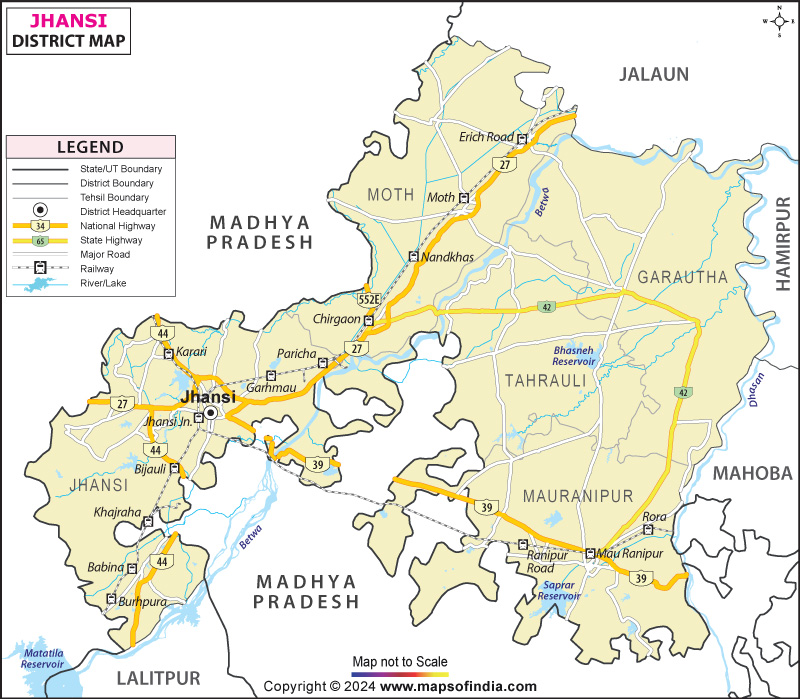





Introduction
The Jhansi region is in the southern part of Uttar Pradesh and is an important historical and administrative region of the state. It belongs to the Bundelkhand region which has its own cultural distinctions, rocky nature and historical significance. The city of Jhansi, a key administrative centre, an important trade centre, as well as a military centre which is located in the north.
It is a strategic district because it borders the state of Madhya Pradesh and also one of the major transportation points linking the north and central India. The area is surrounded by other cities such as Kanpur, Lucknow, Gwalior using major railway lines and highways. This connectivity in the past has resulted in the district becoming economically and strategically important.
The region is well known as closely linked with the heroic history of Rani Lakshmibai, one of the most outstanding representatives of an Indian freedom movement in the uprising of 1857. The resistance to British colonial rule made the region a symbol of courage and patriotism. Historical monuments and forts, as well as memorials related to this era are still visited to date in large numbers by visitors and historians today.
Agriculture is still a significant economic process in the district, but the industrial and service sectors are also formed in urban regions. The rural environment is covered with many villages where farming, rearing of livestock, and small-scale trade offer the people their livelihood. The district has thus introduced a blend of history and culture tradition and economic development at the same time.
History
Jhansi district has a history of political changes, which can be attributed to overall changes of the Bundelkhand region. Archaeological evidence is that the area has been inhabited since ancient times. The location of early settlements was determined by rivers, rocky hills and fertile areas of land that they could use during cultivation. The region was controlled by different dynasties and other regional powers over the centuries.
The area was controlled by clan made Rajput and afterwards Bundela chiefs. These leaders developed strongholds, capital bases and temples in Bundelkhand. The area was a key defense base and a regional centre by positioning important parts of the region.
The region fell under the sway of the Mughal Empire especially the reign of such emperors like Akbar and Aurangzeb in the seventeenth century. The Mughal rule brought novel systems of land taxation and administration which connected the region to the bigger imperial system. Nonetheless, Mughal power became eroded little by little in the eighteenth century and local powers reestablished their control.
It is during this time that the Marathas increased their control to Bundelkhand. The town and the adjacent land were included in the confederacy of Marathas and the Maratha governors took control of the administration. It was at this period when the region became an administrative and military centre.
The greatest historic period in the district is connected with the rebellion of the year 1857 against the British government. The area was then governed by Rani Lakshmibai who was among the most successful people to join the uprising. She resisted and made preparations when the British East India Company tried to annex her kingdom on the basis of the Doctrine of Lapse.
There were fierce fights in the district and around. Rani Lakshmibai was courageous and exhibited great leadership skills as she defended her kingdom against the British. Even though the rebellion was later crushed, her courage and sacrifice had made her a hero in Indian history. This has now been used to her great effect in becoming a potent icon of resistance and national pride.
Since the rebellion was eventually suppressed, the British Crown began to directly govern India and the territory became a part of the North-Western provinces administration. British officials increased the military presence and created new administrative institutions.
Jhansi district was incorporated in Uttar Pradesh state after India got independence in 1947. Improvement of irrigation facilities, education and strengthening of infrastructure development initiatives. Nowadays the district has been in further development though maintaining its historical basis.
Culture
Jhansi district has deeply rooted cultural traditions of the Bundelkhand region. The district contains a mixed population of different communities that possess similar social practices, festivals, and traditions. Centuries of historical interaction of various groups influence their cultural practices.
Rani Lakshmibai remains a heroic figure who shapes the culture of the district. Her place in the fight against colonial rule is marked by annual commemorations, cultural programs and educational activities. Her courage and leadership is a subject of folklore songs, plays, and narratives.
Traditional music, dance and storytelling constitute the folk culture in the district which has survived via oral traditions. During weddings, harvest feast and community events, the Bundeli folk songs are normally sung. These are usually love songs, heroic, devotional, and songs about country living.
The district has also cultural liveliness reflected in local fairs and religion meetings. Artisans, performers and traders in the neighborhoods are united on these occasions. Such gatherings often sell handicraft, textiles, and traditional foods which make cultural environments bright.
Food in the area mirrors the culinary inclinations of Bundelkhand. Diets usually feature wheat-based bread preparations, e.g., rotis made from bajra, which is served with beans, vegetables and dairy products. The use of seasonal food is significant in the traditional food. There are also quite popular street foods including samosas, kachoris and sweets that are eaten in the festivals and other social gatherings.
Social life pays much attention to family and community relationships. The process of marriage and religious events is accompanied by long meetings of families and friends. In spite of the new modernized ways of living in cities, the social relations are still determined by the traditional values of hospitality, respect for elders, and cooperation within the community involved.
Language
The Bundelkhand region is linguistically diverse and this can be seen in the language of Jhansi district. The most used language in administration, education and official communication is Hindi. The standard Hindi is popular in schools, governmental and media.
In day-to-day communication however, most inhabitants use Bundeli language, which is a local dialect of western Hindi language group. There are unique words, dialects, and syntax of Bundeli unlike regular Hindi. It is widely used in small towns and villages throughout the district and it has been a significant sign of regional identity.
Urdu also finds a place in the language aspect especially within Muslim population and in literature. Urdu literature and poetry traditionally served as an extension of culture of the people of northern India and some literary events now glorify the same.
The steady growth in education and occupational lines has led to a higher significance of English. In schools and colleges, English is a commonly used medium of instruction, and particularly in higher education. The young generations are thus taking to the use of English in learning and working situations.
Oral traditions are of vital importance towards the maintenance of the linguistic heritage in the district. The folk songs, proverbs and story tellers are normally in Bundeli dialect. The traditions transmit historical recollections, social standards and cultural understanding among one generation to the next.
Geography
The Jhansi district has a topography of rocky terrain, plateaus and sporadic agricultural plains which are specific to the Bundelkhand region. Unlike the fertile alluvial plains of the north of Uttar Pradesh, the scenery here is mainly composed of the hard rock formations and rolling lands.
The district is found close to the north western boundary of the Vindhyan plateau. Even though some areas of the terrain are not conducive to intensive kinds of agriculture, they have fertile valleys and irrigated regions where cultivation is taking place.
The district is served by several rivers, which help in irrigation and provision of water. The most important of such rivers is the Betwa and Pahuj Rivers. The river is beneficial as it helps in farmland, and supply of water to the surrounding settlements. Different dams and irrigation projects have evolved with an aim of controlling water resources in the area.
The temperature is semi-arid to subtropical. The summers are very hot, as temperatures frequently reach more than 45°C. The monsoon wind takes place between June and September and gives most of the rainfall during the year. The winter is quite mild and comfortable with the weather being favorable at this time.
Agriculture also continues to play a significant role in the local economy though it generally relies on rainfall and irrigation infrastructure. The major crops are wheat, pulses and the oilseeds and millets. Rural livelihoods are also the result of livestock rearing with the common rearing of cattle, goats and buffalo practiced in villages.
The transport networks are very essential in the local connectivity of the district. Jhansi is also a key railway crossing in northern India, the routes of which run between Delhi, Mumbai, Kolkata, and southern India. The district intersected by highways also enhance its significance as a transportation centre.
| Facts of Jhansi District | |
|---|---|
| State | Uttar Pradesh |
| District | Jhansi |
| District HQ | Jhansi |
| Population (2011) | 1998603 |
| Growth | 14.54% |
| Sex Ratio | 890 |
| Literacy | 75.05 |
| Area (km2) | 5024 |
| Density (/km2) | 398 |
| Tehsils | Garautha, Jhansi, Mauranipur, Moth, Tahrauli |
| Lok Sabha Constituencies | Jhansi |
| Assembly Constituencies | Babina, Garautha, Jhansi Nagar, Mauranipur |
| Languages | Hindi, Urdu |
| Rivers | Betwa |
| Lat-Long | 25.542441,79.117241 |
| Travel Destinations | Fort Of Jhansi, Barua Sagar, Jhansi Museum, St Jude'S Shrine, Rani Mahal, Barua Sagar, Iskcon Temple, Laxmi Temple; Shri Kali Temple; Karguan Jain Temple, Shrine Of St. Jude Church; St Antony'S Cathedral, Gangadhar Rao-Ki-Chhatri (Tomb).--Laxmi Bai Park; Narayan Bagh; Jari Ka Math; Barua Sagar & Fort; Garhmau Lake etc. |
| Government Colleges/Universities | Bundelkhand University, Rani Lakshmi Bai Central Agricultural University, Arya Kanya College, Bipin Bihari College, Bundelkhand Degree College, College Of Science And Engineering, Dinedh Patel College, Sharda Devi Degree College, Swami Vivekanand College, M D College, Simit College etc. |
FAQs
Q1: What is the reason why the district is popular among tourists?
It is very famous because the region has a very long historical relationship with Rani Lakshmibai as well as the Indian Rebellion of 1857. Some of the locations that attract visitors include its historic forts, memorials, temples and the narratives related to the resistance of British colonialism.
Q2: When would be the most appropriate time to visit this district?
One should visit during the months of October and March when the weather is nice and can go out to sightsee. Summers are very hot, whereas winters have a pleasant climate so as to visit historical places.
Last Updated on : May 08, 2026
